The first time I took mushrooms in the forest, I wasn’t looking for God—I was just looking to breathe. My nervous system had been in a knot for weeks, clenched from deadlines and screens and the endless grind of trying to keep up. A friend handed me a small handful of golden caps, and we wandered into an old-growth grove just outside of Vancouver. I sat beneath a pine that looked like it had been there for a thousand years. And then, something strange happened. I felt it holding me—not in some metaphorical, poetic way, but literally, like an energetic exhale. My body softened into the dirt, and I cried. Not from fear, or joy, or even clarity. I cried because I felt remembered.
It wasn’t a peak trip. I wasn’t seeing fractals or talking to spirits. It was quiet. It was moss and bark and wind and light through branches. It was the first time in years I’d felt connected—not just to myself, but to the world that had always been there, waiting for me to notice. At the time, I didn’t have a name for it. I thought maybe I was just “on one.” But later, I’d come to learn this kind of experience wasn’t random. It was a kind of medicine all its own—and it had a name: forest bathing.
In Japan, they call it Shinrin-yoku—a practice of intentional, immersive time in the forest, used to reduce stress, lower cortisol, and even strengthen immunity. But when you pair this ancient practice with psychedelics like psilocybin, something even more profound can happen. The forest doesn’t just become a backdrop. It becomes a teacher. A therapist. A companion. Science is beginning to show what many of us have long felt: that nature isn’t neutral. It’s an active participant in our healing.
For me, that pine tree trip changed everything. Not because it was flashy, but because it reminded me that my body, my emotions, even my mind, belonged to something older and wiser than the internet. I didn’t need answers that day. I just needed to be witnessed by the living world. And with the help of a few mushrooms and a grove of trees, I was.
READ: Tripping Safely: How to Responsibly Enjoy Shrooms on the Beach
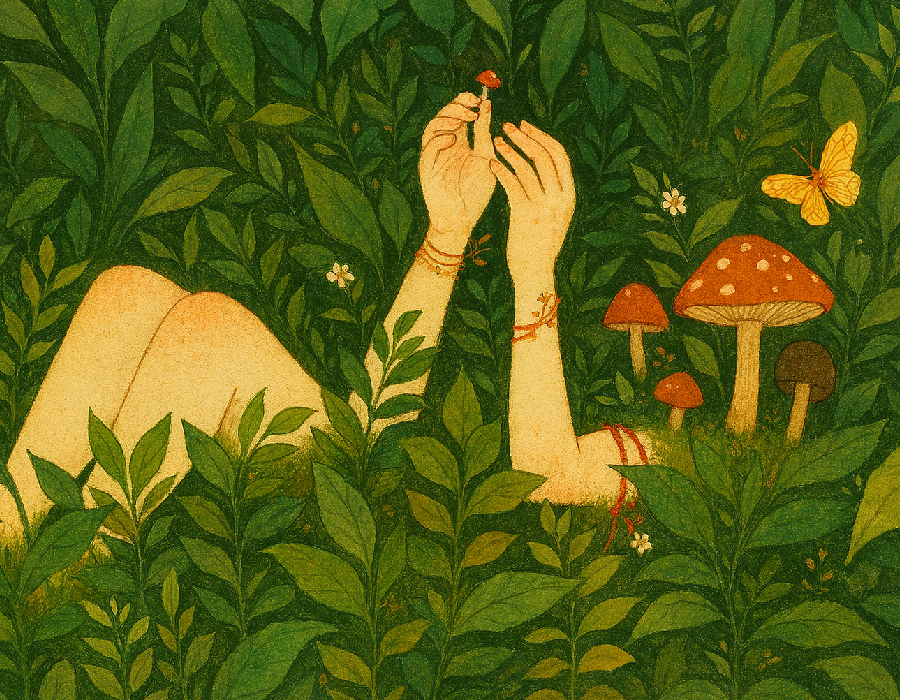
What Is Forest Bathing — And Why Does It Matter More on Mushrooms?
Forest bathing, or Shinrin-yoku, isn’t about hiking, sweating, or logging steps. It’s about presence. The term was coined in Japan in the 1980s as a response to rising urban stress and the mental health toll of disconnection from nature. The practice is simple: go into a forest. Turn off your phone. Walk slowly. Breathe deeply. Let your senses lead. Decades of research show that this kind of mindful immersion can lower cortisol, reduce blood pressure, enhance mood, and even increase natural killer (NK) cell activity—your immune system’s front line.
Now enter psychedelics. Psilocybin, in particular, doesn’t just affect thought—it amplifies perception. It softens the filters we usually use to separate self from world. On mushrooms, the rustle of leaves might feel like a whisper, the sun on your skin a kind of blessing. This isn’t hallucination—it’s amplification. The forest doesn’t change. You do. You become porous, awake to textures and rhythms your default mind usually tunes out.
Studies are beginning to confirm what many psychonauts intuitively know. A 2022 paper by Forstmann et al. found that even a single psilocybin experience can increase long-term feelings of “nature relatedness”—the sense that we are part of, rather than separate from, the natural world. Another study led by Roland Griffiths at Johns Hopkins showed that people who took psychedelics in natural settings often reported stronger mystical experiences and greater psychological benefit than those who tripped indoors.
This isn’t just about vibes—it’s about neurology. Nature, especially when paired with psilocybin, appears to help quiet the default mode network (DMN)—the part of the brain associated with self-referential thinking, rumination, and ego maintenance. When the DMN goes quiet, we’re more likely to experience awe, interconnectedness, and emotional release. In other words, the forest helps you get out of your head. And the mushrooms help you feel the forest.
READ: Shadow Work: A Guide for Beginners

The Science of Trees, Tripping, and Transformation
There’s a growing body of research exploring how the sensory qualities of nature—its fractal patterns, organic sounds, and clean air—impact the nervous system. These elements have been shown to induce parasympathetic activity, the “rest and digest” mode where healing and emotional regulation occur. When you add psilocybin to that equation, which already promotes emotional openness and neuroplasticity, the result can be a profoundly regenerative state—mentally, emotionally, and even physically.
Biologists call this the biophilia hypothesis: the idea that humans are biologically wired to seek connection with nature. Our ancestors lived and evolved in ecosystems, not office buildings. When we reenter those ecosystems—especially while on substances that reduce ego boundaries—we often experience not just beauty, but belonging. The moss becomes meaningful. The breeze becomes a balm. And for many, the natural world becomes animate again, as if it were a co-therapist whispering ancient truths.
Interestingly, psychedelics may also impact the immune system through their anti-inflammatory properties. Chronic stress and trauma often manifest as inflammation, and both forest bathing and psilocybin have been linked to reductions in inflammatory markers. In combination, they may offer a double dose of healing: calming the body while opening the heart. This isn’t just about a good trip—it’s about actual repair, down to the cellular level.
And still, the most powerful evidence may be experiential. Ask anyone who’s taken mushrooms in nature and they’ll tell you: the trees spoke. The river sang. The earth felt alive, and so did they. Whether that’s poetic perception or ecological reality is almost beside the point. What matters is the transformation that follows—the decisions made differently, the reverence awakened, the sense that the world isn’t just scenery, but sacred.
Check out this magic mushroom!!

A.P.E Psilocybin Chocolate Bar
$60.00Dried Penis Envy Magic Mushrooms
Price range: $60.00 through $240.00Golden Teacher Gummies for Microdosing
$25.00


Land, Lineage, and the Original Forest Journeys
Long before Western science coined terms like “forest bathing” or “nature relatedness,” Indigenous communities across the globe practiced land-based healing. From Mazatec mushroom rituals in the cloud forests of Oaxaca, to Shipibo ayahuasca ceremonies in the Amazon, to San rock art hinting at trance dances in the desert—psychedelics were never separate from the land. The forest wasn’t just a setting. It was a participant. A relative. A spirit with its own medicine.
This matters. Because as psychedelic healing gets mainstreamed, there’s a risk of forgetting that nature isn’t just a tool for our transformation—it’s a teacher in its own right. The soil under your feet holds microbial wisdom. The mycelium connects trees in quiet communication. The breeze that carries your breath out of your body is the same one that shaped your ancestors’ prayers. When we trip in nature, we’re not just accessing insight—we’re entering a lineage.
Honoring that lineage means more than Instagramming your barefoot trip. It means learning the history of the land you’re on. Acknowledging whose territory it is. Offering something back—whether it’s cleanup, reciprocity, or even just genuine presence. The forest doesn’t need saving, but it needs remembering. And psychedelics, when used with respect, can be a doorway into that remembrance.
So the next time you plan a forest journey, ask yourself: who walked here before me? What stories live in these trees? What do I have to offer in return? The deepest magic often comes not from peaking hard—but from humbling yourself to the rhythms of a world far older than your ego. And if you listen closely, you might hear the trees welcoming you back—not as a visitor, but as kin.
Practical Wisdom: How to Forest Bathe on Shrooms (Without Losing the Plot)
So how do you actually do it? How do you combine forest bathing with psilocybin in a way that feels safe, grounded, and transformative? First, preparation matters. Don’t just grab a bag of mushrooms and wander into the woods. Know your dose. Start small if it’s your first time—1 to 2 grams can be plenty in nature. Check the weather, tell someone where you’re going, and don’t go alone unless you’re experienced. Forests are powerful, but they’re also wild.
Choose a spot that feels safe and resonant—ideally somewhere you’ve been before. Arrive with intention, not an agenda. You’re not there to peak or have visions. You’re there to listen. To notice. To receive. Bring water, layers, maybe a journal. Leave the music behind, or keep it subtle. Let the birds and wind do the soundtracking. Forest bathing is about sensory immersion—not distraction.
During the experience, let your body guide you. If you feel called to sit under a tree, sit. If you need to walk, walk. If you cry, cry. Trust the intelligence of your own nervous system in relationship with the land. You might be surprised how quickly you drop into presence. The forest doesn’t demand anything from you. It just offers a mirror. And under the influence of mushrooms, that mirror can reflect not just your mind—but your belonging.
And when you return—because integration is everything—go back to that spot. A week later, a month later. Sober. See what you notice. Many people report that their connection to certain places deepens after a trip, almost like the land remembers them. You might find yourself feeling calmer just by standing beneath the same tree. That’s not placebo. That’s relationship. That’s the medicine continuing to work.
READ: Set and Setting: Preparing Your Mind and Environment for a Psychedelic Experience
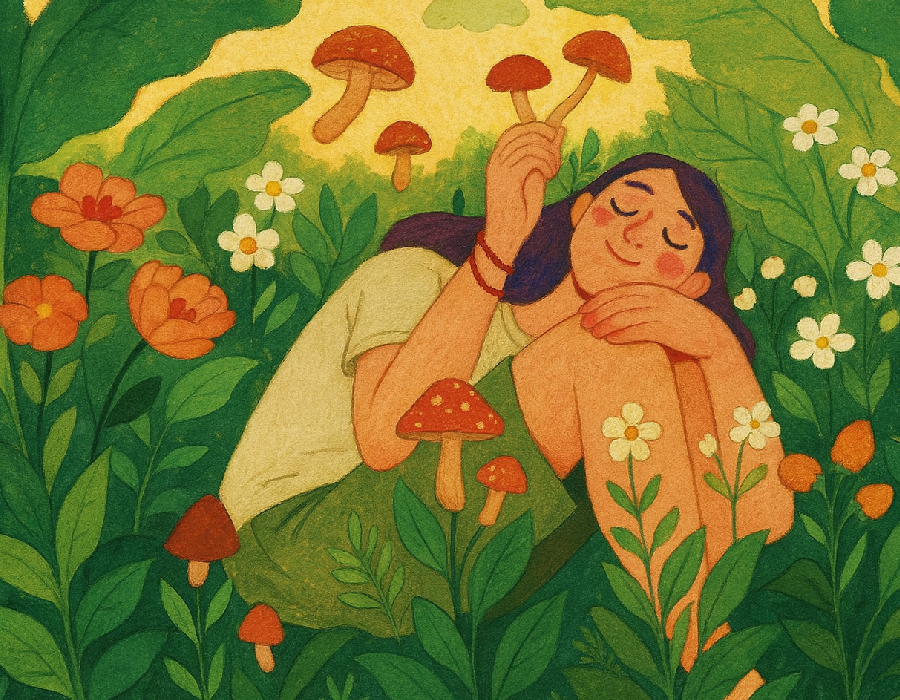
Remembering the Earth Remembers You
Maybe the magic of mushrooms isn’t just in the mind. Maybe it’s in the moss, the wind, the soil beneath your feet. Maybe it’s in the memory your body holds of sitting beneath an old tree and finally, finally feeling still. Forests don’t speak English, but they know how to communicate. They speak in birdsong, shadow, leaf movement, fungal mycelia. And psychedelics? They help us hear it.
In a culture obsessed with inner work as a solo, cerebral process, it’s easy to forget that healing has always been communal—and ecological. We were never meant to do this alone, inside, away from the world that birthed us. The forest offers a kind of rewilding for the soul. And when we bring mushrooms into that space, we’re not adding magic—we’re remembering it.
At Magic Mush, we believe that sacred experiences deserve sacred support. Whether you’re seeking the gentle clarity of a microdose or the deeper opening of a full journey, our chocolate-infused psilocybin, gummies, and dried mushroom bundles are crafted to meet you wherever you are—especially if that place is outside, under the trees.
So next time you feel the call, listen. Pack your bundle. Bring reverence, not expectation. Step into the woods like you’re entering a cathedral. You might not see God. But you might feel held. And if you’re lucky, you’ll walk out of those trees a little more human, a little more whole, and a little more rooted in the living world that’s been waiting for you all along.