

Why Do Psychedelics Make You See Geometry? The Science
By Lily Pelenis / June 19, 2025 / 11 min read
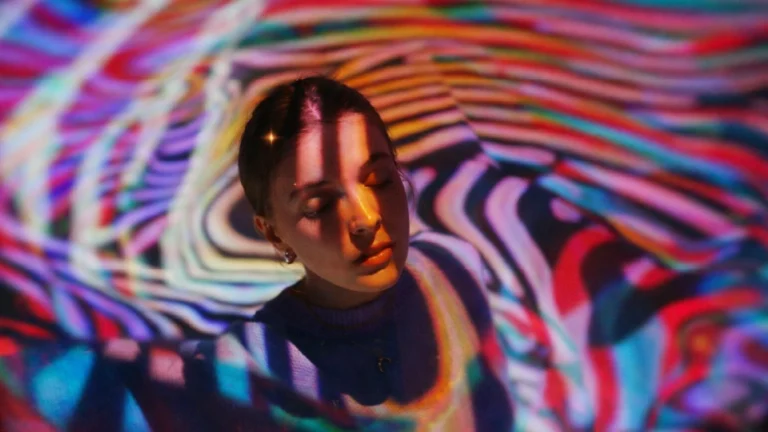
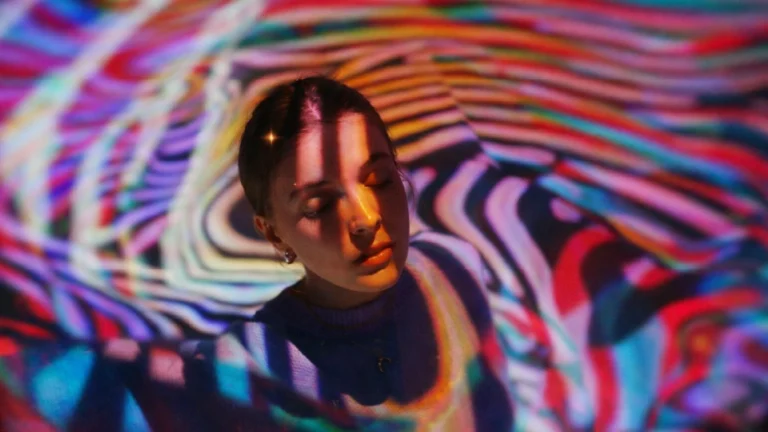
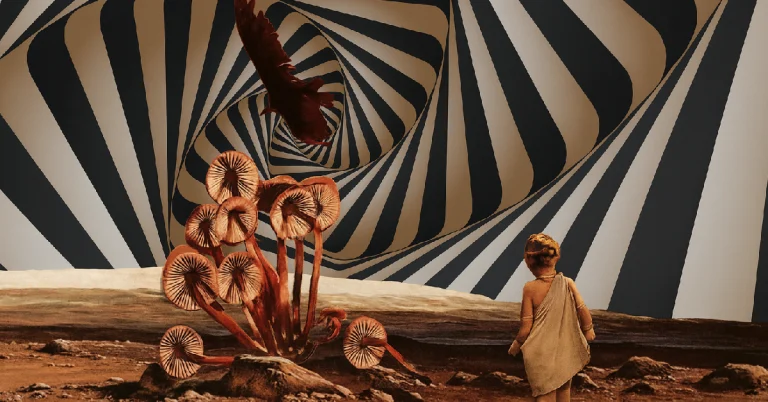
Psychedelics make you see geometry because they change how your visual cortex behaves, not because the patterns are out in the world. Psilocin, the active form of psilocybin, stimulates serotonin 2A receptors, which turns up spontaneous activity in the visual system (Kometer et al., 2013), and when the first visual area of the brain (V1) is pushed into that unstable state, the patterns it falls into look like tunnels, spirals, lattices and cobwebs once they are mapped back onto what you see (Bressloff et al., 2002).
Those four shapes have a name, Klüver’s form constants, and they turn up in many states besides mushrooms: flickering lights, migraine, the edge of sleep. Below is what the form constants are, how the brain builds them, why they are often brightest with your eyes closed, how dose changes them, which of our strains people describe as the most visual, and the rare case where visuals stick around after a trip.
TLDR
Geometric visuals are your visual cortex showing its own wiring. Under psilocybin, activation of serotonin 2A receptors lets spontaneous brain activity overwhelm the signal coming from your eyes, and a blocker of those receptors (ketanserin) stopped psilocybin’s visual effects in a controlled study (Kometer et al., 2013). Mathematical models from 1979 onward show that when V1 becomes unstable it settles into stripes and hexagons of activity, and the way the eye maps onto the cortex turns those into the tunnels, spirals, lattices and cobwebs people report (Ermentrout and Cowan, 1979; Bressloff et al., 2001).
Brain scans back this up: under LSD, increased blood flow and an expanded connectivity profile in V1 correlated strongly with ratings of visual hallucinations (Carhart-Harris et al., 2016). More psilocybin generally means stronger perceptual changes (Hirschfeld and Schmidt, 2021); our dosing guide lists visuals as none at a microdose (0.1 to 0.25 g), mild at a light dose (1 to 2 g) and vivid at a moderate dose (2 to 3.5 g). Visuals that persist after a trip and cause distress (HPPD) are real but uncommon (Halpern and Pope, 2003).
Who this article is for
- Anyone who saw spirals, honeycombs or tunnels on mushrooms and wants to know where they came from
- People curious about closed-eye visuals and why they can be stronger than what you see with your eyes open
- Readers who want the actual research on form constants and the visual cortex, with every claim linked
- Anyone choosing a dose or strain and wondering how visual the experience will be
- People who noticed lingering visual effects after a trip and want to know what is known about HPPD
Lily Pelenis
Author’s note
Geometry is the part of a mushroom trip people describe first and understand least. I hear it framed two ways: either the patterns are a message from the universe, or they are “just” a glitch. I think both miss what makes them interesting. The shapes are so consistent from person to person that scientists have been able to write equations for them, and those equations say something real about how your own brain is built.
So this article sticks to what has been measured and modelled, and links every claim to its source. Meaning is still yours to find in what you saw. Nothing here is a promise about what you will see, and a highly visual trip can also be overwhelming, which is why the dose and safety sections matter as much as the science.
What are psychedelic geometric patterns?
Psychedelic geometric patterns are elementary visual hallucinations: simple, repeating shapes that the brain produces without anything matching them in front of you. The psychologist Heinrich Klüver, working at the University of Chicago, studied reports of mescaline users and experimented on himself, and noticed that the many geometric motifs people described could be reduced to a short list of underlying patterns he called form constants (Chacruna).
Klüver’s four form constants
| Form constant | What people see | Common trip descriptions |
|---|---|---|
| Lattices | Gratings, fretworks, filigrees, honeycombs and chequerboards | Honeycomb grids on walls, tiled patterns over skin or fabric |
| Cobwebs | Fine web-like networks of lines | Webs or nets stretched across the field of view |
| Tunnels and funnels | Tunnels, funnels, alleys, cones and vessels | Being pulled through a tunnel, often with closed eyes |
| Spirals | Rotating spiral shapes | Slowly turning spirals and swirling mandala-like centres |
Groupings and examples in the first two columns are from Bressloff et al., 2001. Mathematicians later noted that in most cases the images are seen in both eyes and move with them, which they read as evidence that the images are generated in the brain rather than in the eyes (Bressloff et al., 2002).
Geometry is only one kind of psychedelic visual
Researchers group serotonergic psychedelic visuals into several types: colours that look more saturated and bright (visual intensifications), objects changing size (illusions), light flashes and recurring geometric figures (elementary imagery), visuals that move with sound (audiovisual synaesthesia), and full scenes of people, animals or landscapes (complex imagery) (Kometer and Vollenweider, 2018). Form constants belong to the elementary group, the simplest and most predictable one.
Why do shrooms make you see patterns?
Shrooms make you see patterns because psilocin raises the excitability of the visual cortex until it starts producing its own organized activity, and the shape of that activity is set by how V1 is wired. The chain runs in four steps.
1. Psilocin activates serotonin 2A receptors
Your body converts psilocybin into psilocin, and its psychedelic effects are believed to come from stimulating serotonin 2A (5-HT2A) receptors. In a brain imaging study, psilocybin doses of 3 to 30 mg occupied up to 72 percent of these receptors, and the intensity of the experience tracked receptor occupancy and blood psilocin levels (Madsen et al., 2019).
2. Internal activity drowns out the signal from your eyes
In a placebo-controlled study, psilocybin (215 micrograms per kilogram) strongly reduced alpha brain waves over the back of the head and reduced the N170, an early brain response to visual input, in step with visual hallucinations. Pretreatment with ketanserin, a drug that blocks 5-HT2A receptors, blocked all of these effects. The authors propose that 5-HT2A activation creates a mode in which stimulus-driven activity is overwhelmed by spontaneous activity (Kometer et al., 2013).
3. An unstable V1 settles into stripes and hexagons
In 1979, mathematicians Bard Ermentrout and Jack Cowan modelled a sheet of interconnected neurons pushed to the edge of instability and showed it forms regular patterns such as hexagons and rolls (stripes), which they proposed are the cortical counterparts of Klüver’s form constants (Ermentrout and Cowan, 1979). The idea is the same as other self-organizing patterns in nature: excitation and inhibition between neighbouring cells, once the balance tips, produce repeating structure on their own (Billock and Tsou, 2012).
4. The eye-to-brain map bends stripes into spirals and tunnels
The visual field is not laid out on V1 like a photograph. The retinocortical map stretches the centre of your vision and compresses the edges, so simple stripes of activity on the cortex appear as rings, rays and spirals in what you see. Bressloff and colleagues extended the model in 2001 to include the edge-detecting, orientation-tuned columns of V1 and its lateral connections, and found that the stable patterns their model produced included representatives of all four form constants (Bressloff et al., 2001).
Their conclusion matters for how you think about your trip: the circuits that generate geometric hallucinations appear closely related to the ones you use every day to process edges, contours, surfaces and textures (Bressloff et al., 2002). That is also why the walls and wood grain are where patterns tend to appear first.

Why do you see geometry with your eyes closed?
With your eyes closed there is almost no input from the outside to compete with, so the visual cortex’s own activity takes over and behaves as if it were seeing something. In a study of 10 healthy volunteers, LSD increased eyes-closed connectivity between patches of V1 and V3 that represent the same part of the visual field, which the authors read as the early visual system behaving as if it were seeing spatially localized visual inputs (Roseman et al., 2016).
The larger imaging study from the same group used three methods (arterial spin labelling, BOLD fMRI and MEG) and found that increased visual cortex blood flow, decreased alpha power and a greatly expanded V1 connectivity profile all correlated strongly with ratings of visual hallucinations. These visual cortex changes did not significantly correlate with ego dissolution, which tracked a different circuit (Carhart-Harris et al., 2016). In other words, the geometry and the sense of self dissolving come from different parts of the brain, which is why some people get intense patterns and little else, and others the reverse.
These studies used LSD, not psilocybin, but both act through the same 5-HT2A receptor, and the same alpha reduction and visual effects were seen with psilocybin in the Kometer study above (Kometer et al., 2013).
Do you only see these patterns on psychedelics?
No. The same small set of geometric hallucinations shows up after cannabis, mescaline, psilocybin and LSD, while looking at bright flickering lights, when waking up or falling asleep, and in near-death experiences (Bressloff et al., 2002). Epilepsy, migraine, magnetic fields and flicker also produce spots, geometric patterns and jagged lines, many of which fit Klüver’s forms (Billock and Tsou, 2012).
That is the strongest clue that the shapes come from the brain’s own architecture rather than from the drug. As one major review put it, elementary hallucinations arise from familiar mechanisms stimulated in unusual ways (Billock and Tsou, 2012). For the cultural and spiritual side of these shapes, we cover that separately in our guide to sacred geometry, and in can magic mushrooms open your third eye we look at how psilocybin changes the brain’s sense of self.
How much do you need to take to see geometric patterns?
Clear geometric patterns usually start around a light dose and become vivid at a moderate dose. Across lab studies, higher psilocybin doses gave higher ratings on most measures, mainly those referring to perceptual alterations (Hirschfeld and Schmidt, 2021). Our dosing guide puts it in grams of dried mushroom:
| Dose level | Dried mushroom | Visuals (dosing guide) | Sitter |
|---|---|---|---|
| Microdose | 0.1 to 0.25 g | None | Not needed |
| Threshold | 0.25 to 1 g | None; colours a touch warmer | Optional |
| Light | 1 to 2 g | Mild: breathing walls, patterns in the wood grain | Recommended |
| Moderate | 2 to 3.5 g | Vivid | Required |
| Strong | 3.5 to 5 g | Intense | Non-negotiable |
| Heroic | 5 g and up | Overwhelming | Non-negotiable |
Dose is not the only factor. The same meta-analysis notes that experience also depends on the person and the setting, so lab results may not carry over to recreational use (Hirschfeld and Schmidt, 2021). Effects start within 15 to 45 minutes and usually last four to six hours (Health Canada). If you want to see patterns, dim light, a plain wall or closed eyes with music tend to give the visual cortex the most room, but more is not better: at strong and heroic doses the dosing guide calls visuals intense and overwhelming.
Which mushroom strains are the most visual?
No study has compared strains for geometric visuals; the research used pure psilocybin, and dose drove the results (Hirschfeld and Schmidt, 2021). What we can share is how each strain we have in stock is described on its product page, and its score on our 10-point potency scale. These are what people report, not lab measurements.
| Strain (in stock) | Potency | How its product page describes the visuals |
|---|---|---|
| Tidal Wave | 8.5/10 | Bright colour and geometric patterns that keep shifting, with eyes open or closed |
| Blue Pulaski | 7/10 | Kaleidoscopic visuals; the part that gets most of the attention, with sight and sound both changing |
| Albino Penis Envy | 9/10 | Intense visuals; vivid colour and shape in everything you look at |
| Trinity | 8.5/10 | A deep, very sensory trip with intense visuals; for experienced people |
| Makilla Gorilla | 5.5/10 | Bright, vivid visuals; chosen by creative people for what it does to colour and shape |
| Burma | Not published | Vivid hallucinations full of colour and pattern |
| Malabar | 8/10 | Gentle effects that lift colours and patterns without overwhelming you |
| Golden Teacher | 6/10 | Changes to how the world looks and sounds, with a trip that turns inward |
Tidal Wave is the only one whose page names geometric patterns directly. The Visual Trip Bundle pairs 7 g of Blue Pulaski with 7 g of Albino Penis Envy and the A.P.E chocolate bar, which has 16 squares so it can be taken in small, measured steps. The strongest strains here are for people who already know how they react to a full dose; start low with any of them.

Can psychedelic visuals stay after the trip?
Sometimes, briefly, and rarely in a way that causes problems. Hallucinogen persisting perception disorder (HPPD) is the diagnosis for visual changes that persist after use and cause distress; a review of 50 years of studies called it a genuine but uncommon disorder, sometimes lasting months or years, reported most often after illicit LSD use and less often with other hallucinogens (Halpern and Pope, 2003).
What the numbers show
- In an online survey of 2,455 hallucinogen users, 60.6 percent reported drug-free visual experiences resembling hallucinogen effects, but only 4.2 percent found them distressing or impairing enough to consider treatment (Baggott et al., 2011).
- In six controlled studies with 142 healthy volunteers, 13 reported drug-like experiences returning after the session, mostly mild, visual, lasting seconds to minutes and within a week. Two found them distressing and they faded on their own, and none met the criteria for HPPD (Müller et al., 2022).
If visual changes after a trip worry you or interfere with daily life, talk to a doctor. We also cover psilocybin side effects in more detail.
Medications that change the picture
Lithium is the clearest danger: in an analysis of 62 reports of classic psychedelics taken with lithium, 47 percent involved seizures and 39 percent involved medical attention (Nayak et al., 2021). Antidepressants and other medications can blunt, strengthen or not change psychedelic effects, depending on the drug (Halman et al., 2024). Our dosing guide’s rule is not to mix mushrooms with alcohol, cannabis, SSRIs, SNRIs, MAOIs, lithium or tramadol. Have a sober sitter for anything moderate or above.
Note on the law: under the Controlled Drugs and Substances Act, the sale, possession and production of magic mushrooms, psilocybin and psilocin are illegal in Canada unless authorized by Health Canada (Health Canada).
Choosing a dose for a visual trip
If geometry is what you are curious about, the research and our own guide point the same way: a measured dose in the light to moderate range, a calm space you can darken, eyes closed with music for part of it, and a sober sitter once you go above a light dose. Start with the dosing guide, weigh your mushrooms, and if you want strains people describe as visual, Tidal Wave or the Visual Trip Bundle are where to look once you know how you react.
FAQ
Why do shrooms make you see geometric patterns?
Psilocin activates serotonin 2A receptors, which lets spontaneous activity in the visual cortex overwhelm input from the eyes (Kometer et al., 2013). Models show an unstable V1 forms stripes and hexagons that appear as tunnels, spirals, lattices and cobwebs (Bressloff et al., 2002).
What are form constants?
Form constants are the four basic geometric patterns Heinrich Klüver identified in mescaline visions: lattices, cobwebs, tunnels and spirals (Chacruna). The same shapes appear with other psychedelics, flicker, migraine and on the edge of sleep (Bressloff et al., 2002).
Why are closed-eye visuals stronger?
With no outside input to compete, the early visual cortex behaves as if it were seeing localized visual inputs, as shown in brain scans under LSD (Roseman et al., 2016).
Are psychedelic visuals real?
The patterns are not in the room, but the brain activity behind them is measurable: visual cortex blood flow and connectivity changes correlated strongly with hallucination ratings (Carhart-Harris et al., 2016).
Can you see geometry on a microdose?
A microdose of 0.1 to 0.25 g is sub-perceptual, and our dosing guide lists visuals as none at that level.
Why do some people not see patterns at all?
Dose, the person and the setting all shape the experience, and lab results may not apply to recreational use (Hirschfeld and Schmidt, 2021). Visual effects and ego effects also run through different brain circuits (Carhart-Harris et al., 2016).
Is seeing patterns after a trip a sign of HPPD?
Not necessarily: brief, mild visual echoes are common and in controlled studies none met HPPD criteria (Müller et al., 2022). HPPD is the persistent and distressing form, and it is uncommon (Halpern and Pope, 2003).
Find your strain, then your dose
Every product on the shelf shows its potency rating and the effects people report. The dosing guide walks through amounts before you order, and a real person answers if you write to us.
About the author
Lily Pelenis
I'm a Toronto-based lifestyle coach, psilocybin enthusiast and certified yoga instructor. I guide people toward mindful, balanced living, and my coaching blends modern wellness practices with ancient wisdom to help clients find deeper self-awareness, resilience and joy.
I've been experimenting with shrooms for over a decade, and I write about my own experience. I love nature, psychology and humans. That is why my articles tend to follow a trip past its peak and into the weeks after it.
Some pieces start with a strain I have tried myself, such as Golden Teacher or Albino Roller Coaster. Others are the practical ones, like how much to take the first time or how to brew a tea that sits easier on the stomach. Over the years I've learned that intention is everything, so I write about why you are taking it before I get to how.
Related articles

50% off your first order
New strains, restocks, sales and new writing from the Notebook, by email. No spam, unsubscribe any time.