
Blue Pulaski Mushroom Strain: Effects, Potency and Dosing
By Lily Pelenis / July 9, 2025 / 12 min read
Blue Pulaski is a Psilocybe cubensis magic mushroom strain, listed on our product page as a cross of Blue Meanie and Melmac, and known for kaleidoscopic visuals and a mood that moves from euphoria into deep introspection. We rate it 7 out of 10 for potency, suited to people with some experience, and a medium dose is 1 to 2.5 g of dried mushroom.
This page covers what is actually known about where Blue Pulaski comes from, how strong it is, what a trip feels like, how it compares with nearby strains, and how to dose it safely.
TLDR
Blue Pulaski is a cultivated cubensis strain, not a wild species. Our product page lists Blue Meanie and Melmac as its parents, but no published, peer-reviewed record documents the cross or the name. We rate it 7 out of 10 for people with some experience. There is no published lab figure for its psilocybin content, so the rating is the best guide to its strength, and every new batch deserves a careful first dose.
The product page lists a microdose at 35 to 400 mg, a low dose at 0.5 to 1 g, a medium dose at 1 to 2.5 g and a high dose at 2.5 to 5 g. Effects usually start within 15 to 45 minutes and last four to six hours (Health Canada). People report strong visuals, sound that changes along with sight, and an emotional, self-reflective trip.
Who this article is for
- People who have seen Blue Pulaski on a menu and want to know what it is before they buy.
- Anyone who has taken a gentler strain like Golden Teacher and is thinking about a step up.
- Readers comparing Blue Pulaski with Code Blue, Makilla Gorilla, Malabar or Albino Penis Envy.
- Anyone who wants to separate the facts about this strain from the stories told about it.
- People who want real dose numbers and the safety basics before their first session.

Lily Pelenis
Author’s note
I work at Magic Mush, and Blue Pulaski is one of the strains people ask about because of the name alone. We had two older articles about it on this site, and between them they leaned on legend: a wild origin in Pulaski County that nobody can document, health promises and personal stories that could not be checked. I brought them together into one page and kept only what holds up: our product pages, our dosing guide and published research on psilocybin.
My view on Blue Pulaski is that it sits in a useful middle spot. It is clearly stronger than a beginner strain, but it does not carry the reputation of the very top of our shelf, so it is easy to take too lightly. Treat it as a real step up, weigh your dose and give it a calm day.
What is the Blue Pulaski mushroom strain?
Blue Pulaski is a named strain (a cultivar) of Psilocybe cubensis, the most widely grown psilocybin mushroom, rather than a separate species. Here are the key facts.
| Fact | Blue Pulaski |
|---|---|
| Species | Psilocybe cubensis |
| Listed parents | Blue Meanie x Melmac (our product page; no published breeding record) |
| Potency rating | 7 / 10 on our scale |
| Psilocybin per gram | No published lab figure for this strain |
| Experience level | Some experience |
| Known for | Kaleidoscopic visuals, changes in sound, euphoria that turns into introspection |
| Dose range | 35 mg to 5 g, dried |
| Onset and length | 15 to 45 minutes to start, 4 to 6 hours in total (Health Canada) |
| Formats we sell | Dried, in 7, 14 and 28 g packs, and in the Visual Trip Bundle |
What Blue Pulaski looks like
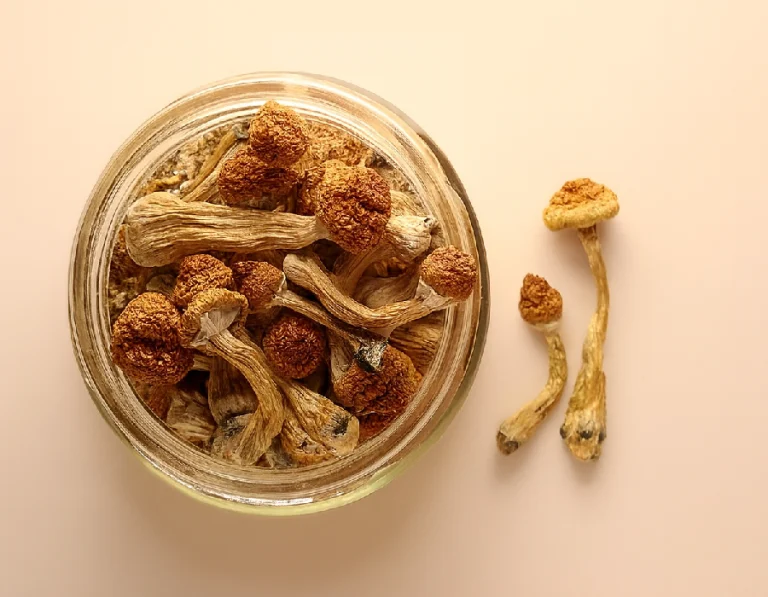
Our 7 g listing describes Blue Pulaski’s colour as a mix of blue and gold. The blue shows up as patches where the mushroom has been cut, bruised or handled, which is true of cubensis in general. That blue is where the name’s first word most likely comes from, and it says more about handling than about strength.
Why Blue Pulaski bruises blue
The blue colour is the same reaction found in every psilocybin mushroom. When the tissue is cut or bruised, two enzymes turn psilocybin into psilocin and then link psilocin molecules into blue chains (Lenz et al., 2020). The researchers, working with Psilocybe cubensis, saw psilocin levels fall as the blue formed. One of the older articles on this site called the blue a marker of extra potency. The chemistry says the opposite: heavy bluing is a sign of handling, not of a stronger mushroom.
Where does Blue Pulaski come from?
Blue Pulaski is a grower’s strain, and its exact origin is not documented: our product page lists it as a cross of Blue Meanie and Melmac, but we could not find a published record of who made the cross, when, or where the name comes from. What can be checked is the story of each parent.
The Melmac side
Melmac is a cubensis strain that a company called Homestead is said to have developed in the 1980s, most likely naming it after the home planet of the TV character Alf. As the story goes, Melmac is a variant of Penis Envy, and some growers think it is closer to the original Penis Envy than other lines, a claim DoubleBlind notes is still debated (DoubleBlind). On our scale, Melmac rates 8.5 out of 10 for experienced users. It is sold out as we write this.
The Blue Meanie side
“Blue Meanie” is a confusing name, because it is used for two different mushrooms. It is a common name for Panaeolus cyanescens, a separate species that grows on dung, and it is also the name of a Psilocybe cubensis strain. A co-founder of the testing lab Tryptomics told GreenState that most people growing Blue Meanies indoors are growing the cubensis strain, and that the lab had never tested a Blue Meanie that was not cubensis (GreenState). A 2025 scientific review also lists Blue Meanie among known cubensis strains (Kurzbaum et al., 2025). Since Blue Pulaski is a cubensis, the Blue Meanie in its family tree would be the cubensis strain.
Was Blue Pulaski found in Pulaski County?
There is no evidence that it was. Older write-ups, including one on this site, said the strain was named after Pulaski County and grows wild there. We found no source for that, and a named cultivar bred from two cultivated strains would not have a wild home in the first place. The honest answer is that nobody has documented where the name comes from.
How much a strain name tells you
Less than you might think. A 2025 review in the Journal of Fungi points out that most information about individual cubensis strains comes from community reports rather than formal research (Kurzbaum et al., 2025). A 2023 study that sequenced the genomes of 86 commercial cultivars found low genetic diversity, signs of selfing and clonal propagation, and that most cultivars were founded from related populations (McTaggart et al., 2023). In other words, many strain names sit on top of very similar genetics. Our own shelf shows the point: Code Blue is listed with the same two parents as Blue Pulaski, yet we rate it 8.5 out of 10.

How strong is Blue Pulaski?
Blue Pulaski is moderately strong: it rates 7 out of 10 on our potency scale and is meant for people with some experience. Our product page describes it as strong enough to ask for a mindful approach, especially if you are new to mushrooms. There is no published lab result for its psilocybin content, so we do not give a milligram figure for it.
Why the batch matters more than the name
Even where lab figures exist, they vary a lot. In 2026, a research team from the University of Haifa and partners grew 14 cubensis strains under identical lab conditions and measured them the same way. Total tryptamines ranged from 2.62 to 20.65 mg per gram across the strains, and single mushrooms from the same strain and the same tub still varied, with coefficients of variation of about 13 to 23 percent (Sharchaton et al., 2026). Blue Pulaski was not one of the strains tested, but the lesson applies to it: the strain name tells you the family, and only a careful first dose tells you how a new batch sits with you.
How does Blue Pulaski compare to other strains?
Blue Pulaski sits in the middle of our potency scale, above Golden Teacher and Makilla Gorilla and below Malabar, Code Blue and Albino Penis Envy. Ratings, experience levels and lab figures below come from each strain’s product page.
| Strain | Potency | Experience level | Psilocybin per gram (published lab test) | Known for |
|---|---|---|---|---|
| Makilla Gorilla | 5.5 / 10 | Some experience | About 6.9 mg | Vivid visuals; shares the Melmac parent (Albino Penis Envy x Melmac) |
| Golden Teacher | 6 / 10 | Some experience | About 15.9 mg | Gentle, inward trip; a good strain to learn your dose on |
| Blue Pulaski | 7 / 10 | Some experience | Not published | Kaleidoscopic visuals, euphoria into introspection |
| Malabar | 8 / 10 | Experienced | Not published | Calm, meditative, warm body high |
| Code Blue (sold out) | 8.5 / 10 | Experienced | Not published | Strong visuals, then introspection; listed with the same Blue Meanie x Melmac parents |
| Albino Penis Envy | 9 / 10 | Experienced | About 21.1 mg | Intense visuals, big shifts in perception |
Our potency rating and a lab figure are different measures. The rating reflects how strong the whole experience tends to be, while a lab figure is one published sample, not a guarantee for every batch.
Blue Pulaski vs Golden Teacher
Golden Teacher rates 6 out of 10 and is known for a gentle trip that turns inward, which is why we suggest it as a strain to learn your dose on. Blue Pulaski is one step up on our scale and leans harder into visuals and emotion. If you know how a full dose of Golden Teacher feels, start Blue Pulaski at the low end of the same range.
Blue Pulaski vs Code Blue
Both are listed with Blue Meanie and Melmac as parents and both are known for visuals, but we rate Code Blue 8.5 out of 10 for experienced users and Blue Pulaski 7 out of 10. Code Blue is sold out at the moment, so Blue Pulaski is the closest match on our shelf. Our Code Blue guide covers it in detail.
Blue Pulaski vs Makilla Gorilla and Malabar
Makilla Gorilla shares the Melmac parent but lands lower, at 5.5 out of 10 with about 6.9 mg of psilocybin per gram in its published sample, so it is a gentler way into the same family (read our Makilla Gorilla guide). Malabar rates 8 out of 10 and goes a different direction: soft visuals and a calm, warm, reflective mood rather than Blue Pulaski’s kaleidoscopic colour.
What does a Blue Pulaski trip feel like?
People describe Blue Pulaski as visual, blissful and cerebral: the world can come alive in unexpected ways, time and space may bend, and the mood often moves from euphoria into deep introspection. How far it goes depends on the dose, your state of mind going in and the place you are in.
The first hour
Effects usually begin 15 to 45 minutes after eating magic mushrooms (Health Canada). Wait out that whole window before you decide anything. A second dose taken because the first “is not working yet” is the most common way people end up higher than they planned.
The peak
At a medium dose, these are the effects people report most with Blue Pulaski, as listed on our product page:
- Visuals: the part that gets most of the attention, with colour and pattern taking over and sound changing along with sight.
- An emotional trip: feelings come up and take some of the space.
- Self-awareness: the trip digs into how you see yourself.
- Altered perception: time and space may bend.
Health Canada’s list of general effects of magic mushrooms includes heightened emotions, hallucinations and an altered sense of time, and at times anxiety, confusion, fear or paranoia (Health Canada). Both ends of that list are possible with Blue Pulaski.
Coming down
The whole experience usually runs four to six hours (Health Canada). Keep the rest of the day clear, with no driving. Because this strain tends to turn inward, many people write down what came up while it is still fresh and talk it through with someone they trust in the days after.
Possible side effects
Our product page lists nausea, vomiting, diarrhea, a quicker heartbeat, anxiety, confusion or paranoia, and in rare cases psychosis, with your body, your dose and your setting deciding how likely they are. Health Canada adds higher blood pressure and numbness, particularly in the face, and notes that frightening “bad trips” can happen, especially at high doses (Health Canada).

How much Blue Pulaski should you take?
A medium dose of Blue Pulaski is 1 to 2.5 g of dried mushroom, and if the strain is new to you, start at the low dose of 0.5 to 1 g. These are the ranges on the Blue Pulaski product page, weighed in grams of dried mushroom.
| Dose | Amount (dried) | What to expect |
|---|---|---|
| Microdose | 35 to 400 mg | Below the point of noticeable effects |
| Low | 0.5 to 1 g | Warmer colours, fuller sound, a lift in mood |
| Medium | 1 to 2.5 g | Clear visuals, emotional depth, a self-reflective trip |
| High | 2.5 to 5 g | Full immersion; with experience and a sober sitter only |
Our dosing guide breaks the full range into six levels, from a microdose of 0.1 to 0.25 g up to a heroic dose of 5 g and more. It features Blue Pulaski at its fourth level, 2 to 3.5 g, which it describes as the classic psychedelic dose: vivid visuals, altered time and space and big emotional experiences, in a comfortable setting with a sober trip sitter nearby and no other plans.
Before you take it
- Weigh it. Use a scale that reads to 0.01 g. Guessing by eye is how a medium dose becomes a high one.
- Eat light. Our dosing guide suggests a light meal 60 to 90 minutes before, and honey ginger tea if nausea hits.
- Mind your set and setting. Researchers at Imperial College London argue that the effects of psychedelics are exceptionally sensitive to context, meaning your mindset and surroundings (Carhart-Harris et al., 2018). Choose a calm, safe place on a day when your head is in a good spot.
- Have a sober sitter. Johns Hopkins safety guidelines for psilocybin research name overwhelming distress, a “bad trip”, as the most likely risk, and call for a safe setting and in-person support (Johnson et al., 2008).
- Skip alcohol and cannabis. Health Canada warns that combining magic mushrooms with cannabis, amphetamines or alcohol raises the risk of serious side effects (Health Canada).

Medications and conditions that do not mix
- Lithium: in a Johns Hopkins analysis of online reports, 47% of 62 reports of lithium taken with a classic psychedelic involved seizures, and 39% involved medical attention (Nayak et al., 2021). Do not combine them.
- SSRIs and SNRIs: a 2024 systematic review found that escitalopram reduced ego dissolution and anxiety on psilocybin, and cites a survey in which about half of people on these antidepressants reported weaker psilocybin effects (Halman et al., 2024). Never stop or change a prescription without your doctor.
- MAOIs: the same review found that several MAOIs blunted or blocked the effects of LSD in older studies, and advises caution when MAOIs are combined with other serotonergic drugs (Halman et al., 2024). Talk to a doctor or pharmacist first.
- Psychosis or heart disease: clinical research excludes people with a personal or family history of psychotic disorders (Johnson et al., 2008), and Health Canada notes higher risk for people with psychiatric conditions or heart disease (Health Canada).
How to store Blue Pulaski
Keep dried Blue Pulaski in a cool, dry place at room temperature, away from direct sunlight and big swings in temperature. An airtight container keeps moisture out, and handling the mushrooms less means less bruising.
Planning your first Blue Pulaski session
Blue Pulaski rewards a little planning: weigh your dose, start low with every new batch, pick a calm place and have someone sober nearby. Read the dosing guide and run through the questions that matter before you trip.
When you are ready, the Blue Pulaski product page has the current packs, starting at 7 g. If you want to compare it with a stronger visual strain, the Visual Trip Bundle pairs 7 g of Blue Pulaski with 7 g of Albino Penis Envy and an A.P.E chocolate bar.
FAQ
Is Blue Pulaski a strong mushroom strain?
It is moderately strong. We rate it 7 out of 10, above Golden Teacher and below Malabar, Code Blue and Albino Penis Envy, and there is no published lab figure for its psilocybin content.
What are Blue Pulaski’s parent strains?
Our product page lists Blue Meanie and Melmac, a cubensis line said to descend from Penis Envy (DoubleBlind). No published breeding record confirms the cross, so treat the parentage as the grower’s description.
Is Blue Pulaski good for beginners?
It is better as a second strain than a first. We list it for people with some experience; if you have never taken mushrooms, start with Golden Teacher and learn your dose first.
How much Blue Pulaski should I take the first time?
Start at the low dose on the product page, 0.5 to 1 g of dried mushroom. A medium dose is 1 to 2.5 g, and you can work up to it on a later day.
How long does a Blue Pulaski trip last?
Magic mushroom effects usually start within 15 to 45 minutes and last four to six hours (Health Canada). Keep the whole day free.
Why is it called Blue Pulaski?
No one has documented it. “Blue” most likely refers to the blue bruising every psilocybin mushroom shows when handled, and we found no evidence for the popular story that it was found wild in Pulaski County.
What is the difference between Blue Pulaski and Code Blue?
Both are listed with the same Blue Meanie and Melmac parents and both are visual strains, but we rate Code Blue stronger, at 8.5 out of 10 for experienced users, against 7 out of 10 for Blue Pulaski.
Where can I buy Blue Pulaski in Canada?
We ship Blue Pulaski mushrooms in 7, 14 and 28 g packs to adults 19 and older anywhere in Canada, in tracked, unmarked packaging. Regular shipping is free over $200.
Find your strain, then your dose
Every product on the shelf shows its potency rating and the effects people report. The dosing guide walks through amounts before you order, and a real person answers if you write to us.

About the author
Lily Pelenis
I'm a Toronto-based lifestyle coach, psilocybin enthusiast and certified yoga instructor. I guide people toward mindful, balanced living, and my coaching blends modern wellness practices with ancient wisdom to help clients find deeper self-awareness, resilience and joy.
I've been experimenting with shrooms for over a decade, and I write about my own experience. I love nature, psychology and humans. That is why my articles tend to follow a trip past its peak and into the weeks after it.
Some pieces start with a strain I have tried myself, such as Golden Teacher or Albino Roller Coaster. Others are the practical ones, like how much to take the first time or how to brew a tea that sits easier on the stomach. Over the years I've learned that intention is everything, so I write about why you are taking it before I get to how.
Related articles




50% off your first order
New strains, restocks, sales and new writing from the Notebook, by email. No spam, unsubscribe any time.