The first time I took synthetic psilocybin, it was in a controlled clinical setting. White walls, heart rate monitors, soft music curated for safety. I remember swallowing the capsule and waiting—for the unraveling, the flood of insight, the thing everyone talks about when they describe “ego death.” What I got instead was something clean, clinical, cerebral. My thoughts became spacious, my sense of time warped, but the whole thing felt… distant. Almost like I was watching myself have a psychedelic experience rather than living it.
At first, I thought this was a good thing. No nausea. No earthy taste. Just pure molecule, pure effect. But in the weeks that followed, something gnawed at me. I didn’t feel changed. I had memories of the journey, but they felt disjointed—like reading pages from someone else’s journal. Where was the sense of communion? Of the sacred? I chalked it up to high expectations, until I tried full-spectrum mushrooms for the first time—outdoors, under the stars, with nothing but the wind and a close friend for company.
That night, I felt something I hadn’t felt in the lab: relationship. The mushrooms didn’t just open my mind—they opened my body. They grounded me into the earth while lifting me into the stars. I cried, not from sadness, but from a sense of reunion. Like I was meeting something ancient inside myself that had been waiting patiently for me to return. People talk about “the mushroom spirit” like it’s a metaphor. That night, it didn’t feel metaphorical at all.
That experience shifted something in me. Not just in how I view psilocybin, but how I view healing. Because there’s a difference between extracting a molecule for consistency—and listening to the intelligence of an entire organism. A difference between the clean edges of pharmacology and the messy, mycelial web of experience. This article is my attempt to explore that difference—not to claim superiority, but to invite a deeper kind of curiosity.
READ: The Strongest Psilocybin Mushrooms: Exploring Nature’s Most Potent Psychedelics
What’s Actually in a Whole Mushroom?
Most people assume psilocybin is the one “active” ingredient in psychedelic mushrooms. But that’s like saying vitamin C is the only thing in an orange. In reality, psilocybin is just one part of a complex symphony of compounds. Whole mushrooms contain psilocybin, yes—but also psilocin (the metabolized form), baeocystin, norbaeocystin, aeruginascin, beta-glucans, and a range of other alkaloids and bioactive substances.
This is where the conversation about the “entourage effect” begins. Borrowed from cannabis research, the term refers to how compounds in a plant may work synergistically to enhance therapeutic outcomes. In the case of mushrooms, some researchers hypothesize that lesser-known compounds like baeocystin may modulate the intensity or emotional depth of the journey. Others believe the mushroom’s unique fingerprint of compounds contributes to a more embodied, intuitive experience.
Synthetic psilocybin, by contrast, is a single, purified molecule. It’s isolated, measured, repeatable—perfect for clinical trials, patents, and pharmaceutical development. This makes sense in a medical context. Doctors and regulators need consistency. But as anyone who’s eaten a handful of homegrown mushrooms can tell you, the experience isn’t just about psilocybin levels. It’s about how the whole system interacts with your system—body, psyche, history, setting.
In lab settings, synthetic psilocybin can produce powerful outcomes—especially when combined with therapy and integration. But many psychonauts, facilitators, and ceremonialists report that whole mushrooms lead to richer emotional releases, more vivid visions, and a greater sense of connection to something beyond the self. The difference isn’t just chemical. It’s relational.
The Entourage Effect: More Than the Sum of Its Parts
The first time someone explained the entourage effect to me, they used a music analogy: synthetic psilocybin is a solo violinist—precise, beautiful, but alone. Whole mushrooms? That’s the full orchestra. There’s harmony, dissonance, unexpected crescendos. It’s harder to predict, yes—but it often moves you in ways you didn’t expect.
Science is just beginning to catch up with what Indigenous traditions have known for generations: medicine isn’t just about active compounds. It’s about relationships—between molecules, between people, between body and spirit. Compounds like baeocystin and norbaeocystin, once considered irrelevant, are now being studied for their potential therapeutic roles. Some early findings suggest they may help shape the emotional tone of a journey, modulate duration, or influence visual and somatic intensity.
Then there are the non-alkaloid components: beta-glucans, which may have immune-modulating effects; terpenes, which influence smell and possibly mood; and the subtle energetic presence that many describe as “mushroom spirit.” These elements don’t show up on pharmacological graphs, but they show up in the body. In the tears that come without warning. In the sudden memory that breaks you open.
After my journey with whole mushrooms, I started paying attention to these layers. The way the nausea wasn’t just a side effect—it was a release. The way the earthy taste felt like a signal: slow down, respect what you’re taking in. With synthetic, the experience felt stripped of all that. Efficient, yes—but hollow. Like a song with the bass removed.
Check out this magic mushroom!!

A.P.E Psilocybin Chocolate Bar
$60.00Dried Penis Envy Magic Mushrooms
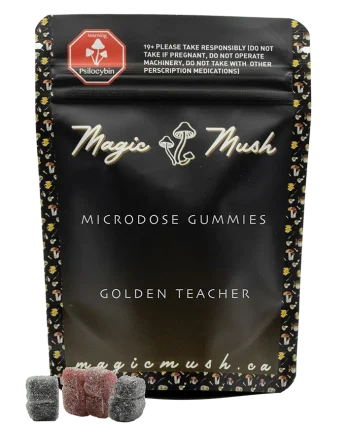
Price range: $60.00 through $240.00Golden Teacher Gummies for Microdosing
$25.00


Clinical Precision vs. Ceremonial Depth
There’s a reason clinical trials use synthetic psilocybin. It’s consistent. It’s measurable. It reduces variables. In a double-blind study, you can’t have people taking two grams of a strain grown under someone’s bed and expect reliable data. Synthetic offers control, and control is crucial when you’re trying to win over regulators, insurance companies, and a deeply skeptical medical system.
And let’s be honest—synthetic psilocybin has helped a lot of people. Clinical trials for depression, end-of-life anxiety, and addiction have shown remarkable results. For some, a clean environment and a precise dose are what make the experience feel safe. The predictability becomes the container. I respect that deeply. Not everyone wants to chew on something that grew out of cow dung and guess what might happen next.
But in ceremonial settings, where unpredictability is part of the wisdom, whole mushrooms are often preferred. Facilitators I spoke to noted that clients seemed to go “deeper into the body,” have more spiritual insights, and engage in richer emotional processing when using full-spectrum fungi. One guide said, “Synthetic psilocybin feels like a peak experience. Whole mushrooms feel like a relationship—with the medicine, with the self, with the Earth.”
I felt that difference viscerally. The synthetic journey stayed in my head. It offered insight, but no integration. It was like being handed a map without learning how to walk the terrain. With whole mushrooms, the path was messier, but it felt like my feet were on the ground. Like I was being walked, not doing the walking.
Heady vs. Hearty: The User Experience Gap
Ask around, and you’ll hear a pattern. People often describe synthetic psilocybin as “clean,” “neutral,” “floaty,” or “heady.” Whole mushrooms? They’re “earthy,” “emotional,” “wise,” “alive.” One woman told me, “With synthetic, I understood my trauma. With whole mushrooms, I forgave myself for it.” That hit me like a bell in the chest.
For me, the synthetic trip brought clarity, but it was almost too analytical—like I was watching my life through a microscope. Useful, sure, but emotionally distant. I didn’t cry. I didn’t laugh. I had insight but not catharsis. With whole mushrooms, I wept for my father’s death for the first time in years. I held my own hand. I smelled the forest. I danced.
Facilitators say that synthetic journeys often require more integration afterward because the insights can be sharp but hard to embody. Whole mushroom sessions, though more intense, often move energy in real time. People come out feeling tender, wrecked, reborn. There’s often nausea, purging, and unpredictability. But there’s also something you don’t always get in a capsule: communion.
None of this is to say that one form is better for everyone. But it’s worth asking: What are you seeking? If it’s clarity, control, and a tight feedback loop—synthetic might be your path. But if it’s depth, surrender, and reconnection to something older than you, maybe let the whole mushroom speak.
READ: The Strongest Psilocybin Mushrooms: Exploring Nature’s Most Potent Psychedelics
Risks, Potency, and the Mycelial Unknown
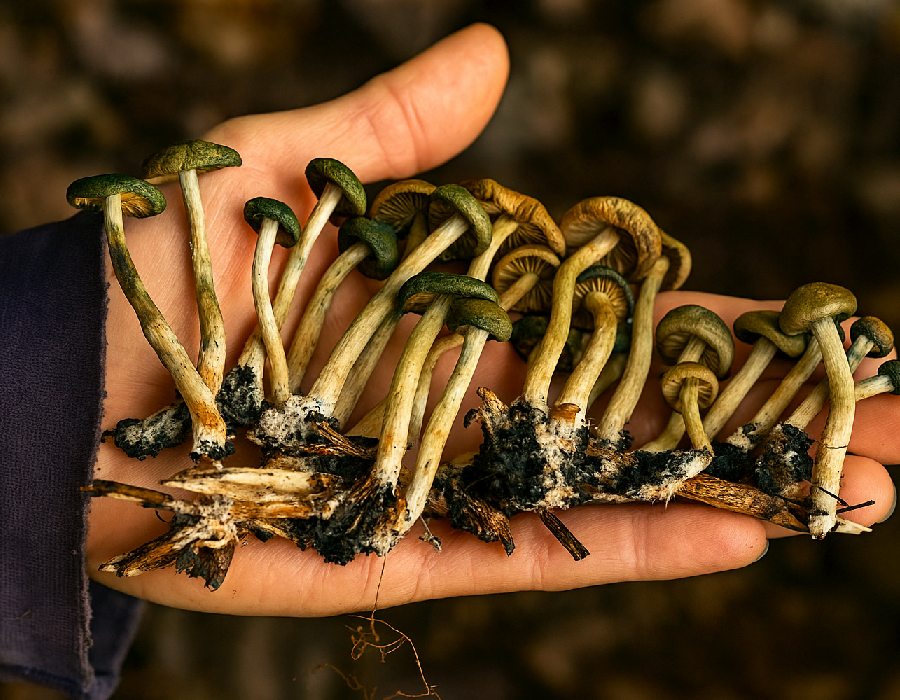
Of course, whole mushrooms aren’t without their complications. Unlike synthetic psilocybin, which is standardized and lab-tested, mushrooms vary widely in potency. A dried gram of Psilocybe cubensis grown in one batch might feel mild; another gram from a different flush might knock you into a cosmic spiral. The variability means more guesswork, more chance of nausea, and less control—factors that make some facilitators and therapists lean toward synthetic for safety.
Then there’s the issue of set and setting. Whole mushrooms are often taken in natural, ceremonial, or home settings, which can be deeply healing—but also riskier for those with a history of trauma, mental health challenges, or poor support systems. Without proper integration or guidance, the very depth that whole mushrooms offer can become overwhelming.
Still, for many, these “myths and risks” are part of the medicine. A client once told me that the nausea she felt during a whole mushroom ceremony mirrored her emotional purging. “It was like the grief had to come out of my stomach,” she said. “I hated it at first. But afterward, I felt… empty, in a good way.” That’s not the kind of thing you measure on a blood panel, but it’s real.
And that’s the crux of it: mushrooms are alive. They’re not just compounds—they’re organisms. Mycelium forms networks beneath our feet, exchanging nutrients, responding to the environment, even demonstrating rudimentary forms of memory. When you consume a mushroom, you’re not just ingesting psilocybin. You’re entering into relationship with a fungal intelligence that’s been shaping ecosystems for millennia. That might sound mystical. It’s also increasingly scientific.
Psychedelics as Relationship, Not Just Chemistry
In Western medicine, we’re trained to see healing as transactional: identify the problem, administer the substance, wait for the results. But psychedelics ask something more relational of us. They remind us that healing isn’t just about what you take—it’s about how you listen, how you prepare, how you honor the space between wound and insight.
This is where whole mushrooms shine. Their unpredictability mirrors the truth of real healing—it’s nonlinear, messy, full of detours and revelations. One facilitator said to me, “Whole mushrooms teach you how to be with complexity. Synthetic teaches you how to see it.” That distinction has stayed with me. Both have value. But for some, one is more transformative.
There’s also the question of lineage. Whole mushrooms carry stories—ecological, Indigenous, ancestral. They’ve been used for thousands of years in ceremonial contexts: by the Mazatec in Mexico, the Bwiti in Gabon, the many unnamed cultures who saw mushrooms not as tools, but as teachers. Synthetic psilocybin, for all its promise, doesn’t carry that lineage. It carries the lab.
And maybe that’s okay. Maybe we need both. The clean, scalable version for hospitals and clinical trials. The earthy, relational one for ceremony, introspection, and rewilding. What matters is that we don’t forget where this all came from: the soil. The forest floor. The quiet intelligence of the fungal world that gave us this medicine in the first place.
READ: Nootropic Mushrooms: The Fungi That Build Better Brains

What Kind of Intelligence Do You Want to Commune With? — With Magic Mush
So what kind of intelligence are you seeking? The lab-designed mind molecule—measurable, clean, and precise? Or the entire living body of the mushroom—chaotic, relational, and rooted in mycelial wisdom? There’s no right answer. But there is a right question: What do you need to feel whole? And are you willing to listen to what the medicine has to say?
At Magic Mush, we honor the full spectrum of this conversation. That’s why our offerings are whole, grounded, and intentionally sourced—from our dried magic mushroom bundles, ideal for intentional journeying, to our microdose gummies that support everyday integration, to our chocolate mushroom bars that offer a gentle bridge into deeper work. Each product carries the full fingerprint of the fungi—not just psilocybin, but all its kin.
We’re not against science. We celebrate it. But we also believe healing isn’t just biochemical—it’s relational. It’s ecological. It’s ancestral. And full-spectrum medicine honors that complexity. We invite you to explore both with care, with curiosity, and with community. Whether you’re preparing for ceremony or simply seeking more presence, we’re here to support the journey.
Visit Magic Mush and discover the difference whole mushroom medicine can make—not just in your body, but in your story, your lineage, your way of relating to the living world. Because sometimes, the most powerful healing doesn’t come from extracting a compound. It comes from remembering your place in the web.