
I still remember that morning in Toronto, when the dishes sat undone and the coffee mug in my hand felt strangely heavy. I had just returned from a journey that knocked the walls of “me” down—spent hours in a liminal place that felt endless and formless. When I tried to boil water, I froze for a moment. I couldn’t remember what “I” was meant to do. Everything ordinary again—terrifyingly, beautifully ordinary.
That moment became the opening scene of my real work: coming back. I’d experienced what many call ego death, and then I found myself at the threshold of ordinary life, clutching a new version of myself and wondering: how do I return — gracefully?
This piece is a friendly, grounded conversation about what happens after the so-called ego death, how it really plays out in the nervous system and daily habits, and how you can come back with humility, presence and even a little humour. If you’re reading this after touching the edge of the infinite — whether via a guided psychedelic journey of chocolate mushrooms style or within a quieter inner collapse of self-identity — welcome. You don’t have to disappear to awaken. You don’t need a trophy. The goal was never disappearance, but deeper participation.
🌀 Explore the journey of ego death when the self dissolves and something deeper emerges
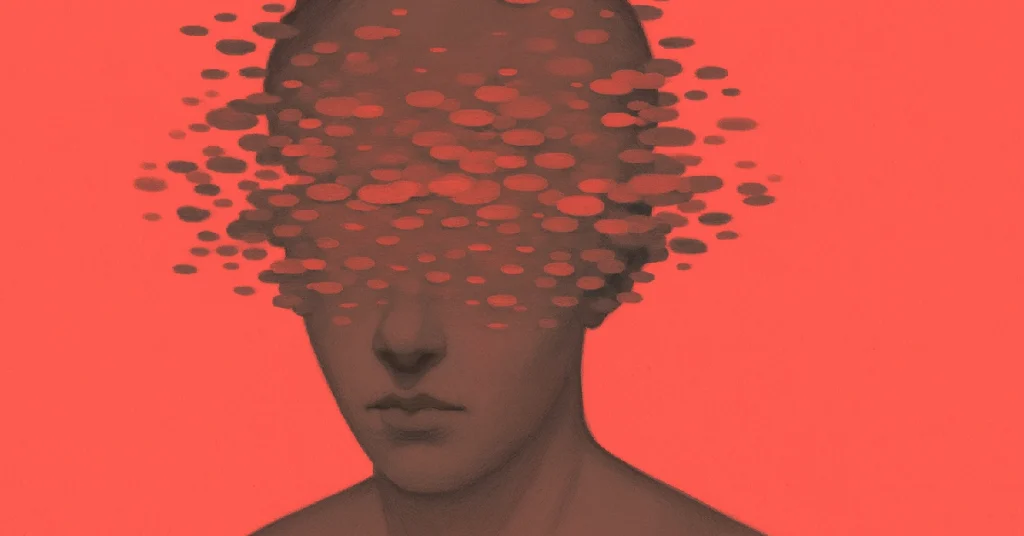
After The Disappearance: When You Come Down And Everything’s Still Here
There you are, mug in hand, the morning light creeping in. You sit down at the table and the world feels a little stretched. There’s now a vivid sense that yesterday’s boundaries softened, that “you” sort of melted into something bigger. And this morning, you’re back. But you’re not quite the same. That’s the kitchen scene of re-entry.
In that moment I felt awe first, then confusion. I had glimpsed “oneness” or at least a dissolving of the edges I called “me,” and now I was back making toast. It felt jarring. I also felt a strange grief—a little mourning for the dissolving of a self that I thought I understood, a self that had habits, stories, routines. And yet I also felt expansion: the realisation that self was never as solid as I thought.
You’ll likely feel this emotional whiplash: the wonder of what happened, the bewilderment of living in a day with deadlines and texts, and somewhere underneath a tremor of “Did that really happen?” When you sit with your coffee and the steam curls up like a question mark, you’re not just making a cup — you’re touching ordinary life through a new lens. And that’s the work: taking that lens with you, rather than simply shrugging it off.
The Myth Vs. The Reality Of Ego Death — Because It Gets Weird Out There
You’ve probably seen the posts: “I reached ego death, I merged with the cosmos, now I’m Enlightened.” In psychedelic circles (yes, in magic mushrooms and psilocybin ripples) ego death has become something of a badge. A peak. A trophy. But let’s talk real.
In myth, ego death is the fireworks explosion: you lose ego, you transcend everything, you become divine. Reality, however, is more subtle and also a little messy. Reality is a nervous system that just got heavy feedback. Reality is the sense that the self you knew was never that solid, and now it’s shimmering like a mirage. As one Canadian facilitator puts it: “Ego death isn’t about losing your self. It’s about remembering it was never solid to begin with.” That rings true.
The myth lures us into thinking that once ego dies, we’re done. Enlightened. Untouchable. But in clinical and integration spaces in Canada, therapists caution: no, the ego doesn’t die. It softens. It shifts. We might say it becomes more transparent. In fact, one paper described ego dissolution as a weakening of the usual “I–other” boundary, a shift in how self-modeling functions in the brain.
So, if you’ve had a big experience, you might ask: did I fail if I didn’t fully “die”? No. You don’t have to dissolve to awaken. The dissolving is not the goal — participation in life with new eyes is. Let’s unpack how your system is probably reacting to that.
🛜 It’s time to let go of the autopilot self discover how releasing “me” can lighten your load and make life more present

The Nervous System Side Of The Story: Because This Isn’t Just Mysticism, It’s Biology
When your sense of self unthreads, it’s not purely mystical. Your nervous system is involved. The neuro-science folks talk about the default mode network (DMN) — a brain network tied to self-referential thinking, the internal narrator of “me doing, me thinking.” Under powerful psychedelics, the DMN quiets, or at least reconfigures. That shift correlates with reports of “ego dissolution” or “selfless” states.
So when I returned, part of me felt free — yes — but another part felt weirdly unanchored. My body was like: “Hold on, wasn’t there an ‘I’ here doing things? Where did the boundary go?” Many integration therapists observe that after ego resetting the body often needs reassurance that existence is still safe. The nervous system may interpret the self-boundary loss as threat. Without grounding, this can lead to dissociation, jittery restlessness, or emotional flatness.
I remember a moment in the shower: the water felt like a curtain between “me” and “not-me,” and I realized I’d lost the tip of the self that normally steered the rubber duck. It sounds silly, but it felt real. The mundane rubber duck moment was profound: I realized I needed to re-learn the mundane from a new vantage point. Because the body, the brain, the cells—all they cared about was: are you safe? Are you in your skin again? Let’s sit with that.
The Return: Why Coming Back Is The Hardest Part (And What You’re Probably Feeling)
Here’s where things get subtle, and where many folks trip up. It’s not the journey out that’s hardest—it’s the journey back. Once you’ve glimpsed vast openness or dissolution, emerging into the everyday can feel flat. You might believe: “Nothing here matters anymore.” You might find yourself bored with little chat, restless in routine, maybe even disconnected from friends who haven’t shifted. I felt exactly that.
After touching eternity, small talk felt like sacrilege. I could barely ask someone “How are you?” without sense of ironic detachment. But here’s the thing: eventually, I realized that small talk was eternity — in disguise. The dishwasher beep, the email ding, the cat demanding food—they were not lesser. They were the container of everything. Coming back means reconciling the infinite with the finite, the self-bound with the interwoven.
Integration after a psychedelic experience emphasises grounding: routines, community, embodiment. Why? Because without those, the shift you experienced may sit like a floating balloon unanchored. You might feel impatient with the mundane. You may struggle to relate. One therapist put it simply: “The journey outward is stunning. The journey inward is slow.” When I went home, I had to relearn how to walk in slippers, conversations in hallways, jokes that ended with a wink instead of a cosmic revelation. I felt momentarily unfit for this world. But over time, I found that the world was just fine—I had changed.
Check out this magic mushroom!!

A.P.E Psilocybin Chocolate Bar
$60.00Dried Penis Envy Magic Mushrooms
Price range: $60.00 through $240.00Golden Teacher Gummies for Microdosing
$25.00


Graceful Re-entry Practices (Yes, It Can Be Story-Driven)
Let’s talk about coming home. But not as a checklist. Rather as a series of lived, gentle moments that you stitch into your days, like a quilt. Gentle because your system has loosened. You don’t want to slam it back.
One morning I cooked eggs slowly. I didn’t rush. I watched the yellow pool soften, I smelled the butter. I treated the cooking like a small ritual. The world was simple — yet the “operator” had shifted. I’d experienced self-dissolution, but now I was cooking with new eyes.
Then I found myself talking less and listening more. I used to talk to fill silence. Now I asked fewer questions and sat in silence longer. The silence felt expansive. I didn’t force meaning onto what I’d seen. I wrote down words without trying to parse them: “the self is soft,” “the boundary is breeze,” “I am the tree’s shadow.” And I didn’t over-interpret. I let mystery stay mysterious for a bit — as a Canadian integration therapist once observed: “Grace isn’t rushing to translate the experience. It’s letting mystery stay mysterious for a while.” (Though I paraphrase.)
I walked in nature. A forest near Vancouver or a park in Ottawa would do. I didn’t demand revelation. I simply touched tree bark, listened to birds. I didn’t schedule another ceremony. I let the world be the ceremony. Days later I painted, doodled, caught a leaf on the breeze. The leaf wasn’t a cosmic sign — it was a leaf. But I saw it with eyes changed by the flight.
If you’ve had an experience via magic dried mushrooms or psilocybin, integration practices like these anchor you back in your body, your friendships, your neighbourhood. Because re-entry isn’t failure—it’s involvement. It’s living what you glimpsed within the bounds you’re given.
The Trap Of Spiritual Inflation — When Ego’s Comeback Tour Sneaks In
Heads-up: just because you’ve touched ego dissolution doesn’t mean your ego is now gone. In fact, the trickiest thing is how fast the ego can bounce back—nothing reassembles faster than the ego that thinks it’s dead. You might hear yourself rattling off: “I died, I merged, I am enlightened.” Watch out. The ego is sneaky. It can turn the dissolution into a badge, a self-manufactured superiority. I once found myself looking down (internally) on someone who “didn’t get it.” And I realised: that wasn’t transcendence. That was ego’s comeback tour wearing a robe.
Humility and humour are your allies. If you think you’ve transcended the ego, ask your roommate if you’ve done the dishes. If you’re floating above criticism, check whether you still get irritated by traffic. Because staying human means the ego may still be around—and that’s okay. You don’t need to eradicate it. You need to learn to hold it lightly. In therapy texts I read: it’s not the absence of ego that matters—it’s the presence of human vulnerability in the wake of awareness.
So when you catch yourself thinking you’re gifted because you “died,” pause. Drink water. Go for a walk. Say “Hello” without adding “My ego died and I can’t suffer.” Let your clothes be wrinkled. Let dishes pile up. Let ordinary life test you. Because real maturity after ego death is being able to laugh at yourself for still being human.
We See Ego Death Not As The Goal, But As A Glimpse — A Reminder
We don’t treat ego death like a trophy. We treat it like a lens. A reminder that the self can be soft, that boundaries are malleable, that re-entry is part of the ceremony. You came down. You came back. The job wasn’t just to dissolve. The job was to return. To the body. To the city. To the second coffee mug. To that awkward small talk. Because real transformation happens between the big collapse and the small conversation.
Here’s what I want to leave you with: Ego death did not erase you. It softened you. It invited you to hold both the cosmic and the quotidian. The trip didn’t erase me, it just made me easier to love—myself, others, the world. I returned not because the journey ended, but because the journey always includes the return.
You’ll wash dishes, argue gently, breathe through sad songs, laugh at duck jokes. And that’s good. That’s awake. That’s human. You’re not on a pedestal. You’re at your kitchen sink. And that’s the ceremony. Bring your awareness there. Let your nervous system settle. Let the mystery stay mysterious for a while but let your feet touch the floor. Let your hands fold laundry. Let your friendships stumble, your routines wobble. And don’t expect a grand reveal. Expect life. Expect presence.
🔍 Explore why ego death isn’t the goal understand how healing can happen even without dissolving your entire sense of self
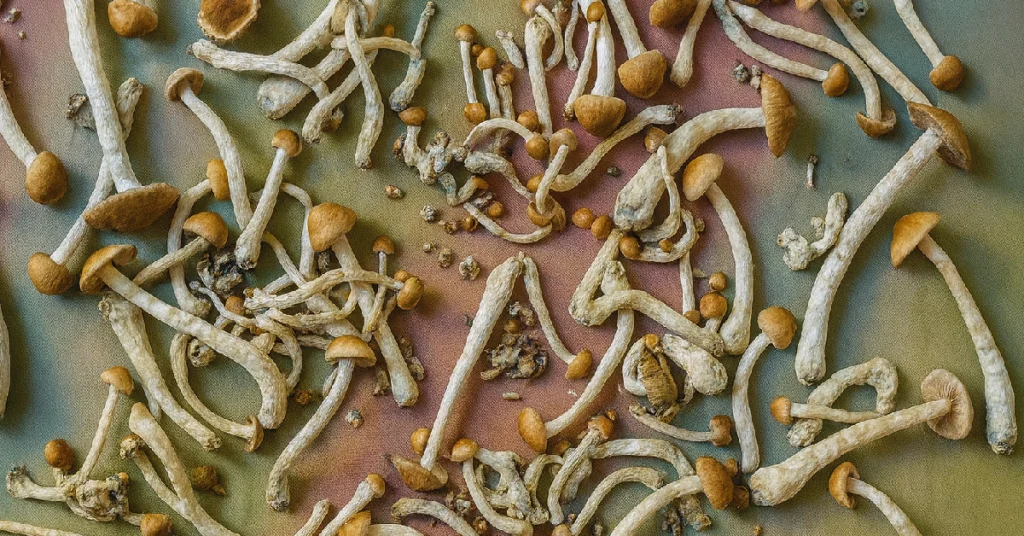
Come Back to Yourself — and Let Magic Mush Canada Walk Beside You on the Way
Ego death isn’t the vanishing act it’s often made out to be. It’s a temporary dissolving — a glimpse into something wider than the “I” we cling to every day. It’s where the stories we tell ourselves about who we are get quiet long enough for us to hear something truer underneath. And when that silence fades, the real journey begins: learning to live again with both feet on the ground and both hands in the world. Coming back gracefully means remembering that the goal was never to escape — it was to participate more fully. It’s about seeing that enlightenment doesn’t happen out there in cosmic vastness, but right here, while washing dishes or feeding the cat.
In this piece, we explored how ego death isn’t a trophy to be won but a nervous system reset — a tender process that asks for gentleness, grounding, and humour. We talked about the myths that surround it, the biology that underpins it, and the ways to weave its lessons back into everyday life. The truth is: ego death shows you that you’re not separate from the world — and that the real art lies in showing up to life again, softer, wiser, and more present than before.
This is where Magic Mush Canada comes in — not as some faraway guide, but more like a friend who’s been down that road and knows where the potholes are. At Magic Mush Canada, we believe that transformation doesn’t end when the trip does. It continues in the small choices you make every day — the grounding, the integration, the staying human. We’re here to help make that process safer, more informed, and deeply personal. We don’t just sell premium magic mushrooms; we nurture understanding, promote safe usage, and work to destigmatize these experiences across Canada. We’re not just a shop — we’re a growing community that believes in the healing potential of connection, consciousness, and care.
When you choose Magic Mush Canada, you’re not just ordering a product online. You’re joining a movement that values education, harm reduction, and authenticity. Every strain we offer is rigorously tested, every guide we share is written with compassion, and every conversation we start is about breaking old biases and building trust. Whether you’re exploring psilocybin therapy in Toronto, seeking integration support in Vancouver, or simply curious about magic mushrooms in Ottawa, we’ve got you covered — with privacy, integrity, and support that feels human.
So, if your trip cracked something open and you’re still learning how to live in that new light — come hang with us. We’ll help you rediscover your footing, offer tools and guidance for your integration, and remind you that the journey back is just as sacred as the trip itself. Explore the possibilities with Magic Mush Canada, your trusted partner in Canada’s growing magic mushroom community. Shop our premium products, join our newsletter, and stay connected with others who get it. Because the magic doesn’t end when the ego fades — it begins when you come home.

