I remember the moment the world fell away—not with fear, but with relief. My body was gone, replaced by light, by breath, by the soft rhythm of the trees outside my window. My name, my job, my childhood stories—all dissolved like ink in water. I wasn’t “me,” and for the first time, that felt not like a loss, but a liberation. When I returned, hours later, the room unchanged, something inside had shifted. The stories I’d been gripping for years—about who I had to be, how I had to hurt—were suddenly less convincing.
This wasn’t my first psychedelic journey, but it was the first where ego dissolution was unmistakable. And in the weeks that followed, my anxiety loosened. My relationships softened. I didn’t just feel better—I felt different.
We often hear that psychedelics “rewire the brain.” But what if the deeper healing doesn’t come from new neural connections, but from loosening the grip of the ego—the rigid, protective structure we mistake for our true self?
READ: Ego, Shadow, Persona, and Self: Carl Jung’s Model of the Psyche

Beyond the Brain: Ego, Identity, and the DMN
Neuroscientific research often starts with the Default Mode Network (DMN), a series of brain regions that activate during self-referential thought—rumination, daydreaming, future planning. The DMN is where our “story of self” lives. It’s not inherently bad, but when it’s overactive or inflexible, it correlates with mental health issues like depression, anxiety, and obsessive thinking.
Psychedelics like psilocybin, LSD, and DMT have been shown to dramatically decrease DMN activity. This suppression allows other, less dominant brain regions to communicate more freely—a temporary state of increased entropy that Carhart-Harris and colleagues describe in the REBUS model (Relaxed Beliefs Under Psychedelics).
REBUS posits that psychedelics soften the top-down predictions we carry about the world and ourselves—what psychologists might call “core beliefs.” When those beliefs are tied to trauma, shame, or identity, loosening them can feel like ego death.
But what exactly is the ego?
REBUS: A Scientific Theory of Surrender
Robin Carhart-Harris’ REBUS model—Relaxed Beliefs Under Psychedelics—gave me language for what I had felt. The model suggests that psychedelics don’t just increase brain entropy; they loosen the top-down predictions that govern perception. In simpler terms: they relax the assumptions we cling to about ourselves and the world.
One of the assumptions I didn’t even realize I was carrying? That I had to be in control at all times to be safe. That belief had burrowed so deeply into my body, it shaped everything—from how I interacted with lovers to how I planned my calendar. On mushrooms, I saw that belief like scaffolding around a fragile heart. Then, I watched it crumble.
According to REBUS, this loosening allows the brain to become more plastic, more curious. It’s not that psychedelics insert new ideas, but that they make space for fresh perspectives to emerge. In clinical terms, this shift in rigidity has been linked to lasting reductions in depression, anxiety, and addictive behaviors.
But what no paper could fully capture is how humbling that loosening feels. For me, it wasn’t about gaining new beliefs—it was about realizing that belief itself can be a cage. I wept, not from sadness, but from the relief of putting the heavy story down.
Check out this magic mushroom!!

A.P.E Psilocybin Chocolate Bar
$60.00Dried Penis Envy Magic Mushrooms
Price range: $60.00 through $240.00Golden Teacher Gummies for Microdosing
$25.00


The Ego: Armor, Identity, Illusion
In Western psychology, the ego is a construct developed in response to early experiences. It helps us distinguish ourselves from others, navigate social norms, and maintain a sense of continuity. But it’s also a filter—one that can calcify around pain, power, and performance.
“When I was young, I learned to control everything to feel safe,” says Maya*, a participant in a psilocybin-assisted therapy trial for treatment-resistant depression. “That control became my identity. On mushrooms, I saw how exhausted that part of me was. It didn’t want to hold everything together anymore.”
Maya’s experience is echoed in clinical data. In a 2022 study at Johns Hopkins, intensity of ego dissolution during psilocybin sessions strongly correlated with lasting therapeutic outcomes—especially among patients with major depressive disorder. Those who experienced a “complete mystical state,” often involving ego death, were more likely to sustain improvements at the 6- and 12-month marks.
Similarly, in studies targeting nicotine and alcohol addiction, patients often described a core shift in identity rather than just reduced cravings. One participant said, “It wasn’t just that I stopped smoking—I stopped seeing myself as a smoker. I remembered who I was before that habit became my reality.”
The Ego as Survival Strategy (and Soul Cage)
I used to think ego was about arrogance. The inflated self. But after several psychedelic journeys—and years of therapy—I see it differently now. The ego is a survival strategy. It’s the part of us that learned how to get love, avoid shame, and stay alive in a complicated world. My ego was charming, competent, and endlessly apologetic. It got me through school, jobs, breakups. But it also kept me disconnected from my deeper truth.
On mushrooms, I watched this persona with new eyes. I saw how it performed, how it contorted itself to be “good.” I didn’t hate it. I grieved for it. Because beneath that performance was a younger self—confused, tender, waiting to be seen.
In the psychedelic state, ego doesn’t die in a blaze of glory. More often, it dissolves like sugar in warm water. There’s no battle—just the soft letting go of something that no longer fits. I didn’t stop being me. I just remembered that I’m not only the version of me shaped by fear.
And that realization was a kind of birth. Not of a new identity, but of a deeper capacity to be. To feel. To show up without the armor. In that space, healing became less about fixing, and more about allowing.
Why Letting Go Scares Us—and Heals Us
Surrendering sounds poetic until you’re actually in it. In one high-dose session, I felt my ego gripping with all its might. My body stiffened, breath shallow, mind screaming: “You’re dying.” And in a way, something was dying—the idea that I was in control.
That panic is common in ego dissolution. And it makes sense: the ego’s job is to maintain a coherent identity. When psychedelics start dissolving that structure, fear surfaces like a reflex. But when I finally surrendered—let the current take me—I wasn’t obliterated. I was opened.
What lay beyond that fear wasn’t a void, but a sense of wholeness I’d never touched before. I felt held by something larger than my own psyche—something sacred, maybe even divine. I understood, viscerally, that my fear had been guarding a door to love.
And here’s the kicker: that shift didn’t vanish when the trip ended. In the days that followed, I found myself reacting differently. More patience. Less defensiveness. I wasn’t “fixed”—I was softer. And that softness became its own kind of strength.
READ: Ego Death: Everything You Should Know
The Fear Before the Fall
“I thought I was dying,” said Jorge*, who participated in a MAPS clinical trial involving MDMA for PTSD. “I fought it at first. But then something in me said, ‘Let go.’ And when I did, I saw my life from the outside. I forgave myself.”
This fear—of losing control, of “going crazy,” of death—is often the ego’s last stand. It’s why many indigenous traditions frame psychedelic rites as symbolic deaths followed by rebirth. These traditions offer ceremonial containers—ritual, community, song—to help anchor the experience.
In contrast, the modern Western model often lacks this scaffolding, which is why integration—through therapy, journaling, community—is so critical. As Bill Richards has noted, the quality of the mystical experience often predicts outcomes, but the integration of that experience determines whether healing sticks.
Ego Work Across Cultures and Practices
Long before psilocybin hit clinical trials, Indigenous cultures were engaging the ego through ceremony and medicine. In Shipibo ayahuasca rituals, in Mazatec veladas with mushrooms, in Andean coca leaf readings, the ego is not villainized—but guided. It is shown its place within a larger web of kinship, cosmos, and community.
What struck me in speaking with traditional healers was how little emphasis they placed on “ego death” as a goal. The aim, rather, was connection—to self, to ancestors, to land. The medicine wasn’t there to erase the self, but to right-size it. To remind it of its place.
In our Western model, we often approach psychedelics with a hyper-individualistic lens. Healing becomes another performance. But ego work, as I’ve come to understand it, is not about transcendence for its own sake. It’s about re-embodiment. Re-rooting. Returning to relationship—with yourself, with others, with the earth.
These cultural teachings have deeply shaped how I approach my own integration. They remind me that my healing isn’t just personal—it’s relational. And that the ego, when softened, doesn’t disappear. It just becomes a better listener.
As Ram Dass once said, “The ego is a wonderful servant but a terrible master.”
READ: Psychedelic Integration: The Real Trip Begins After the Peak Ends
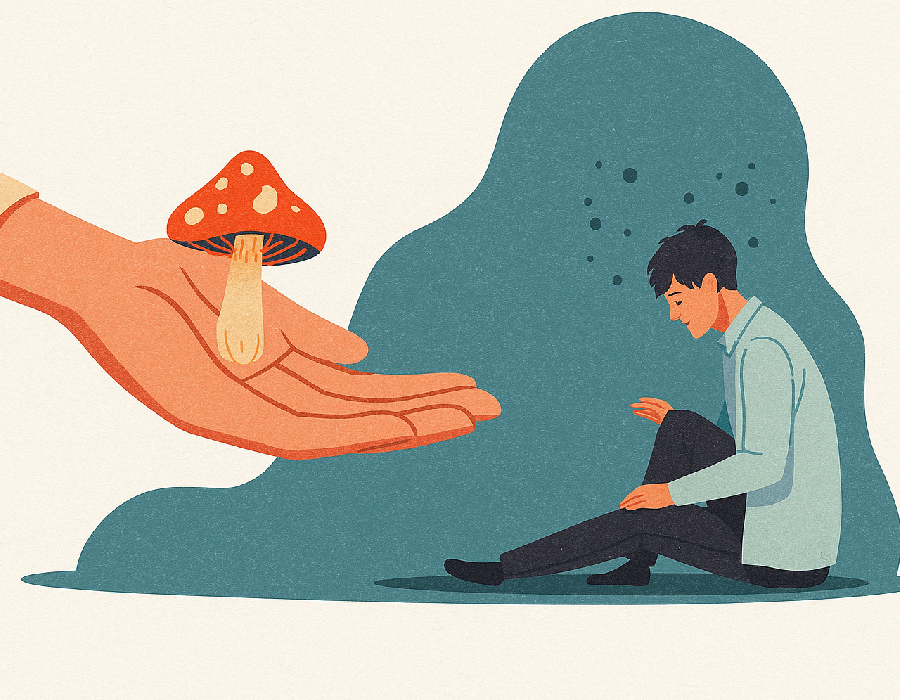
Integration: Where the Real Work Begins
The trip ends. The body returns. The ego, like a cat after a bath, slinks back in—damp, watchful, a little humbler. And this is where the real work starts. Because what good is ego dissolution if it doesn’t change how we live, love, or show up in the world?
For me, integration began quietly. I started paying attention to the moments when my old identities tried to reclaim me—when I reached for productivity as proof of worth, or shrank myself to avoid conflict. But I had seen too much to fall back asleep. The memory of spaciousness, of being more than my defenses, lingered like a scent on my skin.
I began working with a therapist trained in psychedelic integration. We didn’t analyze the trip; we listened to what it was trying to teach. I journaled. I rested. I quit a freelance gig that had become soul-deadening. I told my mother things I’d never had the courage to say. Slowly, I was reassembling a self—not around trauma, but around truth.
And here’s what I’ve learned: the goal isn’t to “kill” the ego. It’s to relate to it differently. To catch it when it panics, soothe it when it clings, laugh at it when it starts performing again. Ego, after all, is just a strategy. But when you’ve glimpsed what lies beyond it, you don’t have to let it drive the car anymore.
From Psychedelic Glimpses to Everyday Presence
I don’t chase ego death anymore. It’s not a badge of enlightenment or a spiritual trophy. It’s a moment of grace—and like all grace, it fades. What matters more is how I live with what it showed me. How I respond to suffering, how I ask for help, how I choose presence over performance.
These days, I find that presence more often in the mundane: washing dishes, walking slowly, saying “I don’t know” without shame. Psychedelics helped me see the illusion of the separate self. But it’s daily life that helps me live that truth—imperfectly, humanly.
That’s the paradox: ego dissolution isn’t an end point. It’s a doorway. The real journey is what comes after—how we integrate that spaciousness into our most entangled relationships, our most vulnerable moments.
And in that ongoing practice, something sacred unfolds. We stop trying to fix ourselves and start listening to the parts we once silenced. We make peace with our complexity. We return—not to who we were, but to who we’ve always been, underneath the stories.
READ: How to Prepare for a Psychedelic Journey: Setting the Stage for a Meaningful Experience
From Insight to Integration — With Magic Mush by Your Side
If psychedelics teach us anything, it’s that transformation doesn’t end when the trip does. The insights we gather—the softening of ego, the healing of old wounds, the remembrance of our interconnectedness—require tending. They ask us to integrate, to reflect, to live differently. And they ask us to seek support, wisdom, and trusted sources along the way.
That’s where Magic Mush comes in.
Magic Mush Toronto isn’t just the city’s most trusted provider of high-quality magic mushroom products like shroom edibles—we’re a hub for education, empowerment, and conscious exploration. Whether you’re microdosing to enhance creativity and mood, or seeking information to prepare for a deeper journey, we’ve got your back with rigorously sourced products and thoughtfully curated content.
At Magic Mush, we believe that mushrooms aren’t just medicine—they’re teachers. And we’re here to make sure you meet them with reverence, knowledge, and care.
So if this article stirred something in you—curiosity, clarity, maybe even a call to let go—check us out. Explore our guides, browse our offerings, and take the next step on your path to self-discovery and healing.