The first time I took mushrooms, I was sitting under a tree in a quiet park, wrapped in a blanket of late afternoon light. I remember looking up at the leaves above me and seeing them shimmer—not just in the way sunlight dances through foliage, but as if the entire tree was breathing. The bark pulsed in slow, rhythmic waves, and the branches curled and stretched like fingers in motion. I wasn’t scared. I wasn’t even surprised. It felt natural, like I was finally seeing something I’d been blind to my entire life.
In that moment, reality didn’t feel broken—it felt upgraded. I saw meaning in everything. The ants on the ground were little engineers of the Earth, the wind carried whispers, and my thoughts spilled out into the world like colors across a blank canvas. But once the trip wore off and I was back in “normal” reality, I couldn’t help but ask myself: what the hell was that? Was it just a hallucination? A glitch in my brain’s visual software? Or did I, in some strange way, glimpse a deeper truth about the world around me?
That trip sent me spiraling into months of curiosity and research. I devoured books, dove into neuroscience articles, joined online communities, and talked to experienced psychonauts. What I learned both grounded and expanded my understanding of what I had seen. Turns out, what many people brush off as “just visuals” actually has roots in deep brain mechanics, centuries-old spiritual practices, and the wild complexity of human perception. The visuals weren’t just pretty nonsense—they were messages, symbols, and maybe even a few buried memories I hadn’t been ready to process before.
That journey—both literal and intellectual—is what inspired this article. If you’ve ever seen the walls melt, witnessed sacred geometry unfold behind your eyelids, or locked eyes with an entity that felt more real than anything in your waking life, you’ve probably asked the same question I did: Why do psychedelic visuals feel so real, even when we know they’re not? Let’s explore.
READ: Top Psychedelic Artists on Instagram Right Now

In-Depth Explanation
Definition
Let’s start with the basics. Psychedelic visuals are the trippy, often beautiful perceptual changes that happen when you take substances like psilocybin (the active compound in magic mushrooms), LSD, or DMT. They can range from subtle shifts like colors becoming more vivid, to mind-bending scenes that feel straight out of a sci-fi novel. You might see swirling fractals, geometric lattices, patterns that dance across surfaces, or entire landscapes unfolding behind your eyelids. Objects might breathe, ripple, or morph into other forms. Sometimes, these visuals go beyond the aesthetic and into the emotional or symbolic—like seeing faces in clouds that feel like long-lost ancestors, or shapes that “mean” something you can’t quite put into words.
Background & Historical Context
The fascination with these kinds of visuals isn’t new. Long before modern neuroscience began decoding brainwaves and neural networks, indigenous cultures were working with plant medicines to access visionary states. In the Amazon, shamans drank ayahuasca—sometimes called the “spirit vine”—to commune with jungle spirits and heal the sick. In Mesoamerica, the Aztecs used psilocybin mushrooms, calling them teonanácatl, or “flesh of the gods.” These visions weren’t just seen as side effects—they were central to the spiritual experience. The visuals were often interpreted as messages from deities, ancestors, or nature itself. Whether used for healing, divination, or celebration, these substances opened the door to a realm that felt just as real—sometimes more real—than the ordinary waking world.
READ: The Strongest Psilocybin Mushrooms: Exploring Nature’s Most Potent Psychedelics

Scientific Explanation
Fast forward to today, and science is starting to catch up with what shamans have known for centuries—that these substances do something truly profound to our perception. At the heart of this transformation is the brain’s default mode network, or DMN. This is the part of the brain responsible for our sense of ego, our internal monologue, and the filtering of sensory input. Under psychedelics, especially psilocybin, the DMN goes quiet. When that happens, different parts of the brain—areas that usually don’t talk to each other—start firing in unison. This wild, new communication pattern is often called neural crosstalk.
Researchers at Imperial College London have used fMRI scans to peek into tripping brains, and what they found is fascinating. Under psychedelics, the brain shows increased entropy—meaning it becomes more chaotic, more flexible, and more creatively interconnected. Imagine your brain as a jazz band that suddenly stops following the usual score and starts improvising together in a wild new rhythm.
And then there’s the thalamus, the brain’s sensory gatekeeper. Under normal circumstances, it filters the flood of data coming in from the world—only letting in what it thinks is relevant. But psychedelics make this gate more porous, allowing a rush of sensory data to pour through. Some of that input is from the outside world, sure, but a lot of it is internal—memories, emotions, subconscious patterns. It all gets projected onto the canvas of your perception.
Cognitive Model of Perception
Now, here’s where things get even weirder—in a good way. According to predictive processing theory, your brain isn’t just a passive receiver of information. It’s actually a prediction machine, constantly making guesses about what’s happening around you. It takes a little bit of sensory data, mixes it with past experiences, and fills in the blanks to create what you experience as “reality.”
Psychedelics disrupt this prediction engine. They loosen the brain’s top-down control (the “big picture” predictions) and allow more bottom-up information (raw sensory data) to flood in. The result? Your brain’s guesses get weird. Instead of seeing a flat wall, you see it ripple and breathe. Instead of recognizing a face in a tree trunk and brushing it off, you see that face become real—with expression, meaning, maybe even a message. The boundary between what’s “real” and what’s “imagined” starts to dissolve.
Check out this magic mushroom!!

A.P.E Psilocybin Chocolate Bar
$60.00Dried Penis Envy Magic Mushrooms
Price range: $60.00 through $240.00Golden Teacher Gummies for Microdosing
$25.00



Key Points
Why Visuals Feel Real
So why do psychedelic visuals feel so convincingly real? One reason is that your brain is using the same perceptual tools it uses in waking life. Whether it’s decoding a dog barking or interpreting a dancing fractal, the visual cortex is hard at work—and under psychedelics, it’s lit up like a Christmas tree.
Another big factor? Emotion. Psychedelics tend to amplify feelings—joy, fear, awe, sorrow. When you see something emotionally charged, like a glowing orb that feels like love incarnate, the emotional weight of the experience makes it feel truer than truth. It’s not just something you saw. It’s something you felt.
Many psychonauts also describe visuals as symbolic—representations of buried emotions, past traumas, or unresolved questions. That snake slithering through your vision might not just be a snake. It might be your fear, your desire, or your inner critic manifesting in a form you can actually look at.
Common Types of Visuals
If you’ve tripped before, some of this might sound familiar. The most common visuals include geometric patterns—lattices, spirals, grids that seem to move or rotate with your breath. There’s also synesthesia, where you might see music or hear colors. Objects in your environment can start to morph, stretch, melt, or breathe. And at higher doses—especially with DMT—you might encounter entities: beings that feel intelligent, aware, and not entirely of this world. Whether you interpret them as figments of the mind or visitors from another dimension, they leave a lasting impression.
When It Gets Intense: Navigating Difficult Visuals
Of course, not all visuals are rainbows and sacred geometry. Sometimes, the imagery gets dark—shadows, monsters, or emotionally raw scenes. These moments can feel terrifying because they often tap into unresolved emotions or fears. The best advice? Breathe. Try grounding yourself—touch a blanket, listen to music, focus on your breath. Remind yourself: this is temporary, and the visuals are coming from you. You’re not broken—you’re just seeing what’s normally hidden.
READ: How to Microdose Psilocybin: A Beginner-Friendly Guide
Are They Hallucinations or Reality-Enhancers?
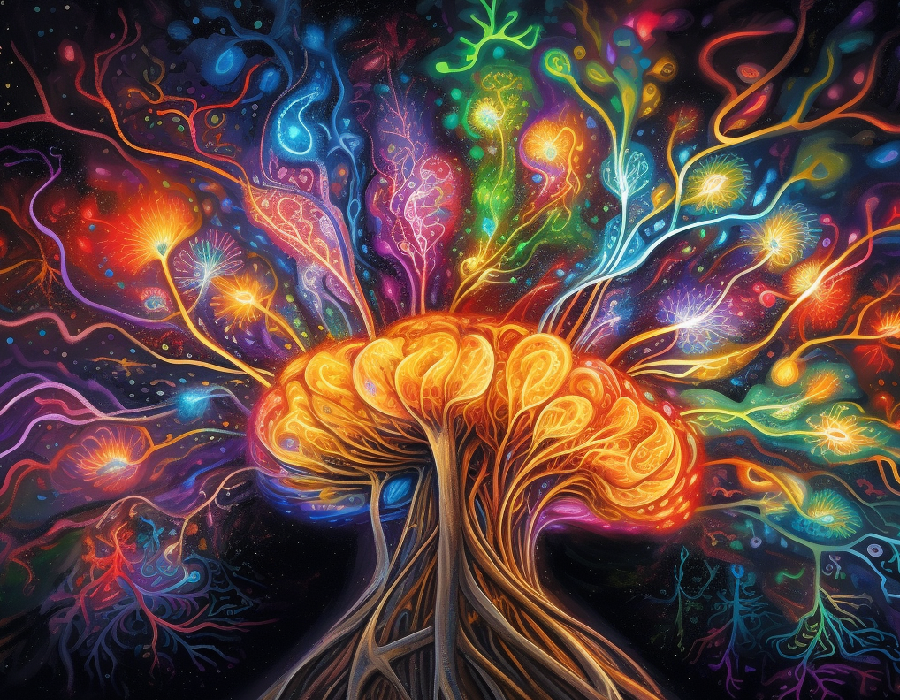
This question never gets old: are psychedelic visuals just hallucinations, or are they showing us something real? From a scientific perspective, they’re brain-generated phenomena—creative rearrangements of sensory input. But from a subjective, spiritual, or philosophical standpoint, many users argue they’re revealing hidden dimensions of reality. That glowing web of energy you saw? Maybe it’s just neurons misfiring. Or maybe—just maybe—it’s something more.
The answer might depend on your worldview. But even if you land on the “it’s all in your head” side, that doesn’t mean it’s meaningless. The brain, after all, is the lens through which we experience everything. If something feels real, impacts you emotionally, and changes your life—that counts for something, right?
Psychedelic/Microdosing Connection
Interestingly, even microdosing—taking sub-perceptual amounts of psychedelics—can nudge the visual system in subtle ways. You might notice that colors seem richer, light more golden, or patterns more detailed. You probably won’t see entities or breathing walls, but there’s often a gentle shift in how you perceive the world. Many people describe a heightened sense of presence or beauty, like you’re looking at reality in high definition. These shifts suggest that even small amounts of psychedelics can affect the brain’s perceptual filters—just enough to hint at the vast visual potential that full doses unleash.
READ: The Most Potent Psilocybin Mushrooms Aren’t Always What You Think

Ready to See What Your Mind Might Reveal? Explore With Magic Mush
Psychedelic visuals feel so astonishingly real because they tap into the very core of how our brains construct reality. Substances like psilocybin, LSD, and DMT interfere with the brain’s usual filters—especially the default mode network—allowing neural pathways to fire in new, creative, and often chaotic ways. The result is a vivid blend of imagination and perception: walls that breathe, colors that sing, and patterns that emerge from nowhere. These visuals aren’t just wild sensory fireworks; they often carry emotional and symbolic weight that feels deeply personal and meaningful.
From ancient shamanic traditions to cutting-edge neuroscience, humanity has long been fascinated by the strange world unlocked by psychedelics. Scientific research shows these visuals are not just noise but reflections of deep brain processes, including memory, emotion, and sensory interpretation. Predictive processing theory helps us understand that when our brain’s normal “guessing machine” is disrupted, we begin to perceive a world that’s as much inner as it is outer. Whether you’re microdosing or journeying on a full trip, these visual phenomena open a doorway into uncharted parts of the psyche.
At Magic Mush, we’re not just here to sell mushrooms—we’re here to be your partner in the psychedelic journey. Our mission is to make high-quality magic mushrooms accessible, safe, and stigma-free across Canada. With rigorous product testing, expert guidance, and a deep respect for the healing and transformative power of psychedelics, we aim to empower you to explore your consciousness with confidence and clarity. Whether you’re new to psychedelics or a seasoned psychonaut, Magic Mush provides the tools and support you need to travel well.
Our platform offers more than just shopping. We believe in education, community, and responsible use. That’s why we provide extensive resources, from dosage guides to the latest psychedelic research, all curated with care. We understand the importance of privacy and customer service—so you can count on discreet delivery, responsive communication, and a team that genuinely cares about your experience. When you shop with Magic Mush, you’re not just buying a product—you’re joining a movement of people reclaiming mental health, spirituality, and personal growth.
So if you’re ready to see the world through a new lens, or just want to start with a subtle shift in perception, Magic Mush is here to guide you. Dive into our collection, read up on best practices, and connect with a community that’s transforming curiosity into healing. The journey starts now—what will you see?