

What Does It Mean When the Mushroom Goes Silent?
By Lily Pelenis / October 22, 2025 / 5 min read
There’s a moment that catches almost everyone off guard.
You prepare the space, set your intentions, maybe even pray a little.
You swallow the dried magic mushrooms, close your eyes, wait for the wave…
And then, nothing.
No visions.
No messages.
No voice of the Earth or inner guide.
Just silence.
A vast, echoing stillness that feels both sacred and unsettling.
You wonder if something went wrong, if the dose was off, or the batch was weak, or you somehow “missed it.”
But what if the silence is the message?
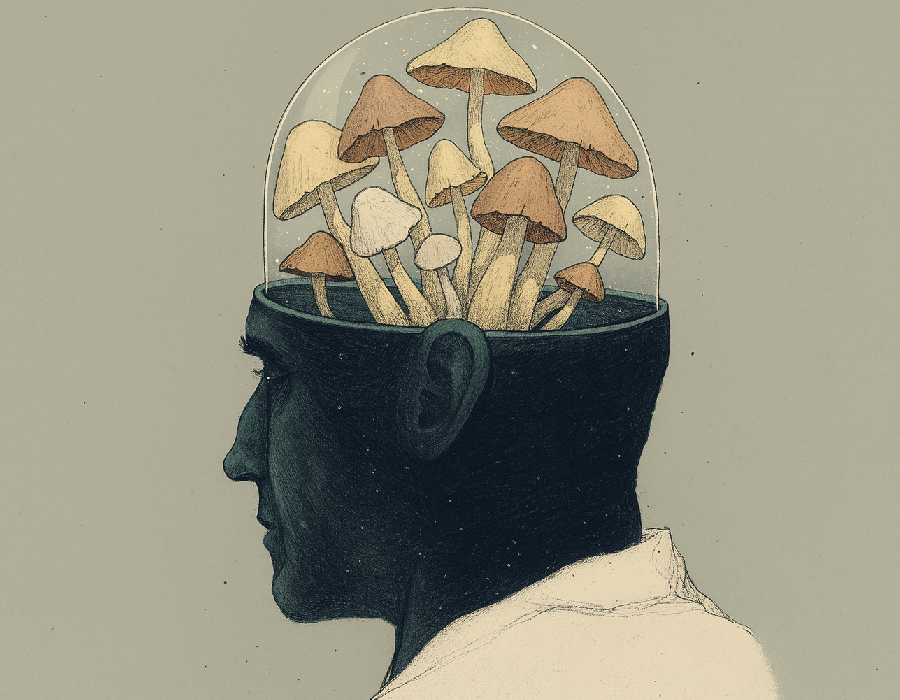
The Expectation of Revelation
We live in a culture that worships noise, even spiritual noise.
We want fireworks, downloads, conversations with God, or at least a whisper from the void.
The modern psychedelic landscape, from psilocybin therapy in Toronto to underground circles in Vancouver, often carries that same hunger for spectacle: transformation as event, not process.
So when the medicine goes quiet, it can feel like rejection.
But silence doesn’t mean the medicine isn’t listening.
Sometimes it’s listening through you, measuring your capacity to rest without answers.
The Physiology of Stillness
There’s also a biological side to the silence.
Psilocybin doesn’t always produce visions or voices because it doesn’t act the same way every time.
Set, setting, and state of mind all shape how the brain receives the experience.
When the default mode network quiets down, some people see fractals or hear symphonies; others experience a kind of inner blackout, a calm detachment that can feel like being “between stations” on a radio.
No static, no music. Just signal loss.
But neuroscientists studying magic mushroom in Toronto have noticed something fascinating: during those quiet phases, brain connectivity still increases.
Even when the surface feels empty, deeper communication is happening between regions that rarely interact.
Silence, it turns out, doesn’t mean inactivity.
It means reorganisation.
Your consciousness might be rearranging itself quietly, like snow settling after a storm.

The Spiritual Intelligence of Emptiness
From a psychological perspective, silence can feel like failure.
From a spiritual one, it’s invitation.
The mushroom’s silence often mirrors the deeper silence of awareness, the part of you that exists before story, before identity, before interpretation.
When there’s no message, no imagery, you’re left face to face with the raw, wordless fabric of being itself.
Mystics across traditions have described this same terrain:
The “cloud of unknowing.”
The Buddhist shunyata emptiness that is full.
The Quaker “inner stillness.”
Different languages for the same paradox:
The absence that contains everything.
The Ego’s Last Strategy
Silence can also be the ego’s subtle defence.
When the medicine begins to strip away layers of control, the mind sometimes responds by freezing, a kind of internal shutdown to avoid dissolution.
It’s not resistance so much as instinct.
If this happens, gentleness is key.
Don’t push. Don’t chase visions.
Let the quiet be the teacher.
Because the deeper you lean into the silence, the more you notice that it isn’t empty, it’s spacious.
It has texture, breath, temperature.
It’s the sound of your nervous system finally taking a break from performing selfhood.
Listening to What’s Not Being Said
Silence changes when you stop fighting it.
At first, it feels like absence. Then it starts to reveal small, delicate details:
the hum of your heartbeat, the faint pulse of breath, a quiet curiosity beneath the stillness.
If you treat silence not as punishment but as conversation, one that happens beneath language, it becomes its own kind of guidance.
Sometimes the medicine goes silent because you’re not meant to receive more information.
You’re meant to integrate what you already know.
It’s saying: you’ve learned enough for now, go live it.
The Integration of Nothingness
After a silent trip, many people feel confused.
What do you integrate when nothing happened?
The answer is: everything.
Integration isn’t about decoding symbols or deciphering messages.
It’s about noticing how silence moves through your daily life afterward.
Do you feel calmer? More sensitive? More impatient? More present?
Those subtle shifts are the integration.
Just because the medicine didn’t speak doesn’t mean it didn’t change you.
Not every update installs with a progress bar.

When Silence Feels Uncomfortable
Of course, not all silence feels peaceful.
Sometimes it’s hollow, lonely, even frightening, like being cut off from the world.
If that happens, ground yourself in the ordinary:
touch, sound, food, human contact.
Silence can sometimes bring old loneliness to the surface, a reminder of what it feels like to be without distraction.
That’s when integration becomes relational: reach out, talk, move, return to life.
Silence isn’t meant to isolate you; it’s meant to recalibrate you.
The Collective Silence
Interestingly, many experienced facilitators and retreat leaders across Canada have noted that as psychedelic culture matures, more people are reporting “quiet” trips.
It’s as if the collective field of use, especially with microdosing, therapeutic settings, and emotional burnout, is evolving from revelation to regulation.
The mushrooms might not need to show us as much anymore.
They might just be teaching us to rest.

The Magic Mush Perspective
At Magic Mush, we believe that silence is not a lack of magic, it’s the most refined form of it.
Healing doesn’t always announce itself.
Sometimes it hums in the background, softly retuning your life while you sleep.
Whether you journey in Toronto, Vancouver, or your own living room, trust the silence as part of the conversation.
The mushrooms don’t stop speaking, they just change language.
Closing Reflection: The Sound Beneath Everything
What if the silence isn’t absence at all, but listening?
What if the medicine falls quiet because it’s waiting for you to speak?
Maybe the next step isn’t to hear more, but to answer back, through action, gratitude, or simply living differently.
Because in the end, the silence after the trip is not the end of communication.
It’s the beginning of embodiment.
Find your strain, then your dose
Every product on the shelf shows its potency rating and the effects people report. The dosing guide walks through amounts before you order, and a real person answers if you write to us.

About the author
Lily Pelenis
I'm a Toronto-based lifestyle coach, psilocybin enthusiast and certified yoga instructor. I guide people toward mindful, balanced living, and my coaching blends modern wellness practices with ancient wisdom to help clients find deeper self-awareness, resilience and joy.
I've been experimenting with shrooms for over a decade, and I write about my own experience. I love nature, psychology and humans. That is why my articles tend to follow a trip past its peak and into the weeks after it.
Some pieces start with a strain I have tried myself, such as Golden Teacher or Albino Roller Coaster. Others are the practical ones, like how much to take the first time or how to brew a tea that sits easier on the stomach. Over the years I've learned that intention is everything, so I write about why you are taking it before I get to how.
Related articles







50% off your first order
New strains, restocks, sales and new writing from the Notebook, by email. No spam, unsubscribe any time.