Pink Buffalo Mushrooms: Origin, Effects and Potency
By Lily Pelenis / March 27, 2025 / 11 min read
Pink Buffalo is a Psilocybe cubensis magic mushroom strain said to come from Thailand, most often traced to the island of Koh Samui, and known among growers and users for an easy, euphoric trip with a strong mental high and lighter visuals. No lab has published a psilocybin figure for it, so its strength is best treated as that of an ordinary cubensis, and Magic Mush does not currently sell it.
This page sets out what is actually on record about Pink Buffalo: where the name and the origin story come from, how strong it is likely to be, what people report it feels like, which strains on our shelf come closest, and how to dose a cubensis you have not tried before.
TLDR
Pink Buffalo is a cultivated cubensis strain with a Thai origin story: one account has ethnomycologist John Allen collecting it from buffalo dung on Koh Samui, another credits a collector named Milo Zverino in 2000 (DoubleBlind). Neither story has a published record behind it. The mushroom is not pink: its caps run from light cinnamon to golden brown. The “smooth and kind” reputation comes from a strain description by the spore site Shroomok, “Tripping is soft, smooth and kind”, quoted by DoubleBlind.
There is no published lab test of Pink Buffalo’s psilocybin content. Typical cubensis effects start within 15 to 45 minutes and last four to six hours (Health Canada). We do not stock Pink Buffalo; the closest strains on our shelf in rated potency and character are Golden Teacher (6 out of 10), Makilla Gorilla (5.5 out of 10) and Burma, a Southeast Asian cubensis with a similar backstory. A first trip on any of them sits at 1 to 2 g of dried mushroom in our dosing guide.
Who this article is for
- People who saw Pink Buffalo on a menu or a forum and want to know what it is.
- Anyone trying to check whether the Koh Samui and “sacred buffalo” stories hold up.
- People who want to know how strong Pink Buffalo is before they take it.
- Readers looking for a gentle, euphoric strain they can actually order in Canada.
- Anyone who wants real dose numbers and the safety basics for a new cubensis strain.

Lily Pelenis
Author’s note
I work at Magic Mush, and Pink Buffalo is a strain people ask us about by name, often because of the line that it is “smooth and kind”. Our older article on it repeated that line along with a lot of folklore, and it read as if we sold the strain. We do not. I rewrote this page so it says only what can be traced to a named source, and says plainly where no record exists.
My view is that Pink Buffalo’s reputation is worth taking seriously as a description of how people experience it, and not as a guarantee. A gentle reputation can lead people to take a bigger dose than they would with a strain known as strong. With any cubensis, the dose, your state of mind and the room you are in shape the trip more than the name on the bag.
What is the Pink Buffalo mushroom strain?
Pink Buffalo is a named strain (a cultivar) of Psilocybe cubensis, the most widely grown psilocybin mushroom, rather than a separate species. DoubleBlind lists Thai Pink Buffalo, PB and occasionally Hairy Buffalo as other names, and describes it as closely related to the Koh Samui variety (DoubleBlind).
| Fact | Pink Buffalo |
|---|---|
| Species | Psilocybe cubensis |
| Other names | Thai Pink Buffalo, PB, Hairy Buffalo (DoubleBlind) |
| Reported origin | Thailand, usually Koh Samui; no published collection record |
| Credited collectors | John Allen (late 1990s to early 2000s) or Milo Zverino (Ban Saket, 2000), depending on the account |
| Appearance | Light cinnamon to golden brown caps, sometimes with a purple tinge; white or cream stems that bruise blue |
| Psilocybin per gram | No published lab figure for this strain |
| Reported character | Euphoric, strong mental high, lighter visuals, less body load |
| Onset and length | 15 to 45 minutes to start, 4 to 6 hours in total (Health Canada) |
| On our shelf | No; see the closest in-stock strains below |
What Pink Buffalo looks like
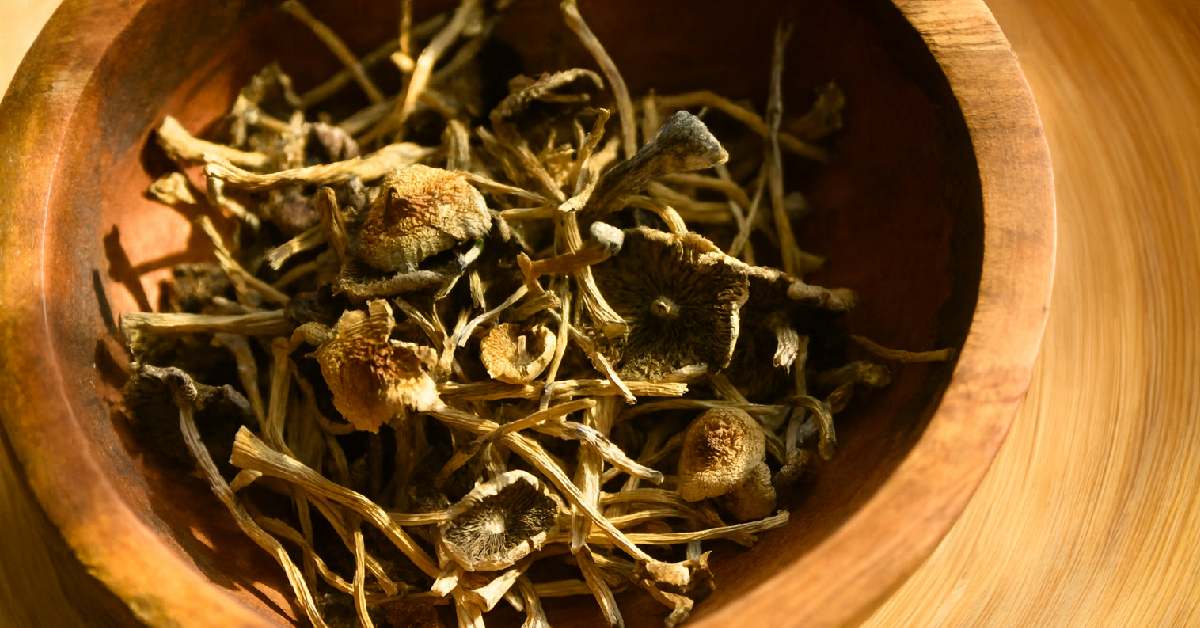
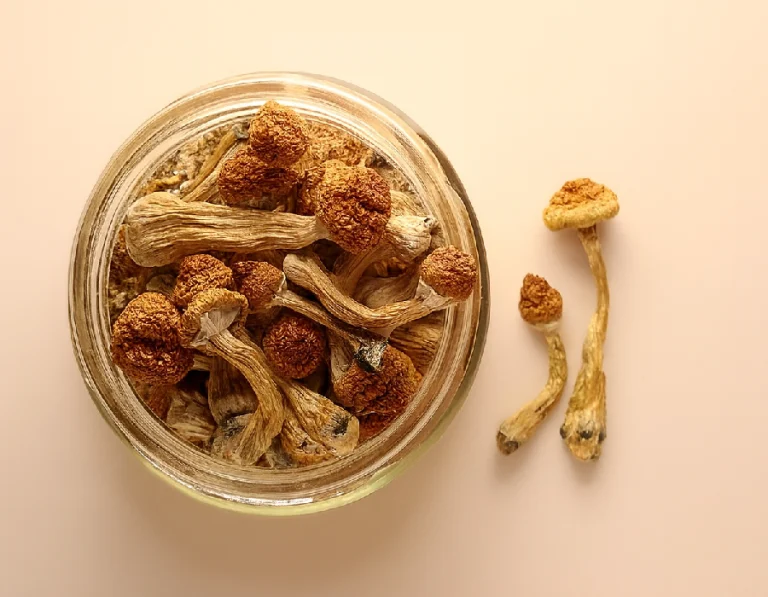
Despite the name, Pink Buffalo is not pink. DoubleBlind describes slender white or cream stems that turn an intense blue when bruised, medium to large caps that range from a light cinnamon brown to a dark golden brown with an occasional purple tinge, and spores from bright violet to purplish black (DoubleBlind). In other words, it looks like most other cubensis.
That matters, because you cannot identify it by eye. Reggie Harris, founder of the testing lab Oakland Hyphae, told DoubleBlind that for about 90 percent of cubensis varieties it is difficult to tell one from another by the naked eye, and that there is basically no genetic testing for strain names, so a strain is “whatever somebody tells you it is” (DoubleBlind).
Where does Pink Buffalo come from?
Pink Buffalo is said to come from Thailand, and most accounts point to the island of Koh Samui, but its exact origin is not documented: the two collection stories in circulation come from forum posts and spore sellers, not from a published record.
The buffalo story
The best known version has the American ethnomycologist John Allen, often called “Mushroom John”, finding the mushrooms on a mound of buffalo dung on Koh Samui after a “sacred” pink buffalo drew him into a rice paddy. DoubleBlind, which reports the story, notes that about one in ten domestic water buffaloes in Thailand has a pinkish hue and that the colour is locally seen as a sign of good luck, and adds that it is not easy to tell fact from fiction here (DoubleBlind). The same article quotes Allen as saying the strain “has changed a bit” since his wild specimen was domesticated.
The other attribution
A Shroomery forum post by Allen, as reported by DoubleBlind, says a mycologist named Milo Zverino collected this cubensis race from Ban Saket, Thailand, in 2000, and some spore sellers credit Zverino with the find as well (DoubleBlind). We could not find an independent record of either collection, a herbarium deposit or a genetic profile under the Pink Buffalo name.
What the published record does support
The setting of the story is real. In a 1992 paper in the Journal of Ethnopharmacology, John Allen and Mark Merlin reported field work on Koh Samui and Koh Pha-ngan from 1989 and 1990, where they collected Psilocybe cubensis and related fungi that often grew in the manure of domesticated water buffalo and cattle, and recorded local cultivation and sale of the mushrooms to tourists (Allen and Merlin, 1992). That paper does not name a Pink Buffalo strain, but it shows that buffalo dung cubensis on Koh Samui was documented, which makes the name a plausible nod to where the mushroom grew.
How much a strain name tells you
Less than you might think. A 2023 study in Current Biology sequenced the genomes of 86 commercially available cubensis cultivars and found low genetic diversity, signs of selfing and clonal propagation, and that most cultivars were founded from related populations (McTaggart et al., 2023). Many strain names sit on top of very similar genetics, so two bags labelled Pink Buffalo from two growers may not be the same mushroom.
How strong are Pink Buffalo mushrooms?
Pink Buffalo is best treated as an average strength cubensis, because no lab has published a psilocybin figure for it. Some online sources call it one of the more potent varieties, but Oakland Hyphae told DoubleBlind it had not knowingly tested Pink Buffalo, and its co-founder Ian Bollinger said lab analyses of cubensis in general find an average of about six milligrams of psilocybin per gram (DoubleBlind).
Why the batch matters more than the name
Even where strains are tested, the numbers vary a lot. In a 2026 study, researchers from Tel-Hai Academic College and the University of Haifa grew 14 cubensis strains under identical lab conditions. Total tryptamines ranged from 2.62 to 20.65 mg per gram across strains, and single mushrooms within a strain still varied, with coefficients of variation for psilocybin of 12.81 to 23.39 percent (Sharchaton et al., 2026). Pink Buffalo was not one of the strains tested, but the lesson applies: a gentle reputation does not tell you how strong the batch in your hand is.
What does a Pink Buffalo trip feel like?
People describe Pink Buffalo as euphoric, easy going and mostly mental, with lighter visuals and less body load than some strains. These descriptions come from strain sellers and users, not from controlled research, so read them as reputation.
Where “smooth and kind” comes from
The phrase comes from Shroomok, a spore and strain information site, whose description reads “Tripping is soft, smooth and kind” and says the mushrooms “plunge you gently in a state of euphoria”. The seller Magic Mycology describes a “powerful mental high, slight visuals, with less pronounced bodily effects”. Both descriptions are quoted in DoubleBlind’s strain profile (DoubleBlind).
The first hour
Magic mushroom effects usually begin 15 to 45 minutes after eating them (Health Canada). DoubleBlind notes that nausea is possible during the come-up (DoubleBlind). Wait out the whole window before deciding anything. A second dose taken because the first “is not working yet” is how many people end up higher than they planned.
The peak and the come-down
At a moderate dose, DoubleBlind describes a peak of two to three hours, with euphoria, visual changes and emotional or spiritual insight all possible, as well as difficult thoughts and visuals (DoubleBlind). The whole experience usually lasts four to six hours (Health Canada).
Possible side effects
Health Canada lists heightened emotions, hallucinations and a distorted sense of time, along with anxiety, confusion and paranoia, and physical effects including facial numbness, a faster heartbeat, higher blood pressure and nausea. It also notes that a “bad trip” may happen, particularly at high doses (Health Canada). A kind reputation does not rule any of these out.
Does Magic Mush sell Pink Buffalo, and what is closest?
No, Pink Buffalo is not on our shelf. If you want a trip in the same spirit, the closest strains we have in stock are Golden Teacher and Makilla Gorilla for a gentle, mid-range potency, and Burma for a Southeast Asian cubensis with a similar origin story. Ratings and lab figures below come from each strain’s product page.
| Strain | Potency rating | Psilocybin per gram (published lab test) | Why it is close to Pink Buffalo |
|---|---|---|---|
| Makilla Gorilla | 5.5 / 10, some experience | About 6.9 mg | Mid-range potency close to the cubensis average; vivid visuals and an inward turn |
| Golden Teacher | 6 / 10, some experience | About 15.9 mg | Gentle effects, euphoria and a trip that turns inward; our pick to learn your dose on |
| Burma | Not rated on its page | About 7.1 mg | Southeast Asian cubensis also tied to John Allen; euphoric, with sharper senses and visuals |
| Blue Pulaski | 7 / 10, some experience | Not published | A step up: kaleidoscopic visuals and euphoria that turns into introspection |
A potency rating and a lab figure measure different things. The rating reflects how strong the whole experience tends to be, while a lab figure is one published sample, not a guarantee for every batch.
Golden Teacher
Golden Teacher is the closest match in character. Its product page describes gentle yet powerful effects, a trip that turns inward, euphoria and a strong sense of connection to the natural world, and we suggest it as a good strain to learn your own dose on. Our Golden Teacher guide covers it in depth.
Burma
Burma is the closest match in story. Its product page says a Thai student is said to have found it near Yangon in Myanmar and given the sample to John Allen, who grew it and spread its spores to growers. It describes the trip as euphoric, with sharper senses, vivid visuals and an insightful streak, and calls it strong, so start at the low end if it is your first time.
Makilla Gorilla
Makilla Gorilla is the closest match on paper for strength: its published sample of about 6.9 mg of psilocybin per gram sits near the cubensis average Oakland Hyphae described. It leans more visual than Pink Buffalo’s reputation. Read our Makilla Gorilla guide for more.
How much Pink Buffalo should you take?
For a first trip on any cubensis you have not tried, including Pink Buffalo, start at 1 to 2 g of dried mushroom, the level our dosing guide calls the first trip. Because there is no lab figure for Pink Buffalo, weigh it and treat each new batch as unknown. These are the six levels in our dosing guide, in grams of dried mushroom.
| Level | Amount (dried) | What the dosing guide describes |
|---|---|---|
| Microdose | 0.1 to 0.25 g | Sub-perceptual; you will barely feel it |
| Threshold | 0.25 to 1 g | Warmer colours, fuller music, a lift in mood; fully functional |
| First trip | 1 to 2 g | Mild visuals, bigger emotions, still in control; for first-timers |
| Journey | 2 to 3.5 g | Vivid visuals, altered time and space; sober sitter, no other plans |
| Deep end | 3.5 to 5 g | Ego starts to loosen; experienced only, sitter required |
| Heroic | 5 g and up | Ceremonial; advanced only |
Before you take it
- Weigh it. Use a scale that reads to 0.01 g. Guessing by eye is how a light dose becomes a heavy one.
- Eat light. Our dosing guide suggests a light meal 60 to 90 minutes before, and honey ginger tea if nausea hits.
- Mind your set and setting. Researchers at Imperial College London argue that the effects of psychedelics are exceptionally sensitive to context, meaning your mindset and surroundings (Carhart-Harris et al., 2018). See our guide to preparing for a trip.
- Have a sober sitter. Johns Hopkins safety guidelines for psilocybin research name overwhelming distress as the most likely risk, and call for a safe setting and in-person support (Johnson et al., 2008).
- Skip alcohol and cannabis. Health Canada warns that combining magic mushrooms with cannabis, amphetamines or alcohol raises the risk of serious side effects (Health Canada).
Medications and conditions that do not mix
- Lithium: in a Johns Hopkins analysis of online reports, 47% of 62 reports of lithium taken with a classic psychedelic involved seizures, and 39% involved medical attention (Nayak et al., 2021). Do not combine them.
- SSRIs and SNRIs: a 2024 systematic review found that escitalopram reduced ego dissolution and anxiety on psilocybin, and cites a survey in which about half of people on these antidepressants reported weaker psilocybin effects (Halman et al., 2024). Never stop or change a prescription without your doctor.
- MAOIs: the same review advises caution when MAOIs are combined with other serotonergic drugs (Halman et al., 2024). Talk to a doctor or pharmacist first.
- Psychosis or heart disease: clinical research excludes people with a personal or family history of psychotic disorders (Johnson et al., 2008), and Health Canada notes a higher risk for people with psychiatric conditions or heart disease (Health Canada).
Our guide to psilocybin side effects covers what to do if a trip gets difficult.
Finding a strain like Pink Buffalo
If the “smooth and kind” reputation is what drew you to Pink Buffalo, start with Golden Teacher, or try Burma for another Southeast Asian cubensis. Weigh your dose, start at the first trip level of 1 to 2 g, and read the dosing guide before your first session.
FAQ
Is Pink Buffalo a strong mushroom strain?
There is no published lab test for it, so nobody can say for certain. Some sellers call it potent, but a testing lab quoted by DoubleBlind had not knowingly tested it and treats cubensis as averaging about 6 mg of psilocybin per gram, so dose it like an average strain.
Are Pink Buffalo mushrooms actually pink?
No. The caps range from light cinnamon to dark golden brown, sometimes with a purple tinge, and the stems are white or cream (DoubleBlind). The name refers to the pink water buffalo in its origin story.
Where does Pink Buffalo come from?
It is said to come from Thailand, usually Koh Samui. Accounts credit either John Allen or Milo Zverino with collecting it, and neither collection has a published record.
Who said Pink Buffalo is “smooth and kind”?
The strain site Shroomok, whose description reads “Tripping is soft, smooth and kind”. DoubleBlind quotes it in its profile of the strain.
Is Pink Buffalo good for beginners?
Its reputation is gentle, but with no lab figure it is safer to treat it as unknown and start at the low end. If you are new to mushrooms, a strain with a published figure, such as Golden Teacher, makes it easier to learn your dose.
How long does a Pink Buffalo trip last?
Effects usually start within 15 to 45 minutes and last four to six hours (Health Canada). Keep the whole day free.
Can I buy Pink Buffalo from Magic Mush?
Not at the moment. The closest strains we stock are Golden Teacher, Makilla Gorilla and Burma, shipped to adults 19 and older in Canada in tracked, unmarked packaging.
Find your strain, then your dose
Every product on the shelf shows its potency rating and the effects people report. The dosing guide walks through amounts before you order, and a real person answers if you write to us.

About the author
Lily Pelenis
I'm a Toronto-based lifestyle coach, psilocybin enthusiast and certified yoga instructor. I guide people toward mindful, balanced living, and my coaching blends modern wellness practices with ancient wisdom to help clients find deeper self-awareness, resilience and joy.
I've been experimenting with shrooms for over a decade, and I write about my own experience. I love nature, psychology and humans. That is why my articles tend to follow a trip past its peak and into the weeks after it.
Some pieces start with a strain I have tried myself, such as Golden Teacher or Albino Roller Coaster. Others are the practical ones, like how much to take the first time or how to brew a tea that sits easier on the stomach. Over the years I've learned that intention is everything, so I write about why you are taking it before I get to how.
Related articles


50% off your first order
New strains, restocks, sales and new writing from the Notebook, by email. No spam, unsubscribe any time.