
Microdosing Language Learning: Can It Help You Speak?
By Lily Pelenis / November 20, 2026 / 8 min read
I had been learning Spanish for about a year. I could read novels, slowly and with a dictionary, and follow my teacher on Zoom without straining. But the moment someone spoke to me, the vocabulary I had spent a year building disappeared. Can microdosing help with language learning? I could not find a single study that tests it in people, so nobody knows yet. What the research does show is why adults freeze, and that the freeze is about state more than knowledge.
TLDR
The case for microdosing language learning rests on a 2023 Johns Hopkins study in mice, where psychedelics reopened a “critical period” for social learning, and on one human study at King’s College London that is still running. Controlled microdosing trials in people found effects that mostly matched placebo.
The better-proven part is the wall itself. Across 97 studies and almost 20,000 learners, language anxiety went with lower achievement. If you want to experiment, measure how you speak, not how you feel, and treat it as a personal test rather than proof.
Quick facts
- 191 people
- microdose and placebo improved alike
- 17.4 years
- when grammar learning starts to decline
- r = -.36
- link between language anxiety and results
- 2 weeks
- psilocybin’s learning window in mice
Who this article is for
- You understand far more of a language than you can say out loud.
- You freeze, nod and say “sí” or “oui” when someone actually talks to you.
- You read that psychedelics reopen critical periods and want to know what that means for you.
- You want to try a microdosing experiment with a real way to track results.

Lily Pelenis
Author’s note
This piece began as a letter to our newsletter readers in July 2026, written the night before I started a 30-day trial on my Spanish. I was learning just for me: no trip planned, no work reason. I liked the sound of it, and I liked the idea of being someone who quietly learns things in the mornings.
I am a Toronto-based lifestyle coach and certified yoga instructor, and I have worked with psilocybin for over a decade. I love psychology and I care about intention, so I wanted a method, not a mood. This article sets out that method and the evidence around it. It is not a verdict, because one person is not a study.
Can microdosing help with language learning?
Nobody knows yet, because I found no published study that tests microdosing for learning a language. The closest evidence comes from animals, from one human study still in progress and from microdosing trials that measured other things.
What the controlled microdosing trials found
The largest placebo-controlled trial, a 2021 self-blinding study of 191 people led by Balázs Szigeti, found that both the microdose and placebo groups improved over four weeks, with no significant difference between them. In a 2022 trial by Cavanna and colleagues, 34 people took 0.5 g of dried Psilocybe cubensis or a placebo. They found no gain in creativity or thinking, plus a few small changes towards impairment.
In the largest placebo-controlled microdosing trial, 191 people improved over four weeks whether they took a microdose or a placebo.
The one human study aimed at a childhood skill
Researchers at King’s College London are testing whether psilocybin reopens “windows of enhanced learning” in adults. Participants try to learn perfect pitch in the week after a dose, a skill usually picked up only in early life. The project is listed as ongoing, with no results yet. It is about pitch, not grammar, but it is the closest thing to a real test.
| Study | Who | What it found |
|---|---|---|
| Hartshorne et al., 2018 | 669,498 English speakers | Grammar learning ability holds until about 17.4, then declines |
| Teimouri et al., 2019 | 97 reports, 19,933 learners | Language anxiety linked to lower achievement, r = -.36 |
| Nardou et al., 2023 | Mice | Five psychedelics reopened a social learning window |
| Szigeti et al., 2021 | 191 people, self-blinded | Microdose and placebo groups improved alike |
| Sanz et al., 2022 | 34 people, 0.5 g mushrooms | Speech on a microdose could be told apart from placebo |
Why can adults understand a language but freeze when speaking?
Adults often freeze because they check every sentence before it leaves their mouth, and anxiety slows that checking even more. Linguists described this pattern decades ago, and later research measured how much anxiety costs.
The “Monitor over-user”
In his 1982 book, linguist Stephen Krashen described “Monitor over-users”: people constantly checking their speech against the rules they know. They speak hesitantly, correct themselves mid-sentence and cannot speak with real fluency. Some have acquired a great deal of the language, he wrote, but “simply do not trust this acquired competence”.
Reading that was like reading my own diary. The words were in there. I had read them yesterday. But by the time I had rejected three drafts of a sentence, the conversation had moved on, and I nodded and said sí.
The affective filter
Krashen also proposed the “affective filter”. He grouped the feelings that matter into three: motivation, self-confidence and anxiety. When the filter is high, he argued, input does not get through, even when you understand the message. It is a hypothesis, and it is about absorbing a language more than producing it, but it names the wall well.
What anxiety costs, in numbers
A 2019 meta-analysis by Teimouri, Goetze and Plonsky pooled 97 reports covering 19,933 learners in 23 countries. Language anxiety and achievement were linked at r = -.36, a moderate negative link. More anxious learners tended to score lower. It shows a link, not proof that anxiety causes poorer results.
Do psychedelics reopen the critical period for language?
Not that anyone has shown. Psychedelics reopened a social learning window in mice, and a language window in adults has never been tested. The idea is interesting, and it is still an idea.
The window everyone says closes
Many of us were told the language window shuts at puberty. A 2018 study by Hartshorne, Tenenbaum and Pinker used grammar quiz data from 669,498 people. It found grammar-learning ability holds almost to adulthood, about 17.4 years, and then declines steadily. That is later than many thought.
In data from 669,498 people, grammar learning held until about age 17.4 and then declined steadily: a slope, not a locked door.
The mouse study behind the excitement
In a 2023 Nature paper, Gül Dölen’s lab at Johns Hopkins showed that psilocybin, LSD, MDMA, ketamine and ibogaine all reopened a critical period for social reward learning in adult mice. How long the window stayed open tracked how long each drug’s effects last in humans. For psilocybin, it lasted about two weeks.
That is social learning in mice, not speaking Spanish in adults. My piece on how long microdosing takes to work covers the timing side of this.
What does a microdose do to how you talk?
A microdose seems to change your speech enough for a computer to notice. Whether it helps you speak a second language better has not been measured.
A computer heard the difference
In a 2022 double-blind study by Sanz and colleagues, 34 adults spoke freely after 0.5 g of psilocybin mushrooms or a placebo. How much they said and the emotional tone of their words differed between conditions. A machine learning model told the two apart with high accuracy (AUC about 0.8). It measured speech in a first language, not learning.
One teacher’s report
When I looked for anyone doing this openly, I mostly came up empty. One exception is Idahosa Ness, who founded a language course called The Mimic Method. In a Third Wave podcast interview, he said he microdoses LSD once or twice a week. He also said cannabis was not that useful for speaking. One person is not a movement, but it was enough for me to try.
Lily’s take
What lowers the wall is state, not more vocabulary. That is the whole hypothesis, and it is why I chose to track my speaking instead of my mood.
How do you run a microdosing language experiment on yourself?
Keep the schedule simple, measure speaking rather than feelings and decide in advance how you will judge it. Here is the 30-day plan I set up.
My schedule and dose
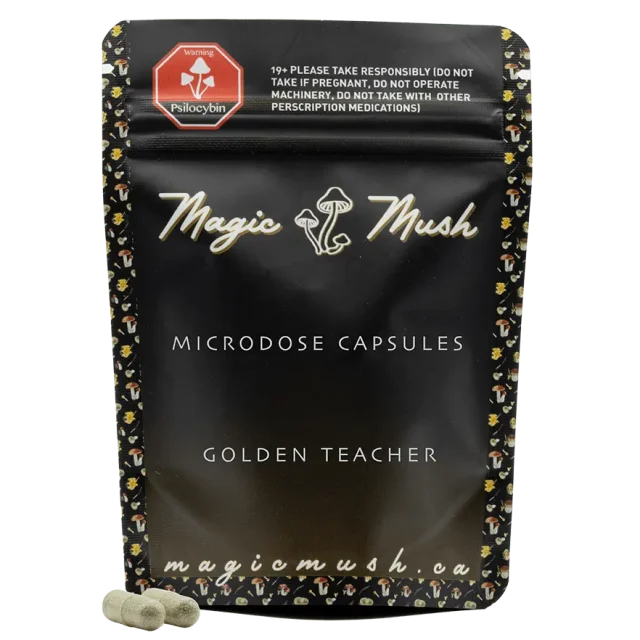
One microdose on Monday, Wednesday and Friday, nothing on the other days, taken with my morning coffee at 7 am. A microdose is 0.1 to 0.25 g of dried mushroom in our dosing guide. I chose Golden Teacher Gummies for Microdosing: each gummy equals 100 mg of mushroom, ten to a pack, with no capsule to swallow. If you prefer capsules, the Golden Teacher Microdosing Capsule holds 125 mg, 30 to a pack.
What I tracked
I kept a journal about how I speak, not how I feel: how long it took to find a word, how many times I nodded instead of answering and whether the wall came down at all. I also recorded a two-minute Spanish voice memo every Sunday morning, to play back all four at the end of the month. My weekly Zoom teacher was the least-blinded observer in the world.
How to make your test fairer
Expectation is the big problem. The Szigeti team built their whole study around self-blinding: people followed instructions to mix real doses with blanks, so they did not know which day was which. If you can, borrow that idea. If you want to compare formats, the Premium Microdosing Bundle puts Golden Teacher gummies, Albino Penis Envy capsules and an A.P.E chocolate bar in one box, all measured.
Try this
- Set a fixed schedulePick three dose days a week and keep them the same for 30 days.
- Record a Sunday memoSpeak for two minutes in your new language and save it.
- Count your nodsNote each time you nodded instead of answering in a real conversation.
- Blind it if you canAsk a friend to mix in blank days you cannot identify.
- Listen back at the endPlay all four memos in a row before you decide anything.
Who should skip it
Health Canada warns of higher risk for people with psychiatric conditions or heart disease. In a review of online trip reports, 47% of 62 reports of psychedelics with lithium involved seizures. Check with a doctor if you take any medication. The rule is the same for readers learning French in Montreal as anywhere else in Canada.
If a dose day feels off, read my notes on whether to microdose on a bad day, and when the month is over, when to stop microdosing. For the basics, start with how to microdose psilocybin.
FAQ
Can psychedelics improve language learning?
It has not been shown. A 2023 mouse study found psychedelics reopened a social learning window, and a King’s College London study is testing pitch learning after psilocybin. No trial has measured language learning.
Is it possible to learn a language subconsciously?
Krashen argued that much of it happens that way. In his 1982 book he called acquisition “a subconscious process”, like children picking up a first language while focused on communicating, not on rules.
What is the most scientifically proven way to learn a language?
No single method wins every study, but lowering anxiety clearly matters. A 2019 meta-analysis of 19,933 learners linked higher language anxiety with lower achievement. Plenty of input you understand, and low-pressure chances to speak, are a good start. For how naming shapes what we notice, see my piece on why things look different on shrooms.
Find your strain, then your dose
Every product on the shelf shows its potency rating and the effects people report. The dosing guide walks through amounts before you order, and a real person answers if you write to us.

About the author
Lily Pelenis
I'm a Toronto-based lifestyle coach, psilocybin enthusiast and certified yoga instructor. I guide people toward mindful, balanced living, and my coaching blends modern wellness practices with ancient wisdom to help clients find deeper self-awareness, resilience and joy.
I've been experimenting with shrooms for over a decade, and I write about my own experience. I love nature, psychology and humans. That is why my articles tend to follow a trip past its peak and into the weeks after it.
Some pieces start with a strain I have tried myself, such as Golden Teacher or Albino Roller Coaster. Others are the practical ones, like how much to take the first time or how to brew a tea that sits easier on the stomach. Over the years I've learned that intention is everything, so I write about why you are taking it before I get to how.
Related articles







50% off your first order
New strains, restocks, sales and new writing from the Notebook, by email. No spam, unsubscribe any time.