
Psilocybin and Childhood Trauma: What the Research Says
By Lily Pelenis / November 20, 2026 / 8 min read
Can psilocybin help with childhood trauma? Research has not shown that it can, and no psilocybin product is approved for trauma in Canada. What we have are early hints: one Canadian survey linked recent use to lower distress in people with hard childhoods, while another study found that people with more childhood adversity were more likely to have problems after psychedelic use. I want you to see both sides before you decide anything, and if you are struggling right now, you can call or text 9-8-8 at any hour.
TLDR
In a 2023 survey of 1,249 people in Canada, those who had used psilocybin in the past three months showed less distress tied to childhood adversity. The study was a one-time online survey, so it cannot show that psilocybin caused the difference.
A 2026 study of 3,168 American adults pointed the other way on risk. People with four or more adverse childhood experiences had almost three times the odds of difficulties after psychedelic use.
The only clinical trial in this area so far is small: 22 adults with post-traumatic stress disorder (PTSD), no comparison group. If trauma shapes your days, a trauma-trained therapist and your doctor come first.
Quick facts
- 1,249
- people in the Canadian survey
- 32%
- of adults in Canada report child abuse
- 2.84x
- odds of difficulties with 4+ adversities
- 9-8-8
- call or text, any hour, in Canada
Who this article is for
- You grew up with abuse, neglect or chaos at home, and you have read headlines about mushrooms and trauma.
- You already use psilocybin and wonder whether your history changes the risks.
- You are thinking about psilocybin therapy and want to know what is legal in Canada.
- You love someone with a hard past and want facts before you talk with them.
Lily Pelenis
Author’s note
This piece began as a letter to our newsletter readers in February 2025. A team from Simon Fraser University and the University of British Columbia had just surveyed people across Canada about psilocybin and childhood adversity, and the results travelled fast. Questions about trauma come up more than almost any other topic in my inbox.
I am a Toronto-based lifestyle coach and yoga instructor, and I have used psilocybin for over a decade. Intention and integration matter most to me. That is why I care so much about this topic: trauma changes what a trip can bring up, and good intentions do not make anyone safe on their own.
What did the psilocybin childhood trauma survey find?
The survey found that recent psilocybin use went along with less distress tied to a hard childhood. It did not test psilocybin as a therapy, and it cannot show cause and effect.
Who was surveyed and how
Card and colleagues published the study in the Journal of Psychoactive Drugs. The authors came from Simon Fraser University in Burnaby, the University of British Columbia, Athabasca University and the University of Michigan. According to PsyPost, 1,249 people answered online, recruited through Facebook, Instagram, Reddit and email. Their average age was 39.8.
They filled in the Adverse Childhood Experiences Questionnaire, a checklist of hard events such as abuse, neglect and violence at home. They also rated their distress over the past 30 days.
What it can and cannot tell us
People who had used psilocybin in the past three months showed a weaker link between their childhood scores and their distress. The authors reported that the effect looked strongest in people with the hardest childhoods. Interest in psilocybin was high whatever people’s scores.
The lead author, Kiffer Card, called the cross-sectional design the major caveat. People answered once, so we cannot tell what came first. People who felt steadier may have been more open to mushrooms, and the volunteers who answered an online survey about psilocybin are not a random sample of Canadians.
People answered the survey only once, so it cannot say whether the mushrooms or the calm came first.
How does childhood adversity affect the brain?
Childhood maltreatment is linked to lasting changes in how the brain develops, and I find the research helps make sense of old reactions. A review by Teicher and colleagues (2016) in Nature Reviews Neuroscience describes changes in the circuits for threat detection, emotional regulation and reward.
Some changes may be ways of adapting
The same review asks whether these changes are damage from early stress or ways the brain adapts to a dangerous home. That question matters to me. A brain that learned to watch for danger did its job, and I find it kinder to start there than with the idea of something broken.
How common is it in Canada?
It is common. In a national sample of 23,395 adults from the 2012 Canadian Community Health Survey, Afifi and colleagues (2014) found that 32% reported physical abuse, sexual abuse or exposure to violence between parents as children. Every type of abuse was linked to higher odds of every mental health condition they measured.
Can childhood trauma make a mushroom trip harder?
It can. The newest data suggest that people with more childhood adversity face a higher risk of problems after a trip, which is the other half of the story.
The 2026 study of 3,168 adults
Olofsson and colleagues (2026) surveyed 3,168 adults in the United States who had used psychedelics. Most, 87.9%, reported no difficulties. About 6.4% had problems lasting more than a day and 1.3% for more than a year. The most common were anxiety, a worse view of themselves and feeling cut off from others.
People with four or more adverse childhood experiences had 2.84 times the odds of difficulties compared with people who had none. They also had higher odds of problems that lasted more than a week. This was also a one-time survey, so it shows a link, not a cause.
| Study | Who took part | Main finding | Main limit |
|---|---|---|---|
| Card et al., 2023 | 1,249 people in Canada, online | Weaker link between adversity and distress after recent use | One-time survey, volunteers |
| Olofsson et al., 2026 | 3,168 US adults who had used psychedelics | 4+ adversities: 2.84 times the odds of difficulties | One-time survey, self-report |
| McGowan et al., 2026 | 22 adults with PTSD, one 25 mg dose | Large drop in PTSD scores at 4 and 12 weeks | No control group, small |
Lily’s take
When someone tells me they want to use mushrooms to face their childhood, I ask who will be with them the week after, not just the night of. Memories that surface need somewhere safe to land.
What do clinical trials of psilocybin for trauma show so far?
Clinical trials are only beginning, and I could not find one that tested psilocybin for childhood trauma itself. The closest is a small trial in PTSD.
The PTSD trial
McGowan and colleagues (2026) gave 22 adults with PTSD a single 25 mg dose of psilocybin with psychological support. There was no placebo group. Symptom scores fell sharply by week 4 and stayed lower at week 12. Half the group had headaches, over a third had nausea, and there were no serious side effects. With 22 people and no comparison group, this is a safety study, not proof.
What is legal in Canada
Health Canada says there are no approved therapeutic products containing psilocybin in Canada or elsewhere, and that clinical trials are the main legal route. A doctor can also ask for access through the Special Access Program, which covers serious or life-threatening conditions when usual treatments have failed or are unsuitable. Requests are judged one by one. My guide to whether psilocybin is legal in Canada covers the wider rules, and shrooms and PTSD goes deeper on that research.
Who should not take psilocybin, and which medications matter?
Some people face real danger, and this is the section I most want you to read. Talk to a doctor before any use if you have a mental health condition, take psychiatric medication or have heart disease.
Mental health history
Health Canada warns that people with existing psychiatric conditions may face a higher risk of side effects. Johns Hopkins safety guidelines exclude people with a personal or family history of psychosis.
Lithium, SSRIs and MAOIs
In reports reviewed by Nayak and colleagues (2021), 47% of 62 cases of psychedelics taken with lithium involved seizures. SSRI and SNRI antidepressants often weaken psilocybin: in a survey by Gukasyan and colleagues (2023), that dulling could last up to three months after stopping. A 2022 review found the real risk of serotonin toxicity comes mostly from combinations with MAOIs, a class of antidepressants. Never stop or change a medication without your prescriber, and read my notes on psilocybin and antidepressants.
Try this
- Book the doctor firstBring your medication list and your mental health history to that visit.
- Find trauma-trained helpLook for a therapist who knows trauma before you look for a trip.
- Ask about trialsAsk your doctor whether a clinical trial or the Special Access Program fits you.
- Plan the after-careName the person you will talk to in the days after any big experience.
- Keep 9-8-8 closeSave the number in your phone before you ever need it.
Where to get help in Canada
The Government of Canada lists these lines. In immediate danger, call 9-1-1. If you are thinking about suicide, call or text 9-8-8, 24 hours a day, 7 days a week. First Nations, Inuit and Métis people can call the Hope for Wellness Help Line at 1-855-242-3310. People aged 5 to 29 can call Kids Help Phone at 1-800-668-6868 or text CONNECT to 686868.
If old memories are flooding in after a trip, call or text 9-8-8, any hour, anywhere in Canada.
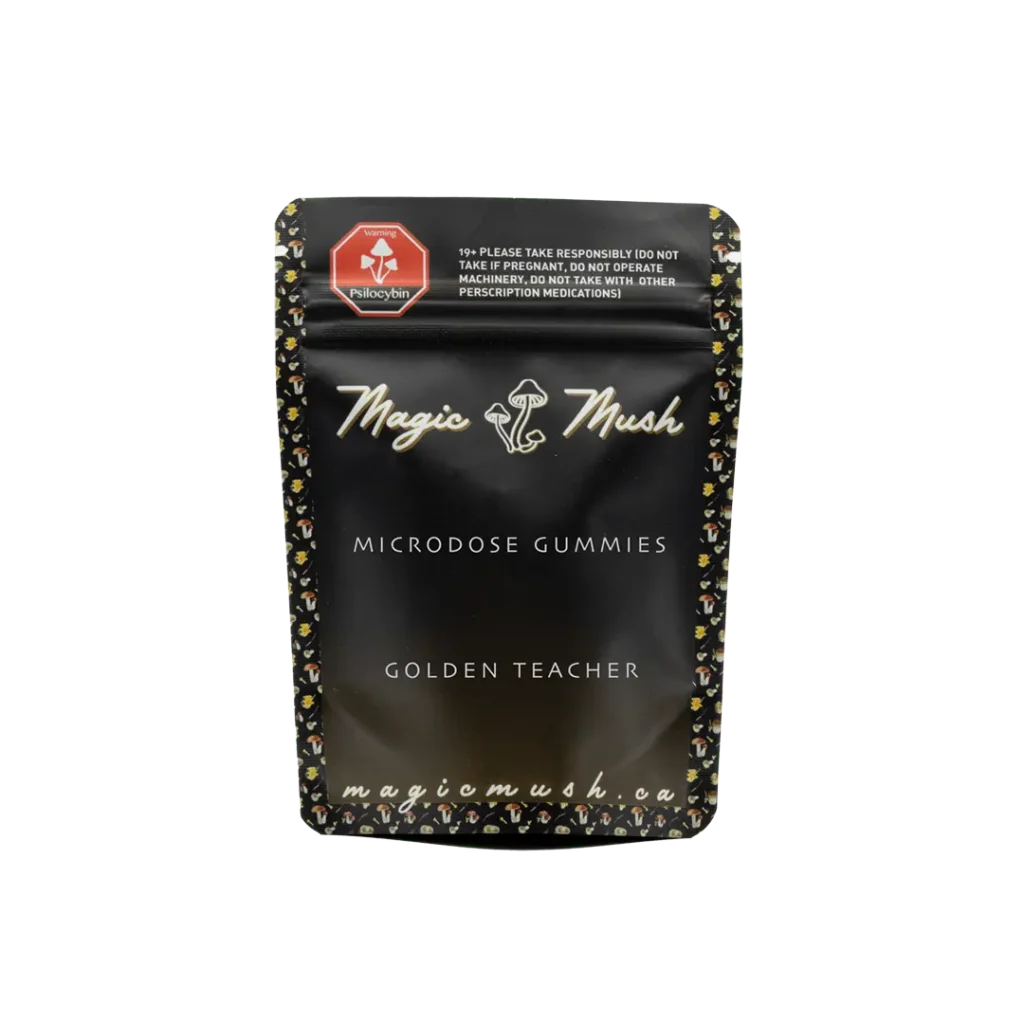
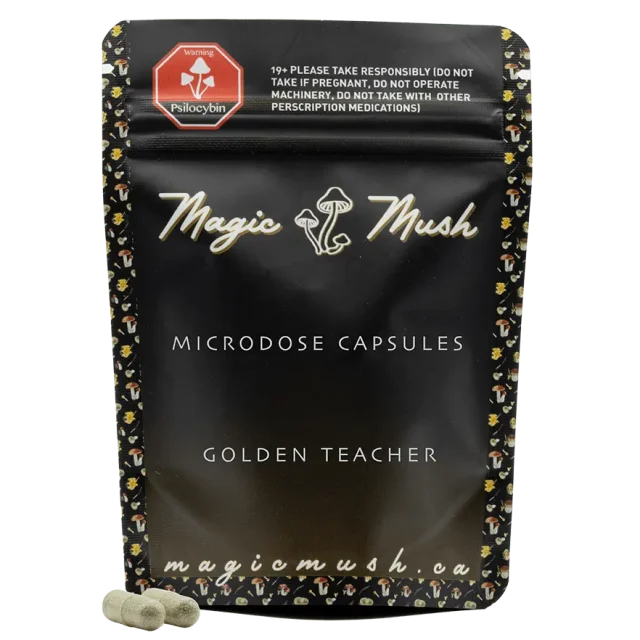
If you are an adult who has spoken with your doctor and still chooses to use mushrooms, I would go small, slow and never alone. Our dosing guide starts with a microdose of 0.1 to 0.25 g. The Golden Teacher Microdosing Capsule carries the lowest potency rating in our capsule range, at 125 mg each. The Golden Teacher Mint Chocolate splits into 16 squares of 250 mg, so the amount is set before you start. Neither is a way to work through trauma alone. If a trip leaves you heavy, read feeling down after a mushroom trip.
FAQ
Can psilocybin help with childhood trauma?
It has not been shown to, and I would not count on it. A Canadian survey of 1,249 people found a weaker link between childhood adversity and distress in recent psilocybin users, but it could not show cause. A larger US survey found that childhood adversity raised the odds of problems after psychedelic use.
Is psilocybin therapy legal in Canada?
Not as an approved treatment. Health Canada says no psilocybin product is approved. Clinical trials are the main legal route, and a doctor can apply through the Special Access Program for serious conditions.
Does microdosing help with trauma?
There is no good evidence that it does. In the largest placebo-controlled microdosing study, Szigeti and colleagues (2021) found that 191 people improved on microdoses and on placebo alike. My piece on placebo and blinding in psilocybin trials explains why that matters.
Can I take mushrooms if I am on antidepressants?
Ask your prescriber first, and I mean before the night, not after. SSRIs often weaken the effects, lithium has been linked to seizures, and MAOIs carry the highest risk of serotonin toxicity. Never stop a medication on your own to make room for a trip.
Find your strain, then your dose
Every product on the shelf shows its potency rating and the effects people report. The dosing guide walks through amounts before you order, and a real person answers if you write to us.
About the author
Lily Pelenis
I'm a Toronto-based lifestyle coach, psilocybin enthusiast and certified yoga instructor. I guide people toward mindful, balanced living, and my coaching blends modern wellness practices with ancient wisdom to help clients find deeper self-awareness, resilience and joy.
I've been experimenting with shrooms for over a decade, and I write about my own experience. I love nature, psychology and humans. That is why my articles tend to follow a trip past its peak and into the weeks after it.
Some pieces start with a strain I have tried myself, such as Golden Teacher or Albino Roller Coaster. Others are the practical ones, like how much to take the first time or how to brew a tea that sits easier on the stomach. Over the years I've learned that intention is everything, so I write about why you are taking it before I get to how.
Related articles

50% off your first order
New strains, restocks, sales and new writing from the Notebook, by email. No spam, unsubscribe any time.