When I first heard someone say that a mushroom trip helped them quit smoking cold turkey, I scoffed. I was sitting in a kitchen with a friend of a friend, both of us nursing beers, and he was telling me about this “life-changing” psilocybin session that had done more for his nicotine addiction than a year of patches, gums, and willpower. I nodded politely, but inside, I rolled my eyes. I’d grown up around addiction—alcoholism in the family, court-mandated AA meetings, relapse after relapse. The idea that a mushroom could be an ally in addiction therapy? It felt naive at best.
But I couldn’t stop thinking about it. Something in his voice had felt different—not performative, not boastful, but clear. And then I started reading. The Johns Hopkins study, where 80% of long-term smokers quit after two or three guided psilocybin sessions. The NYU research on alcohol use disorder showing that participants cut their drinking days in half after just one trip. I thought about all the people I’d watched white-knuckle their way through sobriety, and how few of them ever seemed truly at peace.
I started asking myself hard questions. What if we’ve overestimated the power of routine and willpower in recovery—and underestimated the power of insight? What if healing addiction isn’t about saying no over and over, but about saying yes to something deeper? What if addiction isn’t just a disease of behavior, but a crisis of identity, connection, and meaning?
I wasn’t looking to debunk AA. I’ve seen it save lives. But I was beginning to see its limits too—especially for those who don’t resonate with its language, who struggle in group settings, or who feel alienated by the idea of powerlessness. What if mushrooms offered a different kind of power? Not control, but clarity. Not abstinence, but reconnection.
READ: Understanding the Promise of Microdosing Psilocybin in Alcohol Addiction Therapy
How Psilocybin Rewires the Addicted Brain
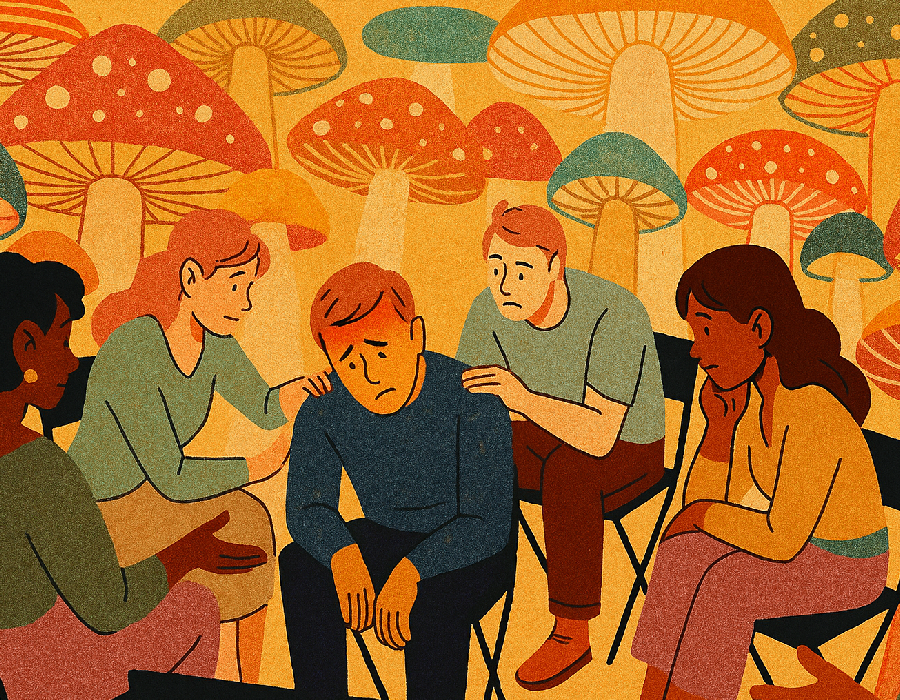
To understand why a single psilocybin session might rival months of meetings, we have to start in the brain. Psilocybin works primarily by stimulating serotonin receptors—particularly the 5-HT2A receptor, which plays a role in mood, cognition, and perception. But the most fascinating effect is its disruption of the Default Mode Network (DMN), the brain’s hub for self-referential thinking.
In people with depression, anxiety, and addiction, the DMN often becomes overactive. It loops old narratives, reinforces shame, and traps the mind in repetitive patterns. Psilocybin quiets this loop, creating space for novel connections and insights. In that silence, people often experience a profound shift in perspective—a moment of seeing their life from the outside, with compassion instead of judgment.
This neurological “reset” also correlates with increased neuroplasticity—the brain’s ability to form new connections. In the days and weeks after a journey, people report more psychological flexibility, better emotional regulation, and a renewed sense of possibility. For someone trapped in addiction, this isn’t abstract. It’s visceral. It’s the moment a person realizes, I don’t have to live this way anymore.
Of course, it’s not just about receptors and networks. The setting matters. The intention matters. These aren’t casual trips. They’re guided, supported, deeply internal journeys—often with hours of preparation and weeks of integration. But the result, when done well, can be nothing short of transformative. Not because the substance “cures” addiction—but because it reintroduces the self to itself.
READ: Shrooms and Alcohol: What Happens When You Try to Mix Them?

Mystical Experience as Motivational Engine
What sets psilocybin apart from many traditional treatments isn’t just how it works in the brain—but what it does to the soul. In nearly every major study, researchers have found that the intensity of a participant’s mystical experience—feelings of unity, transcendence, or ego dissolution—strongly predicts therapeutic outcomes. This isn’t a side effect. It’s the mechanism.
In the 2014 Johns Hopkins study on smoking cessation, participants who reported “complete mystical experiences” during their trip were the most likely to remain abstinent months later. These weren’t just euphoric highs. They were life-altering moments of clarity and connection—what one participant described as “watching decades of self-hate fall away in a single breath.”
AA, in its own way, also acknowledges the need for spiritual awakening. But where AA leads you there through daily practice and surrender over time, psilocybin can drop you into it—suddenly, radically, without warning. That’s both its power and its risk. The suddenness can catalyze transformation. It can also leave people raw, vulnerable, disoriented—especially without proper support.
But when that support is present, something remarkable can happen. People who felt stuck for years suddenly find motivation—not from guilt or pressure, but from a renewed sense of meaning. They no longer identify as broken, but as whole. Not as addicts forever, but as people capable of choosing life. That shift in identity—from pathology to possibility—is the heart of recovery. And psilocybin, for many, is what makes it feel real.
Check out this magic mushroom!!

A.P.E Psilocybin Chocolate Bar
$60.00Dried Penis Envy Magic Mushrooms
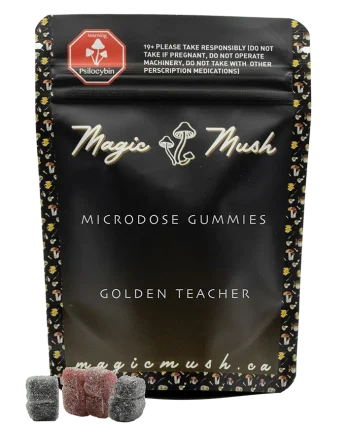
Price range: $60.00 through $240.00Golden Teacher Gummies for Microdosing
$25.00


Why Traditional Models Don’t Work for Everyone
I’ve sat in on a lot of AA meetings. Some have been beautiful—rooms full of honesty, humor, and heartbreak. Others have felt rigid, dogmatic, performative. I’ve seen people thrive in that structure, and others feel alienated by it. The language of surrender, of a higher power, of “once an addict, always an addict”—it doesn’t land for everyone.
For people who are neurodivergent, traumatized, or spiritually skeptical, group-based abstinence models can feel more like surveillance than sanctuary. And for those carrying shame, the public confessional aspect can deepen the wound rather than heal it. That doesn’t mean AA is wrong—it just means it’s not universal.
What psilocybin offers is a quieter kind of encounter. It doesn’t ask you to declare anything to a room. It asks you to listen—to your body, your mind, your history. In the silence of the trip, people often meet the parts of themselves they’ve exiled. The angry child. The abandoned teen. The overwhelmed adult. That reunion can be the moment the cycle breaks.
Of course, this isn’t for everyone either. Some people need the structure, the community, the daily practice that AA provides. But others—especially those who’ve tried everything and still feel stuck—may need something different. Something deeper. Something that bypasses the conscious mind and goes straight to the root.
Psilocybin Doesn’t Fix You—It Reminds You
The most profound thing I heard from someone in psilocybin-assisted recovery wasn’t about abstinence. It was about reconnection. “Mushrooms didn’t fix me,” they said. “They reminded me who I was before I needed to numb.” That line hit me like a truth I hadn’t dared to name. Because isn’t that what addiction often is? Not just a disease, but a form of forgetting. A slow, grinding amnesia of joy, safety, agency.
In guided sessions, psilocybin often surfaces not just memories, but felt senses—of love, of awe, of grief long buried. That emotional richness is what makes the experience stick. You don’t just intellectually understand your addiction. You feel its roots. And you feel—maybe for the first time in years—that you have a choice. Not a pressured command to abstain, but a gentle invitation to return.
I remember one participant describing the moment they walked past a liquor store after their session. “I still thought about drinking,” they said. “But it felt like… watching someone else’s thought. I didn’t have to believe it. I didn’t have to act on it.” That kind of distance—between craving and compulsion—is gold in recovery. It’s also rare in traditional approaches.
That’s not to say it’s easy. Psychedelic healing is messy. It requires preparation, guidance, and especially integration. Without that, the insights can float away like dreams. But when it’s done with care, what emerges isn’t a “cure”—it’s a new relationship to pain, to self, to the very idea of freedom. And that relationship, more than any external tool, is what sustains recovery.
READ: The Role Of Microdosing Psilocybin In Overcoming Treatment-resistant Addiction For Women
It’s Not Mushrooms vs. Meetings — It’s About Coming Home
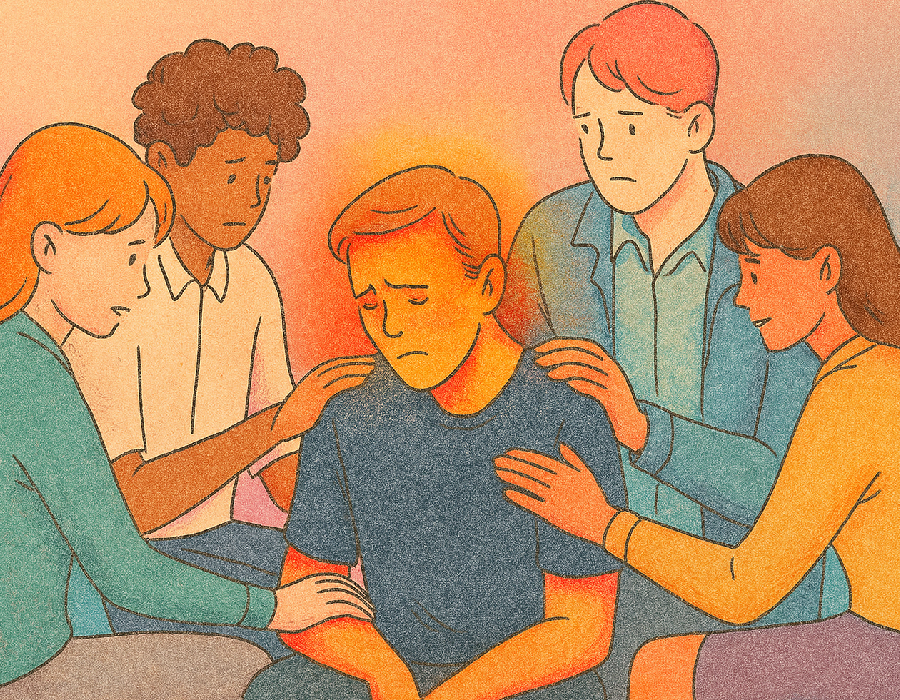
In the end, this isn’t a binary. It’s not mushrooms versus meetings. It’s about what helps people come home to themselves. What helps them feel less trapped, less alone, more alive. For some, that’s a circle of peers in a church basement. For others, it’s a silent afternoon with a guide and a few grams of sacred fungi. For many, it might be both.
At Magic Mush, we honor that complexity. We’re not here to sell silver bullets. We’re here to offer ethically sourced, high-quality psilocybin products for those exploring this path with reverence. Whether you’re curious about microdose gummies to support daily nervous system balance, chocolate mushrooms for a gentler entry point, or dried full-spectrum bundles for ceremonial journeys, we hold the integrity of this medicine close.
We believe recovery isn’t about punishing the parts of you that coped. It’s about healing the reasons you needed to. And psilocybin, when held with care, can be one of the most powerful tools for that kind of healing. It doesn’t erase the past. It illuminates it—and offers a new way forward.
👉Visit Magic Mush to learn more. If you or someone you love is cycling through relapse, exhaustion, and shame, maybe it’s time to look inward in a new way. The medicine doesn’t walk the path for you—but it might just show you where the path begins.