
When to Stop Microdosing: The Signs I Watch For
By Lily Pelenis / November 20, 2026 / 8 min read
You should stop microdosing at the end of every planned cycle, when the change you wanted holds on its own through weeks without a dose, or right away if anxiety rises, the benefit fades or a new medicine enters the picture. Most schedules build the stop in: four to six weeks on, then a few weeks off.
After “when will I feel it,” this is the question I get most, and it usually arrives with a little guilt attached, as if stopping means failing. I see it the other way around. When to stop microdosing is the part of the practice almost nobody plans, so let’s plan it.
TLDR
There are three kinds of stop. A planned stop ends each cycle so your tolerance resets and you can read your notes. A finished stop comes when your calm or focus holds through several weeks off. A stop-now comes with warning signs such as rising anxiety, a dose that keeps creeping up or a new prescription.
Stopping is simple in the body. The Alcohol and Drug Foundation says there is no evidence that regular users become dependent and that there are no psilocybin withdrawal symptoms. The work is in keeping what you learned.
Quick facts
- 4 to 6 weeks
- a common length for one cycle
- 2 to 6 weeks
- the break in the Stamets pattern
- 6+ months
- of steady use is not advised
- No withdrawal
- reported for psilocybin (ADF)
Who this article is for
- You have microdosed for a month or more and are not sure whether to keep going.
- You feel steadier than you did and wonder if you still need the capsules.
- You have noticed the dose creeping up, or the good days fading, and want to know if that is a sign.
- You are starting a new medicine, or planning a pregnancy, and need to know what to do with your routine.

Lily Pelenis
Author’s note
This piece began as a letter to our newsletter readers in September 2025. We called it “So… When Do You Stop Microdosing?”, and the replies told me how many people had never thought about an end point at all.
I have used psilocybin for over a decade, and as a lifestyle coach I care most about integration: what you do with a shift once you notice it. I do not see microdosing as a forever thing. I see it as a practice that reminds you what balance and clarity feel like, so you can learn to find them without it.
When should you stop microdosing?
Stop microdosing at the end of each cycle, when your gains hold without it, or immediately if something feels wrong. The table sorts the signals I watch for into those three kinds of stop.
| Signal | What it looks like | What I do |
|---|---|---|
| End of a cycle | You have finished four to six weeks of doses | Take a break of a few weeks and read your notes back |
| Gains hold | Mood, patience or focus stay steady through weeks off | Stay off; the practice has done its job |
| Benefits fade | Doses feel flat, or old symptoms creep back mid-cycle | Stop and reassess; do not raise the dose |
| Dose creep | You keep taking more to feel the same | Take a tolerance break |
| Rising anxiety or poor sleep | Dose days feel edgy or wired | Stop and talk to a doctor if it lasts |
| New medicine or pregnancy | Lithium, an antidepressant, or planning a baby | Stop and talk to a doctor first |
The planned stop
Every cycle should end on purpose. One popular schedule, the Stamets pattern, runs 4 to 6 weeks on and then takes a break of 2 to 6 weeks, as a guide by researcher Tunde Aideyan in Aeon explains. The same guide says microdosing for six months to a year or more without a pause is not advisable because of possible heart risk.
The rule people break most is starting again on Monday because the last cycle felt good. I take a full week off, read every journal line in one sitting, and only then decide: another cycle, or done.
Why the end of a cycle is also your best data
The week off is where you see what the doses did. If your notes from the off weeks look like your notes from the on weeks, something has carried over. If they look like week one, you have learned something just as useful. I covered that read-back in how long microdosing takes to work.
What are the signs microdosing has done its job?
Microdosing has done its job when the steadiness you wanted is still there after several weeks with no doses at all. These are the four signs we listed in that September letter, and they still hold up for me.
You feel steady after weeks off
This is the sign I trust most. A good dose day proves little, because the dose is still in play. A good Tuesday three weeks after your last capsule is about you, not the mushroom.
You forget about the capsule
You stop reaching for it to feel “okay.” The bottle sits in the cupboard, and you notice only when you are cleaning. That is not neglect. It means the routine no longer carries the weight it used to.
Calm and clarity feel like your baseline
Clarity, calm or creativity no longer feel like something you have to summon on dose days. They show up on ordinary days, in traffic, in a hard meeting, on the phone with your family. In our letter we called it carrying the shift inside you instead of inside the mushroom.
A good dose day proves little, because the dose is still in play; a good Tuesday three weeks after your last capsule is the real test.
Lily’s take
I want people to see stopping as a win, not a loss. Training wheels are meant to come off, and the point was never to need them forever.
When should you stop microdosing right away?
Stop right away if your anxiety rises, your sleep falls apart, the benefits fade or reverse, or you start a medicine that interacts with psilocybin. Those signals mean the practice has stopped serving you, at least for now.
When the benefits fade or reverse
In a small interview study of 21 microdosers by Johnstad (2018), some found that benefits faded or even reversed after a long stretch of use. The author suggested keeping microdosing to phases, which is what the most experienced people in the study did.
When side effects show up
A University of Toronto team led by Anderson et al. (2019) coded the reports of 278 microdosers. Improved mood was the most common benefit at 26.6%, but 18.0% described physical discomfort and 6.7% described more anxiety. If dose days start feeling edgy, I stop instead of pushing through.
When the dose keeps creeping up
A DoubleBlind guide to shroom tolerance gives a simple rule: if you find yourself raising the dose to get the same effect, it may be time for a break.
When a new medicine or a pregnancy enters the picture
In online reports analyzed at Johns Hopkins by Nayak et al. (2021), 47% of 62 cases of psychedelics taken with lithium involved seizures. A survey by Gukasyan et al. (2023) found SSRI antidepressants often made mushrooms feel weaker, possibly for up to three months after stopping the pill. Our Microdosing Bundle page also says microdosing is not recommended during pregnancy or while nursing.
Health Canada notes a higher risk of side effects for people with existing psychiatric conditions. If your mood drops hard, call or text 9-8-8, the suicide crisis helpline that answers in Canada 24 hours a day.
Is a tolerance break the same as stopping?
No. A tolerance break is a pause inside a practice, while stopping means the practice is finished, for now or for good. Both reset your tolerance, but they answer different questions.
How tolerance works
The Alcohol and Drug Foundation says tolerance to psilocybin builds rapidly and returns to normal after a few days without it. That is why schedules leave off days between doses: the Fadiman rhythm is one dose then two days off, and the Stamets rhythm is four or five days on, then two or three off.
Want the breaks built in? Our Focus Blend (Stamets stack) Microdosing Capsule follows that five-on, two-off rhythm, with lion’s mane and niacin in each capsule.
Why long, unbroken use is a different question
A 2023 analysis by Tagen and colleagues points out that psilocybin also acts on the 5-HT2B receptor, which is linked to heart valve disease. Nobody has tested whether years of microdosing raise that risk, which is why I treat long breaks as part of the plan, not an afterthought.
The Aeon guide warns that six months to a year of steady microdosing is not wise, because of a possible risk to the heart.
How do you stop microdosing without losing what you gained?
You keep what you gained by moving the effort from the capsule to the habits around it. The real change, as we wrote in that letter, does not happen in the capsule. It happens in the days between.
Stopping itself needs no taper. A review of psilocybin’s abuse potential by Johnson and colleagues (2018) found it has limited reinforcing effects, meaning it does not drive people to keep taking it the way addictive drugs do. What you taper is attention: slowly hand the job to the practices that were working alongside the doses.
Try this
- Keep the journal going Write your one line a night through the first month off, so you can see if the shift holds.
- Talk it through Share what changed with a therapist or a friend who really sees you.
- Move it through your body Walk, stretch or do ten minutes of yoga on the mornings you used to dose.
- Set a check-in date Mark a day six weeks out to read your notes and decide if you need another cycle.
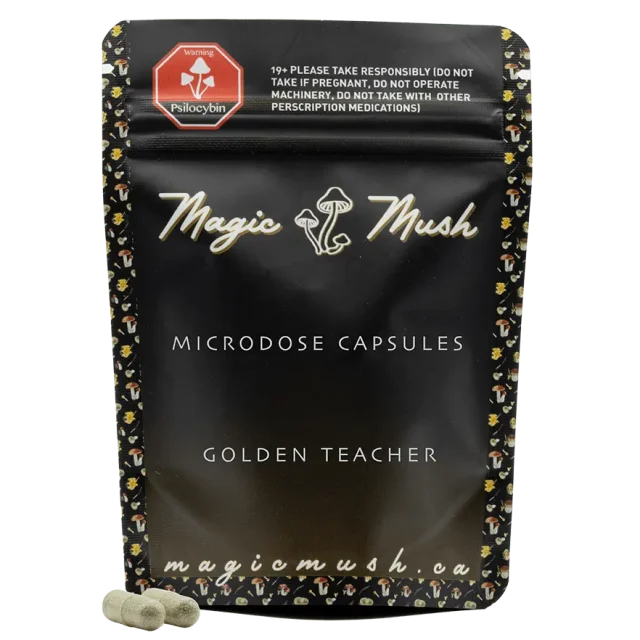
For the body side of that work, our guide to a somatic approach to processing emotions on microdoses pairs well with your first month off. If you come back for another cycle later, start again at the bottom of the range in our dosing guide. Our Golden Teacher Gummies for Microdosing hold 100 mg each, an easy amount to restart with. And if you are tempted to return after one rough morning, read my piece on whether to microdose on a bad day first.
FAQ
Can you have withdrawals from mushrooms?
Psilocybin is not known to cause withdrawal. The Alcohol and Drug Foundation states that there are no psilocybin withdrawal symptoms and no evidence that regular users become dependent. Some people miss the routine, or find old moods returning, which is a reason to keep your other practices going.
How long does it take to get microdosing out of your system?
Psilocybin leaves the body quickly. In a lab study of full doses by Holze et al. (2023), blood levels of psilocin, the active form, peaked at about 2 hours and had a half-life of about 1.4 to 1.8 hours. At that rate, most of a dose is gone within the same day.
Can you microdose long term?
Long-term microdosing has not been studied well. The Aeon guide advises against steady microdosing for six months to a year or more because of possible heart risk, and most people work in cycles of four to six weeks with breaks between them. Our beginner’s guide to microdosing psilocybin covers the common schedules.
How long does it take for your brain to recover from mushrooms?
Your tolerance to psilocybin returns to normal after a few days without it, according to Australia’s ADF drug facts page. That is why even a short break resets how a dose feels. If you feel low for longer after stopping, talk to a doctor, and readers from Vancouver to Halifax can call or text 9-8-8 any time.
Find your strain, then your dose
Every product on the shelf shows its potency rating and the effects people report. The dosing guide walks through amounts before you order, and a real person answers if you write to us.

About the author
Lily Pelenis
I'm a Toronto-based lifestyle coach, psilocybin enthusiast and certified yoga instructor. I guide people toward mindful, balanced living, and my coaching blends modern wellness practices with ancient wisdom to help clients find deeper self-awareness, resilience and joy.
I've been experimenting with shrooms for over a decade, and I write about my own experience. I love nature, psychology and humans. That is why my articles tend to follow a trip past its peak and into the weeks after it.
Some pieces start with a strain I have tried myself, such as Golden Teacher or Albino Roller Coaster. Others are the practical ones, like how much to take the first time or how to brew a tea that sits easier on the stomach. Over the years I've learned that intention is everything, so I write about why you are taking it before I get to how.
Related articles







50% off your first order
New strains, restocks, sales and new writing from the Notebook, by email. No spam, unsubscribe any time.