
How Long Does Microdosing Take to Work? My Week-by-Week View
By Lily Pelenis / November 20, 2026 / 9 min read
A single microdose starts working within about an hour and fades the same day, but the changes people want from microdosing, in mood, stress and focus, take four to six weeks to judge. So if you are asking how long microdosing takes to work, the answer has two parts: hours for the dose, weeks for the result.
I learned that the slow way. My first microdose journal entry reads, word for word: “nothing. warm hands at 11am? maybe. probably coffee.” Here is everything I wish I had known before I wrote it.
TLDR
A microdose of psilocybin mushrooms starts to act 15 to 90 minutes after you swallow it and wears off within hours. The first few doses often feel like nothing, and that is what a dose below the level you can notice is meant to do.
The changes I care about show up across weeks, if they show up at all. In a six-week study of 98 microdosers, gains on dose days mostly faded the next day, while the people who finished scored lower on depression and stress at the end. Placebo-controlled trials found that placebo groups often improved almost as much, so expectation explains at least part of it.
My advice: give one schedule about a month, keep a one-line journal, then take a week off and read it back before you decide.
Quick facts
- 15 to 90 min
- until a swallowed dose kicks in
- 4 to 6 weeks
- before you judge the result
- 98 people
- tracked daily in a 2019 study
- 1 on, 2 off
- the classic Fadiman rhythm
Who this article is for
- You took your first two or three microdoses, felt nothing and want to know if that is normal.
- You are planning your first schedule and want to know how many weeks to give it.
- You are tempted to raise the dose because the small one seems to do nothing.
- You have read big claims online and want to see what the controlled studies actually measured.

Lily Pelenis
Author’s note
This piece began as a letter to our newsletter readers in September 2024, and I came back to it in two more letters in the summer of 2026. Of all the microdosing questions that land in my inbox, from readers in Edmonton to small towns I have never visited, “When will I feel it?” is the one that never goes away.
I have used psilocybin for over a decade, and as a Toronto lifestyle coach and yoga teacher I treat it like any new practice: why you started, and what you do with what you notice. Here is the timeline as I lived it, with the research and its limits beside it.
How long does microdosing take to work?
Microdosing takes about an hour to act on the day you dose and about four to six weeks to show any change in your ordinary days. I call these the two clocks, and almost every “it’s not working” message I get comes from someone reading the slow clock on the fast clock’s timetable.
The dose-day clock: hours
Swallowed psilocybin mushrooms usually take effect within 15 to 90 minutes, peak after about 1 to 3 hours and can last 4 to 9 hours at normal doses, according to the Alcohol and Drug Foundation. Health Canada gives a quicker start of 15 to 45 minutes. Our dosing guide puts a microdose at 0.1 to 0.25 g of dried mushroom, a level most people barely feel.
In a daily-diary study, Polito and Stevenson (2019) at Macquarie University found that ratings of mood, focus and other measures rose on dose days. Those gains mostly did not carry into the following days, apart from a small lift in focus and productivity two days later.
The weeks clock: four to six weeks
The same study followed people for six weeks. By the end, the 63 who finished scored lower on depression, stress and mind wandering. Creativity and life satisfaction, which people expected to rise, did not change.
A Canadian team at the University of British Columbia, Rootman et al. (2022), compared 953 psilocybin microdosers with 180 people who did not microdose over about 30 days. The microdosers showed small to medium improvements in mood and mental health. A guide by researcher Tunde Aideyan in Aeon puts it plainly: at least a month may be needed to see any benefit.
In a six-week study of 98 microdosers, mood gains on dose days mostly faded by the next day, while end-of-study depression and stress scores were lower.
Why do the first microdoses feel like nothing?
The first microdoses feel like nothing because a microdose is built to sit below the level where you notice a change in perception. You are not supposed to feel it the way you feel a coffee. On dose one, you also do not know what to look for.
What I did wrong in week one
I raised the dose on day three. I went from 0.1 g to 0.15 g because the first two “didn’t work,” and that one change cost me the rest of the month. I could no longer tell whether a good day came from the new amount, the schedule or the weather.
Why a bigger dose muddies the read
In Cavanna et al. (2022), 34 people took 0.5 g of dried mushroom, about twice the top of our microdose range. Many could tell they had the real dose, and the stronger effects showed up mainly in those who guessed right. Once you can feel it, your expectations start doing some of the work.
Lily’s take
Keep the dose flat for the first two weeks, no matter what. If you change the dose and the schedule at the same time, you will never learn which one did anything.
What does a microdosing timeline look like, week by week?
A realistic microdosing timeline is quiet in week one, shows small signals in weeks two and three, and gets judged at the end of weeks four to six. The table follows a one-on, two-off schedule and lists what research measured at a similar point. It shows what to watch for, not a promise.
| Stage | Doses so far | What I watch for | What research measured around this point |
|---|---|---|---|
| Week 1 | 2 to 3 | Little or nothing; set a baseline | Dose-day gains mostly faded next day (Polito and Stevenson, 2019) |
| Weeks 2 to 3 | 5 to 7 | Small, specific signals | Up to 7 doses in 3 weeks: no difference from placebo (Marschall et al., 2022) |
| Week 4 | 9 to 10 | Compare off days with week 1 | Microdose and placebo groups both improved (Szigeti et al., 2021) |
| About 30 days | About 10 | Read your notes back in one sitting | Small to medium mood gains (Rootman et al., 2022) |
| Week 6 | About 14 | Stop, pause or plan another cycle | Lower depression and stress scores (Polito and Stevenson, 2019) |
Week one: build the receiver
In week one, the useful work happens in your notebook. Write one line each evening on sleep, mood, focus and stress, on dose days and off days. Without that baseline, you have nothing to hold week four against.
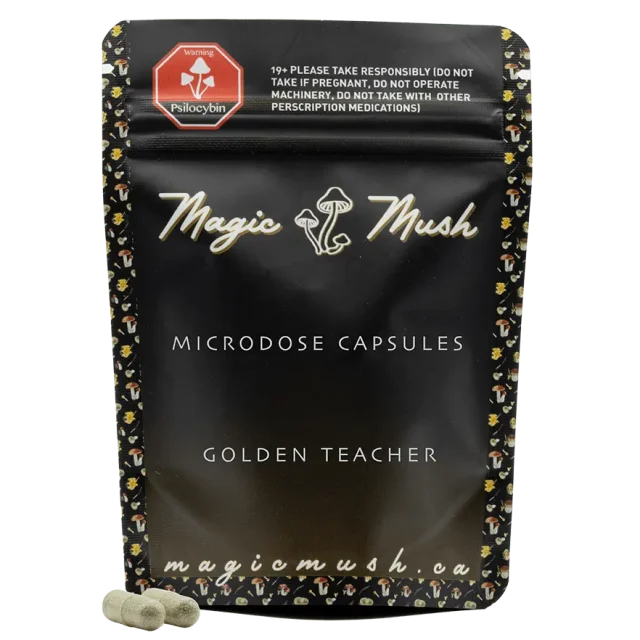
Start low and stay there. Our Golden Teacher Microdosing Capsule holds 125 mg of ground mushroom, and its page suggests one capsule on a quiet day before you ever try two.
Weeks two and three: the first signal
For me it landed in the second week: a small lift late in the morning, like the first coffee I ever drank, only calmer. A message to my sister that I had put off for weeks suddenly felt easy, so I wrote it and closed the laptop. Your marker will be different.
In week three, my off days changed. At the end of the week I noticed my screen time had dropped by about 40 minutes a day, and I had not tried to make that happen. Write these moments down the same day.
Weeks four to six: read it back
This is when you judge, and the best way is to read every note in one sitting. My favourite entry from that month says I didn’t snap at my dad on the phone and only noticed afterward. A few weeks later my mother told me I sounded different. That was my whole review.
Try this
- One line a night Write sleep, mood, focus and stress on every day, not only dose days.
- Same dose, two weeks Keep the amount flat until day 14, whatever happens.
- Mark the off days Your clearest data often comes from the days you did not dose.
- One Sunday read-back After the last dose, read the whole month at once, phone in another room.
How do tolerance and off days change the timeline?
Off days protect the timeline, because daily use builds tolerance fast and blunts each dose. The Alcohol and Drug Foundation notes that tolerance to psilocybin develops rapidly, that using several days in a row makes it far less effective, and that tolerance returns to normal after a few days off.
What the microdose data says about tolerance
Tolerance at microdose levels is less clear than at full doses. A 2022 analysis of a self-blinding microdose trial found that people got worse at telling a microdose from placebo as doses went on, which is a sign of tolerance. That pattern held for LSD but not for psilocybin, and the paper is a preprint, meaning it had not been peer reviewed when it was posted.
Common schedules and their off days
The Fadiman schedule is one dose, then two days off. The Stamets stack runs 4 to 5 days on and 2 to 3 off for 4 to 6 weeks, then a 2 to 6 week break, as the Aeon guide describes. If you like the five-on, two-off rhythm, our Focus Blend (Stamets stack) Microdosing Capsule combines psilocybin mushrooms with lion’s mane and niacin in one capsule.
Daily use builds tolerance to psilocybin within days, which is why almost every microdosing schedule leaves days off between doses.
What did placebo-controlled microdosing studies find?
Placebo-controlled studies found that people often feel better over a few weeks, and that people taking a placebo often feel better too. That matters for timing, because part of what changes in week three may be the belief that something is changing.
In Szigeti et al. (2021), 191 people set up their own placebo capsules at home using sealed envelopes. Both groups improved over the four-week dosing period, and the gap between them was not significant. In Marschall et al. (2022), up to seven psilocybin doses over three weeks did no better than placebo on anxiety, depression or emotion processing.
A 2024 review of 19 placebo-controlled studies by Polito and Liknaitzky argues it is still too early to call microdosing a placebo, since many trials were small, short or used very low doses. If a full cycle brings nothing, read our guide on what to do when microdosing doesn’t work like you hoped.
How long should a microdosing protocol last?
A common microdosing protocol runs four to six weeks, followed by a break of a few weeks before you decide on another cycle. That matches the length of most studies.
Why I never run it for months on end
The Aeon guide advises against steady microdosing for six months to a year or more because of heart risk. A 2023 analysis by Tagen and colleagues explains why: psilocybin also acts on the 5-HT2B receptor, which is linked to heart valve disease, and long-term microdosing has not been studied for it. When a cycle ends, I wrote a separate guide on when to stop microdosing, and one on whether to microdose on a bad day.
Who should talk to a doctor first or skip it
Some medicines change how psilocybin acts. In online reports analyzed by Nayak et al. (2021) at Johns Hopkins, 47% of 62 cases of psychedelics taken with lithium involved seizures. A survey by Gukasyan et al. (2023) found that about half of reports of mushrooms taken with SSRI antidepressants described weaker effects than expected.
Research safety guidelines from Johns Hopkins researchers exclude people with a personal or family history of psychosis, and Health Canada warns that a faster heart rate and higher blood pressure could harm people with heart disease. If any of that is you, talk to a doctor before you start.
Lily’s take
A month of patience beats a week of doubling up. My most useful microdosing tool is a cheap notebook, not a bigger capsule.
FAQ
Does microdosing really work?
The evidence is mixed. Observational studies such as Polito and Stevenson (2019) and Rootman et al. (2022) found better mood and lower stress over four to six weeks. Placebo-controlled trials such as Szigeti et al. (2021) found that placebo groups improved about as much. Most trials were small and short.
Is it safe to microdose every day?
Daily microdosing is not what common schedules suggest. Tolerance to psilocybin builds within days, so daily doses lose their effect, as the Alcohol and Drug Foundation explains.
How long do mushrooms take to start working?
Swallowed mushrooms usually take effect within 15 to 90 minutes and peak after about 1 to 3 hours. With a microdose, many people notice nothing distinct. The beginner’s guide to microdosing psilocybin covers timing and amounts.
What are the positive effects of microdosing mushrooms?
People who microdose report better mood, less stress and better focus. In Polito and Stevenson (2019), depression, stress and mind wandering scores fell over six weeks, while creativity and life satisfaction did not change. These are self-reports without a placebo group. You can compare measured formats on our microdose shelf.
Find your strain, then your dose
Every product on the shelf shows its potency rating and the effects people report. The dosing guide walks through amounts before you order, and a real person answers if you write to us.

About the author
Lily Pelenis
I'm a Toronto-based lifestyle coach, psilocybin enthusiast and certified yoga instructor. I guide people toward mindful, balanced living, and my coaching blends modern wellness practices with ancient wisdom to help clients find deeper self-awareness, resilience and joy.
I've been experimenting with shrooms for over a decade, and I write about my own experience. I love nature, psychology and humans. That is why my articles tend to follow a trip past its peak and into the weeks after it.
Some pieces start with a strain I have tried myself, such as Golden Teacher or Albino Roller Coaster. Others are the practical ones, like how much to take the first time or how to brew a tea that sits easier on the stomach. Over the years I've learned that intention is everything, so I write about why you are taking it before I get to how.
Related articles







50% off your first order
New strains, restocks, sales and new writing from the Notebook, by email. No spam, unsubscribe any time.