How to Dry Magic Mushrooms: Methods, Temperatures and Storage
By Lily Pelenis / July 18, 2023 / 14 min read
The best way to dry magic mushrooms is a food dehydrator set to a low heat, around 45 to 70 °C, until the mushrooms are “cracker dry”: the stems snap cleanly instead of bending. If you have no dehydrator, dry them on a rack in front of a fan and finish them in a sealed container with a desiccant such as silica gel.
Gentle heat is not the enemy most people think it is. Lab work on Psilocybe cubensis found psilocybin stays stable up to about 100 °C and that drying itself caused no significant change in alkaloid content (Gotvaldová et al., summarized in a 2025 review in Pharmaceuticals). What costs you potency is slow drying, bruising, freezing fresh mushrooms and poor storage. This guide compares every common method, gives a step by step for the best one, and covers storage and shelf life with the research behind each claim.
TLDR
Dry fresh magic mushrooms the day they are harvested. A dehydrator at about 45 to 70 °C is the most reliable method and usually takes 4 to 12 hours depending on size; fan drying plus a silica gel finish is the best no-equipment option. Avoid the oven, the freezer and vermiculite. Mushrooms are done when the stems snap and the caps feel crisp, and fresh mushrooms are more than 90 percent water, so expect to end up with about a tenth of the starting weight (DoubleBlind).
Store them whole in an airtight jar with a desiccant pack, in the dark, at room temperature. In the main stability study on P. cubensis, dried mushrooms kept in the dark at room temperature lost the least psilocybin of every condition tested, while fresh mushrooms stored in a freezer lost the most (Gotvaldová et al., 2021). Potency still drops over time, fastest in the first months, so plan to use them within about a year.
Who this article is for
- Anyone with fresh mushrooms who needs to dry them before they spoil
- People choosing between a dehydrator, a fan, a desiccant or the oven
- Anyone worried that heat or drying will destroy the psilocybin
- People who want their dried mushrooms to keep their strength as long as possible
- Anyone unsure whether old or discoloured dried mushrooms are still safe to use

Lily Pelenis
Author’s note
Drying is the least exciting part of working with mushrooms, and it is where most of the avoidable mistakes happen. Most drying guides online repeat the same tips without a single source, and some contradict each other on temperature by 40 degrees. I wanted one page that says what actually protects potency and what is folklore, with the research linked so you can check it yourself.
It matters for safety as much as for strength. Every dose range on our dosing guide is weighed in grams of dried mushroom. Mushrooms that are half dry weigh more and hold less, mushrooms that went mouldy should not be eaten at all, and you can only dose carefully when what is in the jar is what you think it is.
Why do you need to dry magic mushrooms?
You dry magic mushrooms because fresh ones spoil within days, and drying is what turns a perishable harvest into something you can store and dose accurately. Fresh mushrooms are more than 90 percent water, and moisture left in them leads to decomposition and mould (DoubleBlind). Leafly’s guide gives wet mushrooms a few days to about a week in the fridge before they should be eaten or dried (Leafly).
Drying protects the psilocybin
Moisture also lets the mushroom’s own enzymes keep working. When the tissue is damaged, an enzyme called PsiP strips the phosphate group off psilocybin to make psilocin, and a second enzyme, PsiL, oxidizes the psilocin into the blue compounds you see on bruised mushrooms (Lenz et al., 2020). The authors note that psilocybin’s phosphate group acts as a protective cap. A review of the stability research adds that mushrooms left undried, or rehydrated, can lose psilocybin and psilocin to this same oxidation (review, 2025). Getting the water out quickly stops that process.
Drying makes dosing possible
Dose ranges are written for dried weight, and because fresh mushrooms are mostly water, a gram of fresh mushroom holds far less than a gram of dried. Strength also varies a lot from batch to batch. Health Canada notes that the strength of magic mushrooms can vary greatly (Health Canada), and a 2026 study of 14 P. cubensis strains grown under identical lab conditions found total tryptamines varied more than 7.8 fold between strains (Journal of Fungi, 2026). Fully dried mushrooms at least take water out of that equation.
What is the best way to dry magic mushrooms?
The best way to dry magic mushrooms is a food dehydrator, because it gives steady low heat and constant airflow, which dries them fast and evenly. Fan drying with a desiccant finish is the best method without special equipment. Here is how the common methods compare.
| Method | Typical time | Temperature | Equipment | Risk to potency |
|---|---|---|---|---|
| Food dehydrator (best) | 4 to 12 hours | About 45 to 70 °C | Dehydrator | Low: steady heat well under 100 °C, fast and even |
| Fan, then desiccant (best without equipment) | 1 to 2 days on the fan, then 1 to 3 days with desiccant | Room temperature | Fan, wire rack, airtight container, silica gel | Low if the air is dry; slower drying gives enzymes more time |
| Air drying | About 1 to 3 days | Room temperature (16 to 21 °C) | Wire rack or cloth | Moderate: slow, and humid air can leave them damp or mouldy |
| Freeze dryer | One machine cycle | Below freezing under vacuum | Home freeze dryer | Low once in the machine; storing fresh mushrooms in a freezer first is very damaging |
| Oven | A few hours, watched closely | Lowest setting, door ajar | Oven, tray, parchment, oven thermometer | High: still air bakes rather than dries, and it is easy to overshoot 100 °C without a thermometer |
| Vermiculite | Days | Room temperature | Vermiculite, container | Not recommended: older vermiculite can contain asbestos |
Sources for the table: dehydrator settings from DoubleBlind (43 to 49 °C for tray units, 70 °C for vertical units); air drying time and room conditions from Leafly; heat stability from the 2025 review; freezer losses from Windsor et al. and Gotvaldová et al.; vermiculite from the US EPA. Dehydrator and desiccant times are typical ranges; thick stems and humid rooms take longer.
Food dehydrator
A dehydrator moves warm air over every surface at once, which is exactly what drying needs. DoubleBlind’s guide sets tray style units to 110 to 120 °F (about 43 to 49 °C) and vertical units to 158 °F (70 °C), checks every two hours and stops as soon as the mushrooms are cracker dry (DoubleBlind). All of those settings sit well below the roughly 100 °C point where psilocybin starts to break down. A lower setting is gentler; a higher one is faster. The full method is in the numbered steps below.
Fan drying with a desiccant finish
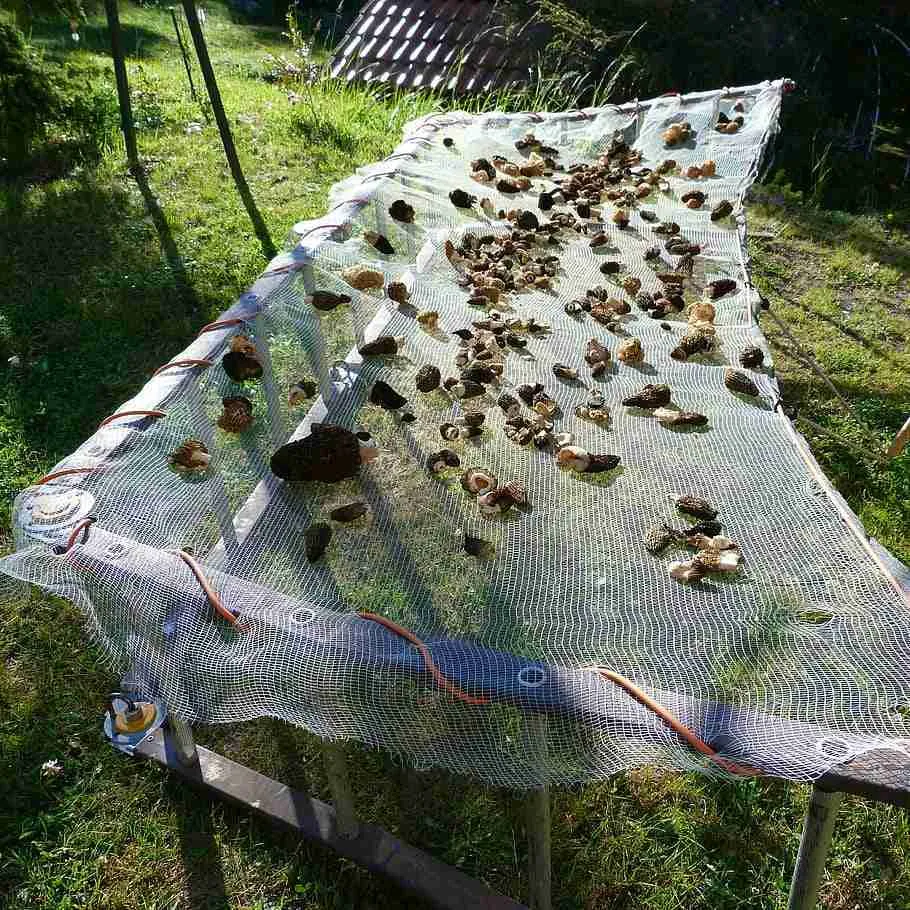
Without a dehydrator, airflow does the work. Lay the mushrooms on a wire rack or mesh screen so air reaches the underside, leave space between them, and point a fan across them on low. A rack beats paper or a plate, because a solid surface traps moisture underneath (Leafly suggests flipping them every few hours if you have no rack). After a day or two they will feel leathery and shrunken but usually still bend. That is the point to move them into a desiccant container to finish.
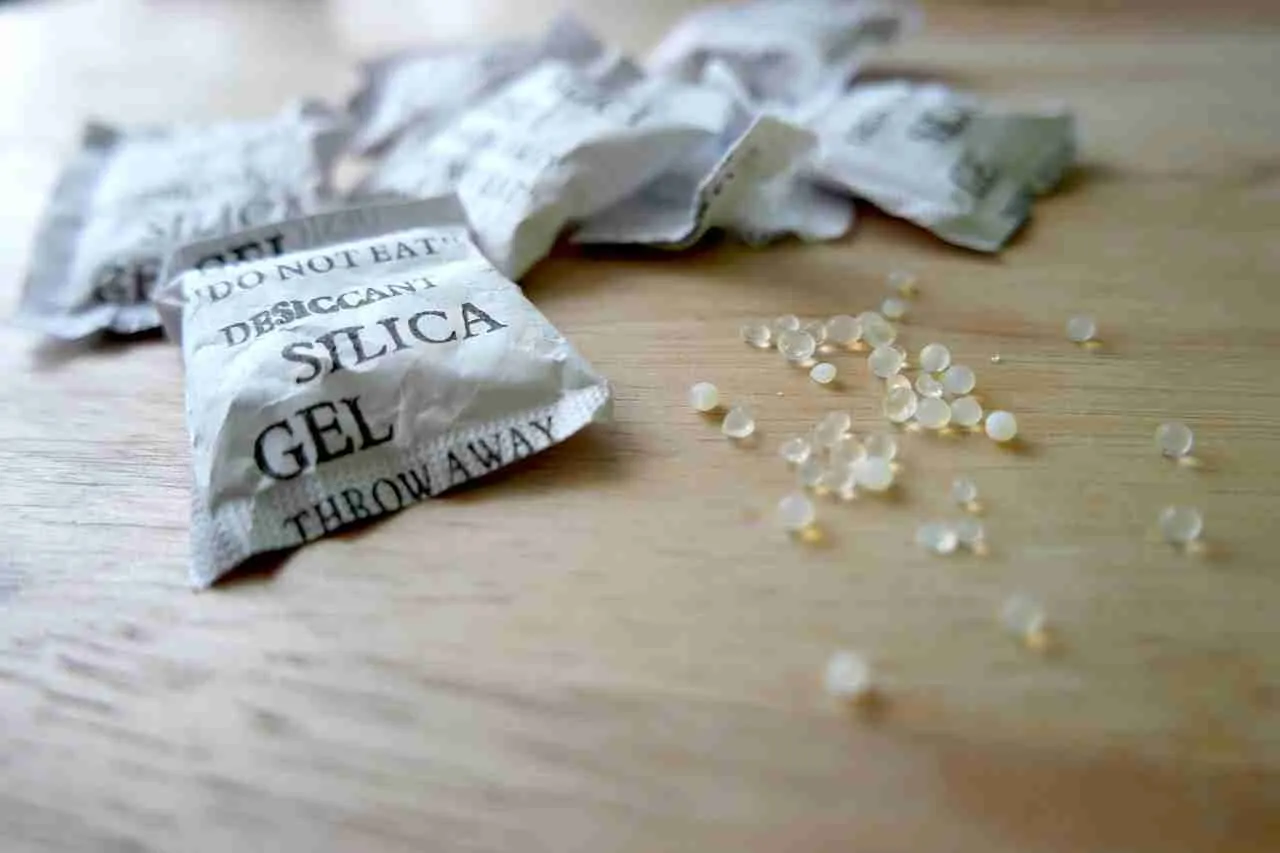
For the desiccant step, cover the bottom of an airtight container with silica gel (food safe packets or loose beads), add a layer of paper towel or a small rack so the mushrooms never touch the desiccant, place the pre dried mushrooms on top in one layer and close the lid. The desiccant pulls the last moisture out over one to three days. Check them daily and take them out once the stems snap. Fan drying alone rarely gets mushrooms fully cracker dry in a normal home, which is why this second stage matters.
Air drying
Plain air drying works only where the air is dry. Leafly’s guide puts it at about one to three days in a room of 60 to 70 °F (about 16 to 21 °C), out of direct sunlight, on a wire rack (Leafly). A cheap hygrometer tells you what you are working with. If the room is humid, the mushrooms can sit damp long enough to bruise, darken or grow mould, so use a fan, a dehydrator or a desiccant instead.
Freeze dryer
A home freeze dryer removes water under vacuum at low temperature, and it is what researchers at Nammex used to prepare Psilocybe reference samples (Windsor et al., Journal of AOAC International). The catch is what happens before the machine. In the same work, fresh mushrooms held in a −20 °C freezer for 24 hours before freeze drying lost most of their psilocybin: P. zapotecorum fell from 1.29 to 0.08 percent and P. cyanescens from 1.16 to 0.27 percent, and the authors concluded that freezer storage of fresh mushrooms should be avoided. Freeze drying straight from harvest is excellent; parking fresh mushrooms in the freezer first is not. Our article on regular vs freeze dried magic mushrooms compares the two in more detail.
Oven drying, and why we do not recommend it
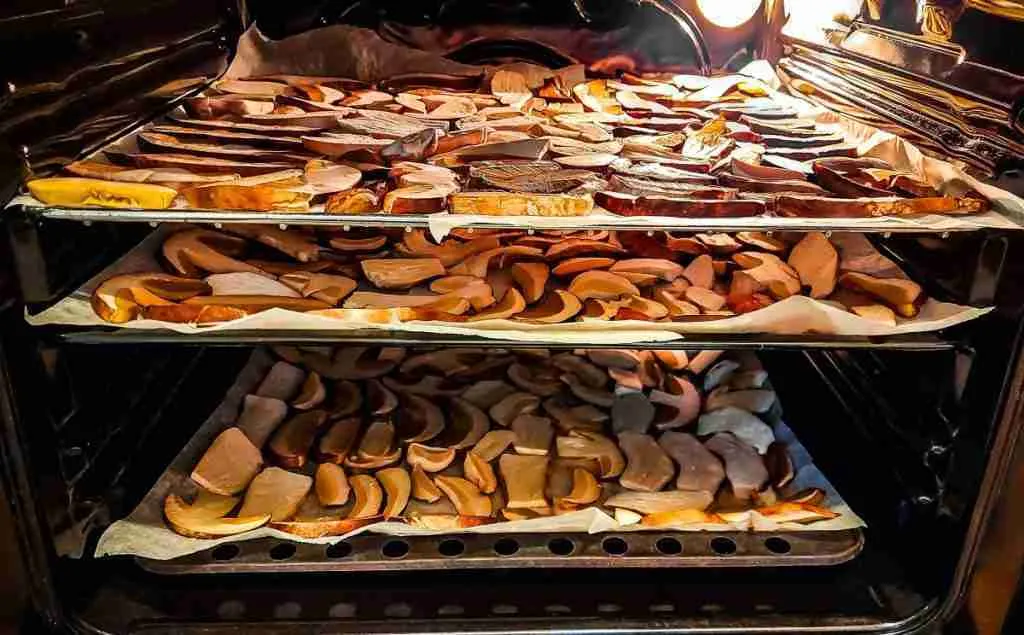
The oven is the method most likely to cost you potency. An oven heats still air, so mushrooms tend to bake rather than dry (DoubleBlind), and Leafly also advises against ovens because they can dry mushrooms too quickly or burn them (Leafly). Psilocybin holds up to about 100 °C and then drops sharply, with psilocin rising as heat strips the phosphate off (review, 2025). If an oven is truly your only option, use its lowest setting with the door propped open, put an oven thermometer on the tray so you know the real temperature where the mushrooms sit, keep it well under 100 °C and check every 20 to 30 minutes.
Methods to skip: vermiculite and direct sun
Vermiculite absorbs moisture, but it is a poor choice next to something you plan to eat. A mine near Libby, Montana, supplied over 70 percent of the vermiculite sold in the United States from 1919 to 1990, and that vermiculite was contaminated with asbestos (US EPA). Silica gel does the same job without that question. Direct sun is also hard to control; DoubleBlind notes that drying on a screen in the sun can even leave grid marks on the caps (DoubleBlind).
How do you dry magic mushrooms in a dehydrator, step by step?
To dry magic mushrooms in a dehydrator, lay them whole on the trays without touching, run it at about 45 to 70 °C, and check every couple of hours until the stems snap cleanly. Here is the full method.
- Start the same day. Dry mushrooms within hours of harvest. Do not put fresh mushrooms in the freezer to deal with later; that is the single most damaging thing you can do to psilocybin before drying (Windsor et al.).
- Clean your hands and trays. Wash your hands and wipe the trays and work surface. You do not need bleach; you need clean, dry surfaces.
- Trim, do not chop. Cut off any substrate or growing medium at the base of the stems (DoubleBlind). Handle them gently, since bruising starts the blue oxidation reaction.
- Keep them whole where you can. In the Gotvaldová study, cutting moist mushrooms into pieces promoted oxidation and loss (review, 2025). Only split very thick stems lengthwise, and only if they will not dry otherwise.
- Load the trays in one layer. Leave a gap around each mushroom. Put the largest ones where the airflow is strongest: the top tray in a stacking unit, nearest the fan in a box unit (DoubleBlind).
- Set the temperature. About 45 to 50 °C in a stacking tray unit, up to 70 °C in a box unit with a rear fan. Stay well under 100 °C.
- Check every two hours. Pull out small mushrooms as soon as they are done rather than waiting for the whole batch. Most batches take 4 to 12 hours, depending on size and how full the machine is.
- Do the snap test. A finished stem snaps with a clean crack, and the caps feel crisp and light. If anything bends, it goes back in.
- Cool, then seal. Let them cool to room temperature for a few minutes, then put them straight into an airtight jar with a desiccant pack. Dried mushrooms pull moisture back out of the air if they sit out.
- Label and store. Write the strain and date on the jar and keep it in a dark, room temperature cupboard out of reach of children and pets.
Does heat destroy psilocybin?
Normal drying heat does not destroy psilocybin; temperatures above about 100 °C do. In the Gotvaldová experiments on P. cubensis, the phosphorylated tryptamines (psilocybin and its relatives) stayed stable up to roughly 100 °C and declined sharply beyond that, while psilocin rose as heat stripped psilocybin’s phosphate group (review, 2025). The same work found no significant change in alkaloid content after drying.
Why the advice on temperature is so confused
Popular guides recommend anything from 35 °C to 75 °C, often with no source. The research points to the real risks being elsewhere: slow drying in damp air, bruising and cutting wet tissue, freezing fresh mushrooms, and the oven’s uncontrolled heat. Within a dehydrator’s normal range, choose the setting that dries your batch evenly in hours rather than days.
Is blue bruising lost potency?
Some of it, yes. The blue colour is made from psilocin that has been oxidized after the enzyme PsiP removed psilocybin’s phosphate (Lenz et al., 2020), and the review notes this degradation means a loss of biological activity (review, 2025). A little blue on the stems is normal and does not mean the mushrooms are bad. Heavy bluing is a sign of rough handling or slow drying, and colour alone is not a reliable gauge of strength: in the Nammex work, a species that turned intensely blue after freezing had low psilocin (Windsor et al.).
How do you know when magic mushrooms are fully dry?
Magic mushrooms are fully dry when they are “cracker dry”: the stem snaps cleanly with an audible crack instead of bending. Leafly uses the same test: if you can easily snap the stem they are done, and if it bends they need more time (Leafly). DoubleBlind’s warning is blunt: if they are still slightly wet when stored, they will mould (DoubleBlind).
- Stems: snap cleanly, with no rubbery give in the middle
- Caps: crisp at the edges and light in the hand, not leathery
- Weight: roughly a tenth of the fresh weight, since fresh mushrooms are over 90 percent water
- Thickest pieces: test the fattest stem in the batch, not the thinnest, because it is the last to finish
Mushrooms that feel dry on the outside but bend are “leather dry”. They will reabsorb moisture and can spoil in a sealed jar, so finish them in the dehydrator or a desiccant container first.
How should you store dried magic mushrooms?
Store dried magic mushrooms whole, in an airtight container with a desiccant pack, in a dark place at room temperature. That matches the evidence: in the Gotvaldová study, dried biomass kept in the dark at room temperature showed the lowest decay of every storage condition tested (Gotvaldová et al., 2021), and the review of that work adds that dark storage was less harmful than light (review, 2025).
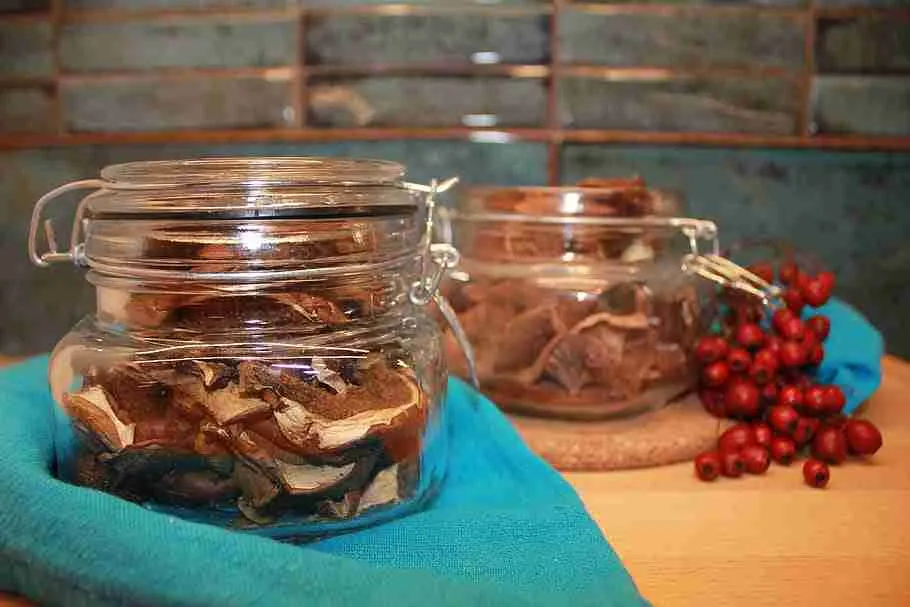
- Container: a glass jar with a rubber seal or a vacuum sealed bag. Leafly notes that jars and bottles block air better than zip bags (Leafly).
- Desiccant: a food safe silica gel packet in the jar soaks up any moisture that gets in each time you open it. Replace or recharge it when it is saturated.
- Light: keep the jar in a dark cupboard or use an opaque container.
- Temperature: steady room temperature, away from the stove, a sunny window or the top of the fridge. Leafly advises against the fridge and freezer for dried mushrooms (Leafly).
- Whole, not ground: grind only what you are about to use. Whole mushrooms expose less surface to air.
- Out of reach: a labelled, closed container in a place children and pets cannot get to. Our guide to safe storage in homes with pets covers this in detail.
How long do dried magic mushrooms last?
Properly dried and stored magic mushrooms stay usable for many months, but they lose strength over time, and the loss is fastest early on. In the Gotvaldová storage experiments, the first months of storage showed the highest rate of alkaloid degradation in dried mushrooms, with more than half of the original concentration lost in that period, and storage in the dark slowed it (review, 2025). Leafly puts the practical window at several months to a year before potency starts to fall off (Leafly).
Older mushrooms are not dangerous because they are old; they are just weaker, so a dose that worked last spring may feel lighter now. For a full breakdown by format (dried, capsules, chocolate and honey), see our article on how long dried magic mushrooms last.
Signs dried mushrooms have gone bad
Throw them out if you see fuzzy growth, green or black patches, a slimy or soft texture, or a sour smell. Leafly lists green or black mould, blackening and funky or sour odours as signs mushrooms should be discarded, while noting that blue bruising on its own is normal (Leafly). Do not try to cut away the mouldy part: some moulds produce mycotoxins, and in soft foods mould can spread below the surface where you cannot see it (Healthline).
Rather skip the drying?
Drying at home is simple once you have the snap test down, but if you would rather start with mushrooms that are already dried and weighed, our dried magic mushrooms include Golden Teacher, Blue Pulaski and, for experienced users, Albino Penis Envy, in 7, 14 and 28 g packs. Store them the way this guide describes, weigh every dose, and use the dosing guide to find your starting amount.
FAQ
What temperature should I dry magic mushrooms at?
About 45 to 70 °C in a food dehydrator. Research on P. cubensis found psilocybin stable up to about 100 °C, so any normal dehydrator setting is safe for potency (review, 2025).
How long does it take to dry magic mushrooms?
Usually 4 to 12 hours in a dehydrator, about one to three days air drying in dry room air, and two to five days with a fan and desiccant. Size, how full the trays are and the humidity in your home all change the time, so go by the snap test rather than the clock.
Can you dry magic mushrooms without a dehydrator?
Yes. Dry them on a wire rack in front of a fan for a day or two, then finish them in an airtight container with silica gel until the stems snap. Avoid the oven if you can.
Does drying magic mushrooms reduce potency?
Drying itself does not measurably reduce it: the Gotvaldová study found no significant change in alkaloid content after drying (review, 2025). Losses come from heat above about 100 °C, bruising, slow drying and freezing fresh mushrooms.
Can you freeze fresh magic mushrooms instead of drying them?
No. Fresh mushrooms frozen at −20 °C or −80 °C lost more than 80 percent of their psilocybin in the Gotvaldová study (review, 2025), and a separate study found the same pattern after just 24 hours in a freezer (Windsor et al.).
Should you cut magic mushrooms before drying?
Only if you have to. Cutting wet mushrooms into pieces promoted oxidation and loss in storage tests (review, 2025), so dry them whole and split only very thick stems lengthwise.
Why did my mushrooms turn blue while drying?
Blue is psilocin oxidizing after the mushroom’s own enzymes act on damaged tissue (Lenz et al., 2020). Some blue is normal; a lot of it means rough handling or slow drying, and some potency loss.
Should dried magic mushrooms be kept in the fridge?
No. A dark cupboard at room temperature in an airtight jar is the condition that showed the least decay in testing (Gotvaldová et al., 2021).
Find your strain, then your dose
Every product on the shelf shows its potency rating and the effects people report. The dosing guide walks through amounts before you order, and a real person answers if you write to us.

About the author
Lily Pelenis
I'm a Toronto-based lifestyle coach, psilocybin enthusiast and certified yoga instructor. I guide people toward mindful, balanced living, and my coaching blends modern wellness practices with ancient wisdom to help clients find deeper self-awareness, resilience and joy.
I've been experimenting with shrooms for over a decade, and I write about my own experience. I love nature, psychology and humans. That is why my articles tend to follow a trip past its peak and into the weeks after it.
Some pieces start with a strain I have tried myself, such as Golden Teacher or Albino Roller Coaster. Others are the practical ones, like how much to take the first time or how to brew a tea that sits easier on the stomach. Over the years I've learned that intention is everything, so I write about why you are taking it before I get to how.
Related articles







50% off your first order
New strains, restocks, sales and new writing from the Notebook, by email. No spam, unsubscribe any time.