Microdosing can quietly open emotional doors—but what happens when what comes through is stored in the body, not the mind? A somatic approach can help you feel more safely, integrate more deeply, and gently release what words alone can’t reach.
I never thought microdosing would turn into such a deeply physical experience. I had expected subtle shifts in mood, maybe a bit more focus, a light creative spark. Instead, one afternoon as I sat quietly on the floor, eyes closed, breathing slowly, my body began to take over in a way that surprised me. My shoulders twitched gently, then shook in small waves. My hands tingled and my breath caught in a pattern I couldn’t control. There was no particular memory or emotion I was trying to unpack—it wasn’t sadness or fear or anger—but it was something old, something buried deep in the cells of my body. It felt ancient and unavoidable, as if my nervous system was finally allowed to move after holding still for years.
That moment was strange but also strangely beautiful. It wasn’t about talking or thinking. It was about feeling. My mind stepped back, and my body spoke a language I hadn’t listened to in a long time. I realized then that healing isn’t always mental work. Sometimes it’s a physical process. A release stored in breath, muscle, or movement. And microdosing psilocybin had gently cracked open that door.
For a long time, I thought emotional healing was about finding the right words, the right insights, the right story. But what I discovered on that microdose journey was different. It was about sensations—the tightness in my chest, the lump in my throat, the trembling in my legs—and learning to stay with them without rushing to explain or fix. This body-first way of working is called somatic healing, and when paired with microdosing, it creates a powerful invitation: to feel what words can’t reach, and in doing so, to heal in a deeper, more embodied way.
If you’ve ever taken a microdose and felt a strange tightness, a sudden rush of warmth, or an inexplicable calm that didn’t come from your thoughts, you’re not alone. These physical responses are signs that your nervous system is starting to engage and release stored emotional patterns. This article is about how to listen to those signals, how to respond with kindness and care, and how a somatic approach can transform your microdosing practice into a path of true healing—not just mental clarity, but nervous system restoration and emotional integration.
I’ll share what I’ve learned about the ways psilocybin and the body work together to unlock emotional blocks, practical somatic tools you can try on your microdose days, and how to recognize when your body needs more space or support. This is not a quick fix or a prescription. It’s an invitation to slow down, to get curious about your sensations, and to meet yourself with more compassion than ever before.
Healing isn’t just a story in your head. It’s a felt experience. And sometimes, to heal, you really do have to feel it to heal it.
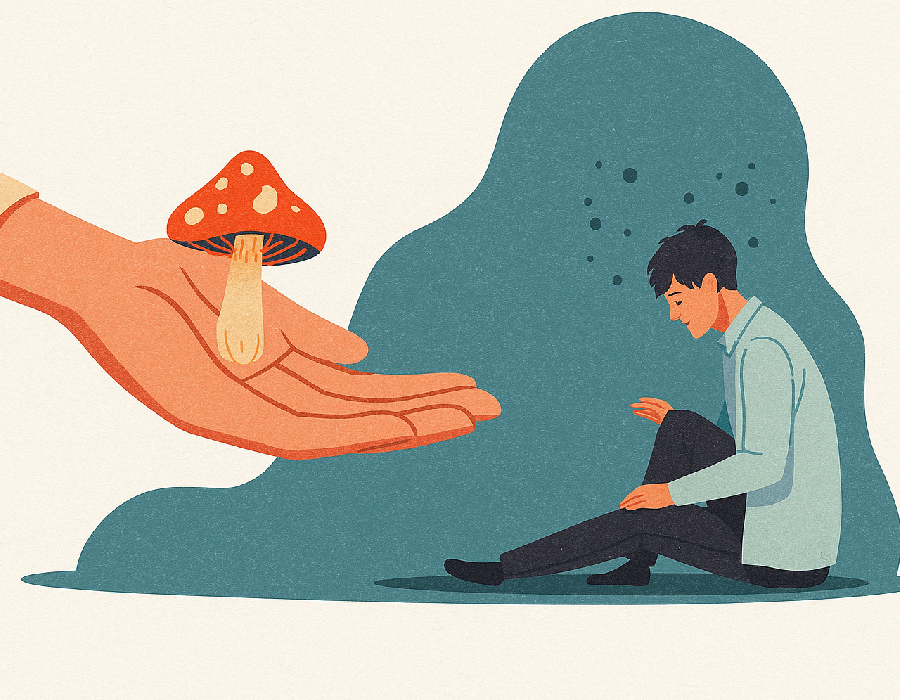
I wrote this to help you recognize the subtle (and not-so-subtle) ways your body might be processing and releasing what it’s held for years
Microdosing Helped Me Tune Into My Mind… But My Body Had Its Own Story
Somatic practices center on the body—on sensations, on breath, on the nervous system. Unlike talk therapy, which lives mostly in the mind, somatic work invites us to feel without the pressure to explain. It’s a bottom-up approach to healing, and when paired with microdosing, it can open incredibly deep channels of awareness and release.
Here’s why it matters. The nervous system is where so much of our emotional life is stored. Trauma, stress, unprocessed grief—these don’t just live in thoughts or memories. They live in tension patterns, in the breath we unconsciously hold, in the tightness in our chest or the clenching in our belly. Microdosing psilocybin doesn’t just tune us into our thoughts—it turns up the volume on our interoception, or awareness of internal sensations. Suddenly, we’re more present to what’s happening inside our body. We notice the subtle shifts: the fluttering in our chest, the warmth in our throat, the way our breath stops when something hard surfaces.
This heightened awareness makes somatic tools incredibly effective on microdose days. Because rather than trying to think your way through an emotional experience, you can feel your way through it. You can learn to track sensation, to move with it gently, and to trust that your body knows how to process and release what your mind may not even understand.
🍄🟫 I wrote this to help you start microdosing with clarity, confidence, and care.
What Is a Somatic Approach?
At its core, a somatic approach is about shifting attention from thoughts to sensations. It’s not about fixing or solving—it’s about noticing and feeling. A somatic experience might begin with recognizing that your shoulders are tight, or that your chest feels heavy. Instead of pushing those sensations away, you stay with them. You breathe into them. You let them exist without rushing to make sense of them.
Microdosing enhances this process because it lowers the defenses that usually keep us disconnected from our bodies. Under the influence of a small dose of psilocybin, you might feel more sensitive—not just emotionally, but physically. You might notice subtle vibrations, tingles, warmth, or constriction that you’d usually miss. These aren’t random. They’re somatic messages—your body’s way of speaking its truth.
This is where the magic happens. When you begin to respond to these sensations with gentleness—placing a hand on your chest, slowing your breath, softly stretching, or even letting your body tremble—you start to build a new relationship with yourself. One based not on control or analysis, but on presence and trust.

If you’ve ever struggled to set boundaries without guilt or fear, this explores how to do it with clarity and compassion
Recognizing and Responding to Somatic Signals
You may feel a lump in your throat, an inexplicable heat rising through your chest, or a sudden shiver moving through your spine. These are not just “weird microdose effects.” These are somatic responses—your body beginning to process something old, something stored.
The best way to meet these moments is with stillness and curiosity. Pause. Breathe. Ask gently, “What’s happening in my body right now?” You don’t need to name it as trauma or sadness or grief. You don’t need a narrative. Just feel. Notice if the sensation shifts when you breathe into it. See if your body wants to move, stretch, or even cry. Let it.
Simple practices like placing a hand over the sensation, swaying side to side, lying down on the floor, or softly vocalizing can help. These aren’t dramatic tools—they’re subtle, grounded ways to let the nervous system discharge what’s no longer needed. The key is safety. Go slow. If something feels overwhelming, stop. You can always return later.
How I Spend My Microdose Days… and Why It Matters
A great starting point is journaling for microdosing—not writing about your thoughts, but checking in with your body. Try questions like: “What do I feel in my belly?” “Where is there tension?” “What happens when I breathe into that space?” Write down the physical sensations without turning them into a story.
Walking meditations are also powerful. Tune into how your feet hit the ground, how your shoulders move, how your breath feels. Let your body guide your awareness.
Another deeply grounding practice is simply lying on the floor and scanning the body slowly from head to toe. Notice where you feel open, where you feel dense, where you feel nothing at all. There’s wisdom in all of it.
Somatic tracking—the practice of staying with a sensation and watching it shift—is one of the most powerful tools you can use while microdosing. It’s not always comfortable, but it’s incredibly freeing. You might feel a knot in your chest start to unravel, or a tightness in your throat soften into warmth. That’s the body doing what it knows how to do: release, reorganize, restore.
Check out this magic mushroom!!

A.P.E Psilocybin Chocolate Bar
$60.00Dried Penis Envy Magic Mushrooms
Price range: $60.00 through $240.00Golden Teacher Gummies for Microdosing
$25.00


Knowing When to Pause
Sometimes, the sensations might feel too strong. That’s not failure—it’s a sign to take a break. Emotional overwhelm, flashbacks, panic, or dissociation are indicators that the nervous system is being pushed too far, too fast. If this happens, stop the practice. Take a walk. Drink water. Call a friend. Remind yourself you’re safe.
It may also be a sign that your dose is too high, or that your body needs more time between sessions. Somatic work is deep work, and it’s best done slowly. If trauma is being triggered, or if you’re feeling persistently destabilized, it’s time to seek out a trained therapist—ideally someone familiar with somatic and psychedelic integration.
The body holds more than we realize. And when it begins to release, it deserves care, patience, and support.
The Quiet Reasons I Keep Saying Yes to This Journey
For so many people, talk therapy has helped—but only up to a point. They understand their patterns, they know their triggers, they’ve told their story a hundred times. But something still feels stuck. That’s where somatic work shines. Because it bypasses the thinking mind and goes straight to the source: the nervous system.
When paired with microdosing, this body-first approach can offer profound healing. It helps people who’ve felt numb reconnect with sensation. It helps those who’ve carried stress for decades begin to relax. It allows for a kind of healing that doesn’t require language—only presence.
And perhaps most importantly, it gives us back our connection to ourselves. To feel is to be alive. To be in the body is to be home.
🍄🟫 For those seeking dried mushrooms with care and quality in mind, this is a great place to start.
The Moment I Realized My Body Had Its Own Story to Tell
Even in small amounts, psilocybin gently stimulates the limbic system, the part of the brain that governs emotion and memory. It also increases nervous system flexibility, helping us shift between stress and calm with more ease. This makes somatic work during microdosing particularly potent—because the mind is quiet, and the body is ready to speak.
Many integration retreats now combine psilocybin with somatic practices like breathwork, movement therapy, and guided body scans. Therapists trained in somatic experiencing and Hakomi are increasingly incorporating microdosing into their sessions to support clients in going deeper—without overwhelming them. These approaches help build the emotional and physical resilience needed not only for healing in daily life, but also for preparing the body for larger psychedelic experiences down the line.

If you’ve felt emotionally stuck and wondered whether microdosing might help, this guide covers everything I wish I’d known
Feel It to Heal It—With the Help of Magic Mush
At the heart of microdosing and somatic healing is one shared truth: you have to feel it to heal it. The sensations, the trembles, the tears—they’re not problems. They’re your body telling the truth in its own language. And with gentle tools and consistent support, that language becomes not only understandable, but liberating.
If you’re ready to explore this path with safety, education, and trusted products, Magic Mush is here to support you every step of the way. As the most reliable and compassionate source for high-quality magic mushrooms in Montreal, Magic Mush is more than a store—it’s a sanctuary for transformation. Whether you’re new to microdosing or deepening your practice, they offer everything you need to start your journey with confidence and clarity.
At Magic Mush, healing isn’t about numbing—it’s about awakening. Their commitment to rigorous testing, education, and destigmatization ensures that you’re not only getting the best psilocybin products like dried magic mushrooms, but also the knowledge and community you need to grow. With online guides, expert insights, and customer service that truly cares, Magic Mush helps make the path of somatic healing accessible and empowering.