A few months into my microdosing routine, something odd started happening. Some days, I’d take my usual 100mg of Golden Teachers and feel the gentle glow I’d come to know—an easy presence, a subtle opening, like the world had exhaled. But other days, usually after I’d eaten something heavy or processed, the same dose left me either anxious, foggy, or totally numb. I kept thinking it was the strain, or the dose, or maybe just the moon. But then I read that up to 90% of serotonin—the same neurotransmitter psychedelics modulate—is produced in the gut, not the brain.
Suddenly, it all clicked. The “gut feeling” wasn’t just a metaphor. It was literal. My microbiome, that teeming inner ecosystem I’d barely paid attention to outside of yogurt ads, was influencing my trips. The more I paid attention, the more patterns I noticed. My cleanest, most connected journeys always came after days of light, plant-rich eating. My roughest ones followed stress, poor sleep, or gut-heavy meals. The body wasn’t just part of the experience—it was steering it.
This wasn’t just about digestion. It was about mental and emotional regulation. I remembered one trip where I sobbed for hours, but afterward felt light, calm, almost reborn. That same week, I’d been eating fermented veggies, sleeping well, and walking daily. Another time, I’d been eating takeout, barely moving, and doomscrolling late into the night. The trip I took then felt closed, confused, stuck. The contrast was undeniable.
It was humbling. I’d thought of psychedelics as mind-expanding. But they were also body-revealing. They showed me what my nervous system, my gut, even my immune function had been trying to tell me all along. And as I started digging into the research, I realized: I wasn’t alone. Scientists, too, were beginning to ask if gut health was the missing link in the psychedelic healing puzzle.
READ: The Connection Between Medicinal Mushrooms and Gut Health
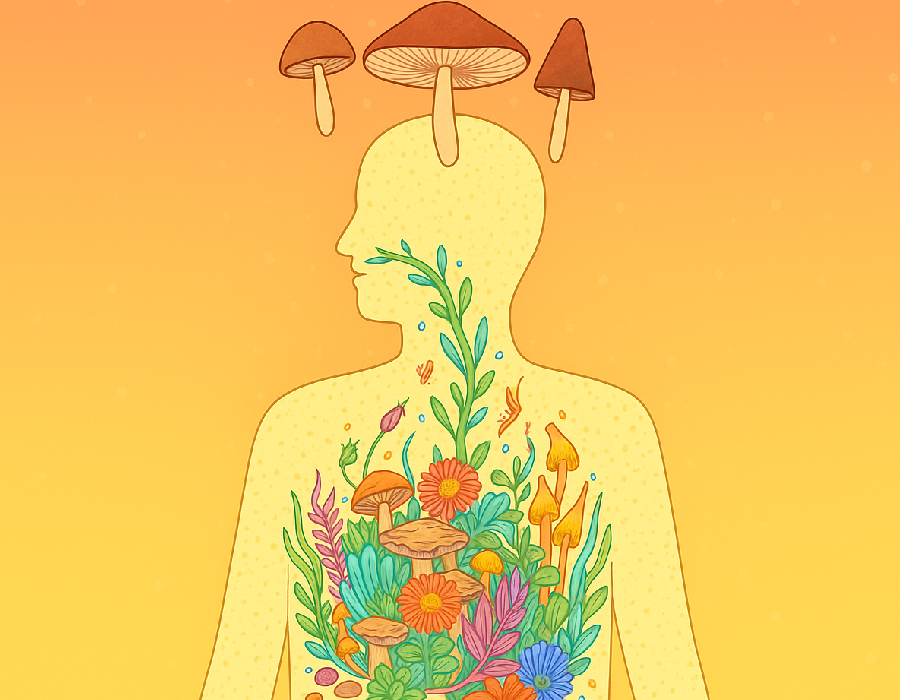
The Gut-Brain Axis, Explained (and Why It Matters When You Trip)
At the heart of this connection is the gut-brain axis: a complex communication network linking the central nervous system (the brain and spinal cord) with the enteric nervous system (the nerves embedded in your gastrointestinal tract). These two systems “talk” constantly—via the vagus nerve, hormonal signals, immune responses, and, crucially, the trillions of microbes that live in your gut. This microbiome isn’t just passive—it’s active, producing neurotransmitters like serotonin, dopamine, GABA, and even influencing stress hormones like cortisol.
When we talk about psychedelics—especially psilocybin, LSD, or DMT—we’re talking about substances that deeply affect serotonin signaling, primarily through the 5-HT2A receptor. But if 90% of serotonin is produced in the gut, then the gut’s health, microbial diversity, and inflammation levels aren’t just side notes. They may fundamentally shape how these substances are processed, felt, and integrated. A “bad trip” might not just be about setting or trauma—it could be linked to systemic inflammation or gut dysbiosis.
Recent studies back this up. A 2022 paper in Frontiers in Psychiatry noted that psychedelics may act not only on the brain, but on immune cells and gut permeability—possibly reducing the low-grade inflammation often associated with depression, PTSD, and chronic stress. Research by Doll & Lutz (2023) points to the gut-brain axis as a key area for innovating mood disorder treatments, with psychedelics offering a potential bridge between mental and physical health.
It’s not just theory. Clinical researchers, including teams at Johns Hopkins and the Multidisciplinary Association for Psychedelic Studies (MAPS), have begun measuring biomarkers like inflammatory cytokines and gut integrity alongside psychological outcomes in psychedelic trials. The emerging hypothesis? That healing with psychedelics may be just as much about restoring immune and gut function as it is about mystical insight. In other words, you’re not just tripping—you’re possibly rebooting your entire gut-brain ecosystem.
Check out this magic mushroom!!

A.P.E Psilocybin Chocolate Bar
$60.00Dried Penis Envy Magic Mushrooms
Price range: $60.00 through $240.00Golden Teacher Gummies for Microdosing
$25.00


Food, Mood, and the Microdosing Microbiome
Let’s zoom in on microdosing, where the gut-brain connection becomes even more nuanced. Unlike a full-dose journey, microdosing unfolds across weeks—subtle, cumulative, and deeply affected by your baseline state. If your gut is inflamed, your diet erratic, or your sleep dysregulated, the microdose can feel unpredictable. Some days it may lift your mood; other days it might trigger anxiety or simply feel like a dud. This variability isn’t just about dosage—it may be about digestion.
Several anecdotal reports and preliminary studies suggest that the effectiveness of microdosing is influenced by what you eat, when you dose, and how your body metabolizes serotonin precursors like tryptophan. If your gut is thriving—with plenty of fiber, fermented foods, prebiotics, and a diverse microbial population—you’re likely to experience smoother, more emotionally regulated effects. But if your microbiome is compromised (say, from antibiotics, processed foods, or chronic stress), your microdose might backfire, amplifying unease or leaving you feeling flat.
This is where food and routine matter. Psychedelics don’t exist in isolation—they operate in a physiological context. One researcher I spoke with described it like this: “Your body sets the stage, the mushroom amplifies what’s already there.” That means the days leading up to a journey, or your diet and lifestyle across a microdosing protocol, may shape the emotional tone of your entire experience. It’s not just “set and setting” anymore—it’s “set, setting, and stomach.”
And for people using psychedelics to support anxiety, depression, or trauma recovery, this gut-brain connection is especially critical. These conditions are often linked to inflammation, leaky gut, and dysbiosis. Supporting the microbiome—through diet, sleep, stress reduction, or even psychobiotics (gut-targeted probiotics)—may enhance not just physical health, but the depth and safety of your psychedelic work. The body, it turns out, is not separate from the trip. It is the trip.
READ: Should You Eat Shrooms on an Empty Stomach

From “Purge” to Protocol: Gut Health in Traditional and Future Psychedelic Healing
What’s especially fascinating is that traditional psychedelic practices have long honored the gut—whether they knew it through science or not. Think of ayahuasca, whose purgative effects (vomiting, diarrhea) are not seen as side effects but as integral to the healing process. Or peyote ceremonies, where fasting and dietary restrictions precede the journey. Or even psilocybin mushrooms, which have a long history of being consumed in ways that honor bodily cleansing before and after the trip.
From a modern lens, these practices might support vagus nerve activation (which modulates stress and inflammation) or reset aspects of the microbiome. That cleansing sensation? Maybe it’s not just symbolic. It might actually be your nervous system rebalancing, your immune system recalibrating, your gut signaling a kind of reset. It’s poetic and biochemical all at once.
Looking forward, we’re likely to see gut health become an integral part of psychedelic protocols. Imagine taking a personalized gut microbiome test before starting a psilocybin therapy program. Your guide might recommend a tailored diet or specific probiotics to optimize serotonin production and reduce inflammation. Integration might include not just journaling and therapy, but gut repair—fermented foods, prebiotic fiber, adaptogens. The future of psychedelic medicine may be less “high tech” than we imagined—and more “gut check.”
And maybe, for psychonauts who value self-inquiry and self-regulation, this shift is already happening. More and more, I hear folks say they’re eating cleaner before a journey, paying attention to digestion, or tracking how stress impacts their trip outcomes. It’s not dogma—it’s data. It’s not restriction—it’s reverence. If psychedelics ask us to tune in deeply, maybe that tuning should begin not in our heads—but in our guts.
Psychedelics as Psychobiotics? A New Frontier in Healing
The term “psychobiotics” refers to live organisms—usually probiotics—that can influence mental health by interacting with the gut-brain axis. It’s an emerging field, still mostly the domain of researchers and niche supplement companies. But what if psychedelics themselves could one day be seen as psychobiotics—agents not just of cognitive change, but of gut healing and systemic emotional regulation?
It’s not such a leap. After all, psilocybin doesn’t just affect mood—it modulates inflammation, neurogenesis, and vagus nerve tone. Several studies have suggested that chronic stress, trauma, and depression are as much embodied states as psychological ones. They live in the belly, in the immune system, in the way the body metabolizes experience. Psychedelics, with their ability to restore emotional and neurological flexibility, may be able to influence these systems directly—and the gut is often the first place that change registers.
This could radically shift how we approach mental health. Imagine protocols where gut-supportive nutrition is as essential as integration therapy. Where a journey isn’t complete without tending to digestion, sleep, and hormonal rhythms. Where facilitators are trained not just in trauma support, but in the basics of microbiome science. We may be on the verge of a new kind of healing—one that doesn’t see the body and mind as separate, and recognizes the gut as the terrain through which both speak.
It’s humbling, too. Our ancestors may not have had the vocabulary of the microbiome, but they had the wisdom of preparation, cleansing, and embodiment. Maybe modern science is just beginning to catch up. As we explore the wild frontiers of psychedelic medicine, the path forward might not be more mind—but more body. More belly. More listening to the wisdom that’s been fermenting inside us all along.
READ: Should You Eat Before Taking Shrooms: Shroom Trip Prep
The Wisdom in Your Belly
Maybe healing doesn’t just come from seeing the light—it comes from listening to what your body’s been whispering all along. That anxiety during a trip? Maybe it wasn’t “bad vibes,” but gut dysbiosis. That clarity after a ceremony? Maybe it was serotonin finally flowing freely through a system no longer inflamed. Psychedelics are revealing, yes—but what they reveal might be biochemical, emotional, and microbial.
This isn’t about obsessing over your gut or turning your trip into a nutrition spreadsheet. It’s about curiosity. About care. About realizing that your mind, heart, and gut are in constant conversation—and psychedelics are powerful amplifiers in that dialogue. So if you’re preparing for a journey, ask not just what your intention is, but what your body needs to support it.
At Magic Mush, we understand that the journey doesn’t start with the first visuals—it starts with how you feed your body, set your rhythm, and tend your internal ecosystem. Whether you’re microdosing with our mushroom gummies, exploring deeper states with our dried mushroom bundles, or finding ease with our chocolate mushrooms, we encourage you to honor the whole self—including the belly.
So before your next trip, try this: keep a gut-and-mood journal. Notice how food, stress, and digestion shape your day. Consider integrating gut-friendly habits—more fiber, fermented foods, or a little breathwork before dosing. Because the next time you feel a shift in consciousness, it might not just be the medicine. It might be your microbiome, saying thank you.