
What Real-World Psilocybin Research Is Finally Showing Us
For the last few years, psychedelic research has revolved around a single, seductive question:
Does it work?
Clinical trials answered that with impressive clarity.
Response rates north of 50 percent.
Symptom reductions that outperformed many conventional treatments.
Headlines declaring “breakthrough therapy.”
But beneath the excitement, another question has been quietly waiting its turn:
Does it still work when real life gets involved?
When patients don’t fit neatly into trial criteria.
When they’re still on other medications.
When they carry years of trauma, failed treatments, and complicated inner worlds.
Because healing, in reality, rarely happens in controlled environments.
It happens in the mess.
The Limits of Clean Data
Randomized controlled trials are designed to succeed — and for good reason.
They isolate variables, reduce noise, and protect patient safety.
But they also do something else: they remove complexity.
People with overlapping diagnoses are excluded.
Those with extensive trauma histories are filtered out.
Medication interactions are minimized.
Lives are simplified.
The result is clarity — but also distance from the world most people actually live in.
As psychedelic therapies move closer to clinical and cultural legitimacy, researchers are beginning to ask harder questions about what happens outside the lab.
Real People, Real Outcomes
One of the most important developments in recent years hasn’t come from a glossy trial — but from real-world data.
In Switzerland, where limited medical access to psilocybin has been allowed under specific conditions, researchers tracked patients with treatment-resistant depression receiving psilocybin-assisted therapy.
These were not ideal candidates.
Most had already tried multiple antidepressants without success.
Many lived with anxiety, PTSD, or other overlapping mental health conditions.
Some had been ill for years.
And yet, the outcomes were meaningful.
Depression scores dropped significantly.
Roughly one third of patients showed a clear response.
Around a quarter reached full remission.
These are not miracle numbers.
They are not headline-friendly.
But for people who had exhausted conventional options, they matter.
Because when nothing else works, meaningful improvement is not a small thing.
Why Real-World Evidence Changes the Conversation
What makes this data powerful isn’t just the outcomes — it’s the context.
These patients weren’t protected by perfect conditions.
They weren’t psychologically “clean.”
They weren’t simplified.
And yet, psilocybin still helped some of them.
That suggests something important:
psychedelic therapy may retain therapeutic value even when life is complicated — as long as it’s approached with care, structure, and support.
It also reminds us that healing isn’t binary.
It doesn’t always look like a cure.
Sometimes it looks like a reduction in suffering that holds.
The Return of the Mystical Question
Alongside outcome data, another pattern keeps surfacing — one that makes modern medicine uneasy.
Across multiple psychedelic studies — including work with ibogaine for PTSD in veterans — researchers are noticing a consistent correlation:
The intensity of the mystical experience appears linked to better outcomes.
Not just feeling good.
Not cognitive insight alone.
But experiences described as:
- Ego dissolution
- Deep unity or interconnectedness
- A sense of meaning larger than the self
- Profound emotional or existential reframing
In several studies, participants who reported more intense mystical-type experiences showed greater reductions in PTSD and depressive symptoms.
This presents a challenge.
Medicine is comfortable with molecules and mechanisms.
It is less comfortable with experiences that sound spiritual.
And yet, the data keeps pointing in the same direction.

Healing Beyond Chemistry
None of this suggests that psychedelics work because they’re mystical.
But it does suggest that healing may not be purely biochemical.
For some people, relief comes not just from altering neurotransmitters — but from experiencing:
- A different relationship to the self
- A temporary loosening of identity
- A felt sense of meaning or connection
These experiences don’t replace therapy or integration.
They don’t stand on their own.
But they may create a psychological opening — one that allows other forms of healing to take root.
Canada’s Quiet Role
This shift in thinking isn’t happening only in the U.S. or Europe.
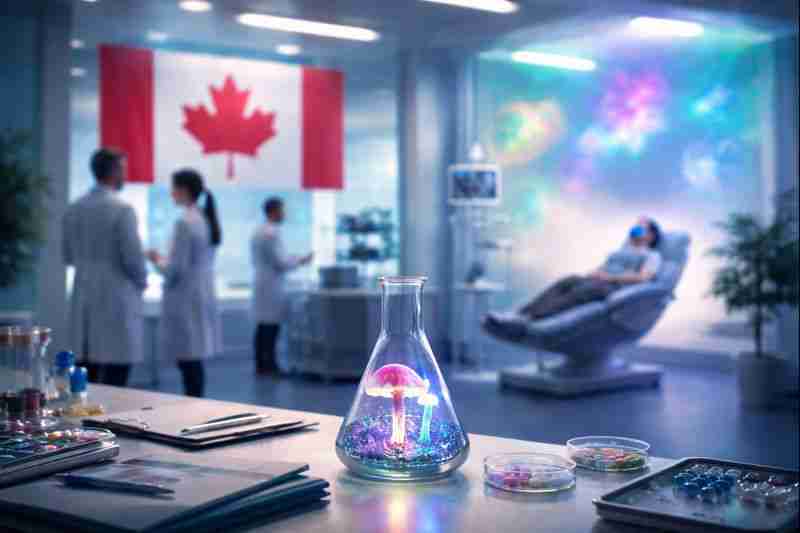
In Hamilton, Ontario, a major hospital network has recently opened a new psychedelic research centre, focused on safety, efficacy, and real-world application of psychedelic therapies.
That matters.
Canada has taken a notably measured approach to psychedelics:
- Cautious rather than rushed
- Evidence-driven rather than ideological
- Patient-centred rather than market-led
Rather than chasing hype or quick legalization, Canadian institutions are building infrastructure — training, ethics frameworks, and long-term research capacity.
It’s not flashy.
But it’s responsible.
Why This Moment Matters
Clinical trials are designed to answer one question: Can this work under ideal conditions?
The emerging research is answering a harder one:
Can this help when conditions are far from ideal?
The answer, so far, appears to be: sometimes — and with limits.
Psilocybin is not a silver bullet.
It does not override trauma.
It does not replace therapy, support, or integration.
But when used intentionally, with preparation and care, it may offer something rare:
a meaningful intervention for people who have been failed by simpler solutions.
A More Mature Psychedelic Conversation
What we’re seeing now is a shift.
Less hype.
More humility.
More honesty about risks, boundaries, and limitations.
And that’s a good thing.
Because healing doesn’t always arrive as a dramatic transformation.
Sometimes it arrives as a quieter change — one that endures.
At Magic Mush, we pay attention to where the conversation is actually going — not just where the headlines point.
What’s emerging is a psychedelic space that’s growing up.
More nuanced.
More responsible.
More grounded in real human lives.
🌱
Magic Mush

- Autumn Is a Season of Metabolism - 09/28/2026
- What If Creativity Isn’t Something You Create? - 09/24/2026
- Quick Relief Or Lasting Shift? The Psychedelic Trade-Off - 03/30/2026
