For many, music is more than entertainment—it’s a conduit to emotion, memory, and identity. Yet, for individuals battling depression, this connection often fades, leaving melodies hollow and rhythms lifeless. Traditional antidepressants, while alleviating certain depressive symptoms, can sometimes dampen emotional responsiveness, a phenomenon known as “emotional blunting.” Emerging research suggests that psilocybin, the active compound in psychedelic mushrooms, may offer a different path—one that preserves and even enhances emotional engagement.
🧠 Understanding Emotional Blunting
Selective serotonin reuptake inhibitors (SSRIs) like escitalopram (Lexapro) have long been considered a gold standard in the treatment of depression and anxiety disorders. Their primary function is to increase the availability of serotonin, a neurotransmitter involved in regulating mood, sleep, appetite, and emotional balance. By preventing the reabsorption of serotonin in the brain, SSRIs aim to create a more stable emotional baseline—lifting people out of despair and helping them regain functionality in daily life.
And for many, they do.
But there’s a quiet cost that doesn’t always show up on clinical outcome measures: the dulling of emotional depth.
Known in psychiatric literature as emotional blunting, this phenomenon affects nearly half of all patients prescribed SSRIs. It’s not the absence of mood improvement—but the narrowing of the emotional spectrum. You’re no longer sinking into despair—but you’re not quite rising into joy either.
Patients often describe it as a muted existence. They no longer cry at sad movies—or laugh uncontrollably with friends. Music doesn’t hit the same. Touch feels distant. The highs and lows are flattened into something tolerable, but also eerily neutral.
It’s important to note: this isn’t apathy. People with emotional blunting still care. They still want to feel. But the access point to emotion feels blocked, like watching your own life through frosted glass.
Neuroimaging studies suggest that SSRIs may exert this effect by increasing top-down regulation from the prefrontal cortex—essentially strengthening the brain’s internal brakes. While this helps contain overwhelming emotions (such as panic or despair), it can also suppress spontaneous affect, leaving people emotionally constricted in ways they didn’t anticipate—and weren’t warned about.
What makes emotional blunting particularly tricky is that it’s not always recognized as a side effect. For many clinicians, the reduction of intense emotionality is seen as a success, especially in cases of affective instability. But for patients—especially artists, parents, partners, and empaths—this emotional quieting can feel like a different kind of loss.
One that isn’t about suffering, but about not feeling anything at all.

🍄 Psilocybin: A Different Mechanism of Mind
Unlike SSRIs, which slowly and subtly elevate serotonin by blocking its reuptake, psilocybin takes a more radical route.
It acts as a partial agonist at the 5-HT2A receptor, a serotonin receptor densely expressed in the cerebral cortex—especially in areas responsible for cognition, introspection, and emotion. But its effects go beyond just boosting mood chemistry. Psilocybin appears to disrupt the brain’s default predictive coding—the way we filter and suppress stimuli to make the world manageable.
That suppression is useful in day-to-day life. It helps us tune out irrelevant noise, navigate complexity, and “get on with it.” But in depression, those filters become overactive—muting not just distractions, but also the very inputs that make life feel rich and meaningful.
Psilocybin seems to turn down those top-down controls. Not recklessly, but gently. As if lifting a veil, it allows a more direct, unfiltered experience of raw emotion, sensation, and beauty.
And one of the most powerful ways to measure that? Through music.
🎶 The Music Study: Psilocybin vs. Escitalopram
In a landmark 2022 study published in Molecular Psychiatry, researchers asked a question both simple and profound:
What happens when depressed people listen to music—on mushrooms vs. on Lexapro?
Participants diagnosed with Major Depressive Disorder (MDD) were randomized into two groups: one received two high-dose sessions of psilocybin-assisted therapy, and the other took daily escitalopram (Lexapro) over six weeks.
To measure their emotional reactivity, participants were exposed to emotionally evocative music while undergoing functional MRI (fMRI) scans. The music included unexpected changes—in tempo, key, rhythm, and harmony—designed to provoke surprise and affective response.
🧠 Key Findings
Emotional Response:
The psilocybin group showed preserved or heightened emotional reactions to the musical surprises. Participants often described the music as deeply moving, even transcendent.
In contrast, the escitalopram group demonstrated reduced neural responses—a flattening of affect that aligned with previous reports of emotional blunting under SSRIs.
Brain Activation:
Psilocybin increased activity in the ventromedial prefrontal cortex, a region tied to self-referential thought and emotional insight, as well as auditory and sensory areas involved in emotional resonance.
Escitalopram, however, showed higher activity in memory-related areas (such as the hippocampus), suggesting a more cognitive, less embodied engagement with the music. The “spark” was dimmed, even if the notes were technically registered.
Anhedonia Reduction:
Anhedonia—the inability to feel pleasure—is a core symptom of depression. Psilocybin led to a greater reduction in anhedonia scores than escitalopram, both subjectively (self-report) and neurologically (via activation in reward circuitry).
💡 So What Does It Mean?
The implications go beyond music. What this study points to is a deeper difference in how these substances engage the emotional brain.
SSRIs help stabilize mood—but often by muting emotional highs and lows.
Psilocybin invites a return to emotional presence, with all its complexity: the ache, the awe, the tears that catch you off guard.
For many, especially those who have felt emotionally muted for years, that reconnection is more than therapeutic. It’s sacred.
🎧 Why Does Music Feel So Different on Mushrooms?
There’s something almost mythical about how music lands during a psilocybin journey. A simple melody can feel like a message from the universe. A bassline can move through the body like memory. A lyric can open a door you didn’t know was closed.
But this isn’t just poetic language—it’s neuroscience.
Researchers are beginning to piece together why psilocybin doesn’t just change how we hear music, but how we feel it, how we inhabit it. Three key mechanisms have been consistently observed in fMRI and EEG studies:
🧠 1. Reduced Prefrontal Control
The prefrontal cortex is often called the brain’s “executive” region. It’s responsible for organizing thoughts, inhibiting impulses, and applying filters—especially emotional ones. Under depression, this region tends to become overactive, leading to excessive rumination and suppression of affect.
Psilocybin turns down the volume in the prefrontal cortex. It loosens the grip. As a result, feelings can arise more spontaneously. You’re not analyzing the music. You’re experiencing it—viscerally, unguarded.
🌐 2. Increased Global Brain Connectivity
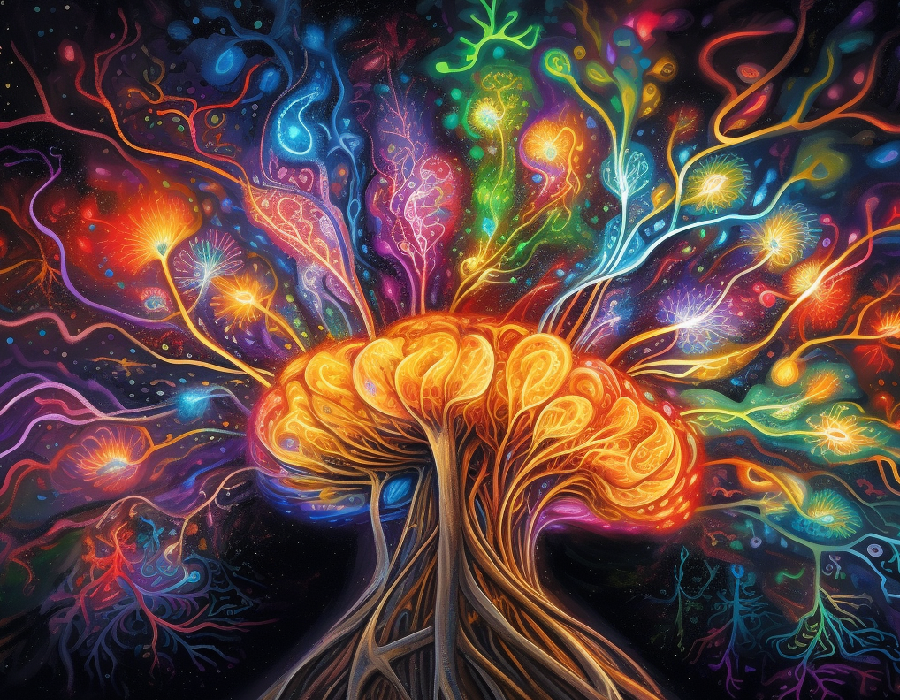
In typical waking consciousness, brain regions communicate in specialized, siloed networks. But under psilocybin, there’s a marked increase in cross-talk between distant regions, including the visual cortex, auditory areas, limbic (emotional) centers, and the Default Mode Network.
This phenomenon—sometimes visualized as a “firework” pattern of connections—is what allows music to become multisensory. You don’t just hear the song. You see it, feel it, sometimes even become it. A cello can feel like grief in the chest. A cymbal can crack open joy.
💓 3. Increased Emotional Salience
“Salience” is the brain’s way of assigning meaning. Under normal conditions, our minds automatically rank stimuli: this matters, this doesn’t. Depression often dampens this system, causing everything to feel equally dull—like the volume of life is turned down.
Psilocybin appears to restore the emotional “weight” of experience. Suddenly, things matter again—not in a logical way, but in a bodily, intuitive way. A song lyric hits not because it’s clever, but because it knows you. Because for a fleeting moment, it mirrors something honest inside.
🎭 But Isn’t Feeling Too Much… Risky?
Yes. And that’s the invitation.
SSRIs are often described as creating a “buffer”—a protective barrier between the self and the sharp edges of feeling. For some, that’s vital. For others, it slowly becomes a kind of prison. Safe, but sealed off.
Psilocybin dismantles the buffer.
It doesn’t blunt. It opens. To grief, yes. To longing. To wonder. To pain. But also—to color. To presence. To music that finally lands.
It’s not always gentle. Some people cry for the first time in years. Not from sadness, but from sheer contact. From the shock of remembering what it means to be permeable. To be moved.
As one participant in the Molecular Psychiatry study put it:
“I didn’t realize how much I’d lost until I started crying to a song I used to love. And it wasn’t even a sad song. It just… touched something real.”
⚖️ This Isn’t a Binary. It’s a Spectrum
Let’s be honest—this isn’t a war between mushrooms and meds.
SSRIs save lives. They offer stability. They make mornings possible. For many people, that’s enough. That’s everything.
But psilocybin offers something else: not stabilization, but reconnection.
It doesn’t try to “fix” you.
It invites you to remember who you were before the numbness.
It gives you access to tears not as breakdown, but as breakthrough. To music not as background, but as language. To yourself not as a problem—but as a system of meaning waiting to be felt again.
🌱 Healing as Reconnection
What if we’ve misunderstood healing?
What if it’s not about the absence of symptoms—but the presence of emotion?
What if getting better doesn’t mean feeling “nothing bad”—but feeling everything, in all its sacred, unpredictable complexity?
What if the real medicine is the moment a song breaks through your skin—not because you’re fragile, but because you’re finally porous again?
What if healing looks like this:
Tears without warning.
Goosebumps at a minor chord.
Laughing mid-cry.
Being moved by a voice that once meant nothing.
Maybe that’s what psilocybin gives us: not just relief, but reunion.
A reunion with the part of ourselves that still knows how to feel alive.