The first time I heard the name María Sabina, it wasn’t on the pages of a book or in a documentary voiceover. It was during a mushroom ceremony—deep in the woods, surrounded by people who spoke softly and moved even softer. Someone whispered her name like a mantra, a reverent invocation. “María Sabina,” they said, almost as if we were being watched, almost like she was still there. I didn’t know then who she was, but I felt the weight of her name immediately. It stuck with me, like mycelium curling into the cracks of curiosity.
Later, I found out she was a Mazatec curandera from the mountains of Oaxaca, a healer who worked with sacred mushrooms in rituals passed down through generations. Her influence stretched further than I ever imagined—etched not only in Indigenous medicine but in the very core of the psychedelic movement that’s now finding its way into clinical trials, wellness apps, and Silicon Valley boardrooms. Yet, her name is rarely mentioned in those spaces. Her story is a haunting reminder of how easily Indigenous knowledge is consumed, commodified, and forgotten.
This is her story—the real one, not the sanitized version splashed across Western mushroom memes or dropped in passing during a podcast. This is about remembering María Sabina not just as a “mushroom woman,” but as a wise elder, a spiritual guide, and a healer who gave more than she received.
READ: Did Ancient Buddhists Use Psychedelics?

María Sabina: The Woman Behind the Mushrooms
Definition & Introduction
María Sabina Magdalena García was born in 1894 in the misty mountain village of Huautla de Jiménez, in Oaxaca, Mexico. She was a Mazatec sabia—a wise woman and healer. Her tools weren’t stethoscopes or scalpels. Instead, she worked with language, prayer, ceremony, and mushrooms. Not just any mushrooms, but the sacred Psilocybe species native to her region, long used in Indigenous rituals for healing, divination, and communion with the spirit world.
These weren’t casual experiences. They were veladas—deeply sacred nighttime ceremonies rooted in Indigenous cosmology. Veladas weren’t about getting high. They were about healing—of the body, the heart, the soul. People came to María not because they were curious about psychedelics but because they were hurting, broken, or lost. And through chants, prayers, and the wisdom of the mushrooms, she guided them toward wholeness.
María didn’t see herself as a psychedelic pioneer. She was simply doing what her ancestors had always done. Her power didn’t come from ego but from tradition, reverence, and connection to the unseen.
READ: An Enthusiast’s Guide to Psilocybe Aztecorum
Historical Background
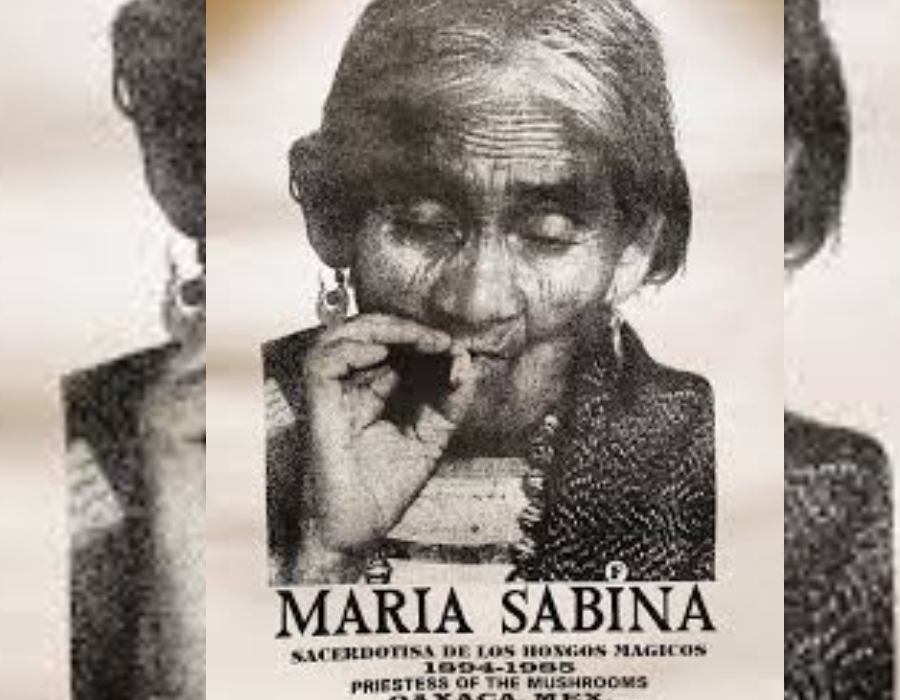
The world didn’t know María Sabina’s name until 1955 when an American banker-turned-mycologist named R. Gordon Wasson showed up in Huautla, looking for the fabled “magic mushroom.” Wasson was one of the first Westerners to participate in a velada, thanks to María’s reluctant openness. He claimed to be seeking spiritual understanding, but what followed was something else entirely.
In 1957, Wasson published a sensational article in Life magazine titled “Seeking the Magic Mushroom.” It featured photos of María Sabina and told the world about her sacred work. Except—she never gave him permission to publish her name, her face, or her words. The article turned her village into a psychedelic pilgrimage site. Thousands of Western seekers flocked to Huautla, some respectful, many not. They came in search of visions but left a trail of chaos.
The exposure brought more than fame. It brought destruction. María was blamed by her community for the influx of outsiders. Her house was burned. She was ostracized. Authorities harassed her. And despite all this, she remained dedicated to her role as a healer until her death in 1985. Her life became a painful example of what happens when sacred traditions are exploited without consent.
Scientific Context
As María Sabina’s story was making headlines, Western science was just starting to take notice of psilocybin. Chemists isolated the active compound from the mushrooms she used, and by the 1960s, researchers were experimenting with psychedelics in clinical settings. From Harvard to Hollywood, the mushroom craze exploded.
But in this transition from ceremony to science, something got lost. The cultural and spiritual context was stripped away. Psilocybin became a chemical compound, a tool for psychological exploration and, later, mental health treatment. María’s ceremonies were rebranded as “trips.” Her chants and prayers were replaced with white coats and EEG scans.
Today, psilocybin is having a renaissance—studied in labs, debated in legislature, and microdosed at tech start-ups. Yet the movement rarely credits the Indigenous traditions that nurtured this medicine for centuries. María Sabina’s legacy is hidden in footnotes while her wisdom echoes through every guided session and psychedelic retreat.
Check out this magic mushroom!!

A.P.E Psilocybin Chocolate Bar
$60.00Dried Penis Envy Magic Mushrooms
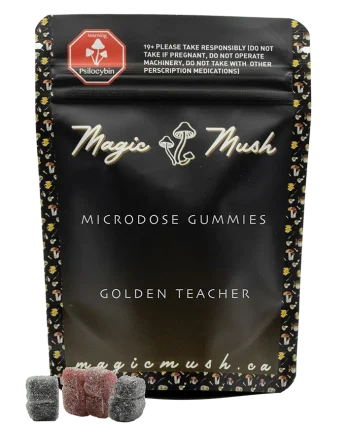
Price range: $60.00 through $240.00Golden Teacher Gummies for Microdosing
$25.00


The Role of Veladas
To understand María Sabina is to understand veladas. These sacred ceremonies weren’t recreational gatherings. They were spiritual journeys—initiated with intention, reverence, and deep respect for the mushroom spirit, or niños santos as they’re called in Mazatec.
A velada often took place at night, in candlelit rooms, guided entirely by the sabia. María would ingest the mushrooms along with the person seeking healing, and from there she would chant—sometimes for hours. These chants weren’t just beautiful language; they were invocations, ancestral code, spiritual navigation systems that connected the physical world with the divine.
Participants in these ceremonies came with grief, illness, trauma, or existential longing. And through María’s guidance, the mushrooms revealed what needed to be seen, felt, and released. She described it as a conversation with God, a communion with forces beyond the visible. There was nothing casual about it.
Veladas weren’t designed for fun or recreation. They were medicine. And María Sabina treated them with the gravity and sacredness they deserved—something often forgotten in the West’s obsession with “tripping.”
Western Exploitation & Erasure
Wasson’s visit brought fame, but it also brought devastation. The story of María Sabina quickly became one of appropriation, exploitation, and erasure. Despite his claims of admiration, Wasson’s actions violated the very essence of what he claimed to honor. He published her name, her photo, and details of her ceremonies without informed consent—an act that would be considered unethical by today’s standards.
And the repercussions were brutal. María was accused by her own people of selling out sacred traditions. Outsiders flooded her village, treating her home like a tourist attraction. Some came respectfully. Many came to party. The town’s spiritual ecology was disrupted, and María paid the highest price.
What’s worse, while Wasson and others profited—through books, speaking tours, and academic prestige—María lived in poverty. She never received financial compensation or meaningful recognition for her contributions. Her name became a footnote in the psychedelic movement, rather than a centerpiece. She was commodified, then cast aside.
READ: The Aztec Gods Mushroom Strain: A Wild Journey into Effects and Transformative Benefits

Legacy in the Psychedelic Movement
María Sabina’s voice echoes quietly through the halls of modern psychedelic therapy. Her influence is there—in the language of healing, in the sacred framing of experiences, in the reminder that mushrooms are more than molecules. Yet, she is rarely credited.
Much of today’s psychedelic discourse is dominated by clinical trials, neuroscientific models, and biohackers. While these developments are exciting, they risk repeating the same mistakes—extracting knowledge from Indigenous practices without reciprocity, flattening spiritual wisdom into science.
María’s legacy is a wake-up call. Her life reminds us that this medicine came from somewhere—with roots, rituals, and responsibilities. Any movement that claims to be about healing must also reckon with the harm it has caused—and the healing it owes to those it overlooked.
Restoring the Narrative
Thankfully, a shift is underway. A new generation of Indigenous healers, researchers, and activists are reclaiming María Sabina’s story. They are pushing back against the whitewashed narratives and calling for acknowledgment—not just of her name, but of her cultural lineage and spiritual insight.
Conferences, books, and documentaries are beginning to tell her story more truthfully. Organizations working in psychedelic research are being urged to include Indigenous voices in their leadership and funding structures. There’s a growing awareness that healing without justice isn’t really healing at all.
Honoring María Sabina means more than quoting her. It means centering Indigenous knowledge, paying respect to the people who have protected these medicines for generations, and making sure they have a seat at every table where decisions about psychedelics are being made.
READ: Entheogen: What This Ancient Word Reveals About Psychedelics and Spirituality

Honor María Sabina’s Legacy With Every Journey – Powered by Magic Mush
María Sabina’s story is more than a footnote in psychedelic history—it is the origin point. From the mountains of Oaxaca, her sacred veladas offered profound healing through psilocybin mushrooms, rooted in generations of Indigenous wisdom. Her chants, rituals, and unwavering dedication to spirit served as the quiet foundation of a global psychedelic movement. But when the world came knocking, it did so without consent or care, leaving her life in ruin. Despite her pivotal role, María Sabina was pushed aside, her contributions erased, and her name whispered only in underground ceremonies and hushed reverence.
This article has explored the beauty and tragedy of her legacy. We’ve looked at how her sacred practices were transformed into scientific studies, how her community was forever changed by foreign intrusion, and how the modern psychedelic movement has rarely paid homage to its roots. Yet today, a new generation is beginning to recognize the power of María Sabina’s work. Her story reminds us that psilocybin is not just a molecule—it is medicine that belongs to a people, a history, a tradition. To honor her is to slow down, listen, and reconnect with the source.
At Magic Mush, we believe in honoring the roots of psychedelic healing by empowering a new, mindful generation of explorers. As a trusted source for high-quality magic mushrooms in Ottawa, we’re committed to education, safety, and reverence. Whether you’re seeking personal transformation, emotional clarity, or a deeper connection with yourself, we’re here to help you do it right—with respect for the legacy that made all of this possible. Our dried magic mushrooms and edibles are rigorously tested, and our customer service is designed to support you every step of the way. From beginner-friendly guides to advanced resources, we make sure your journey is informed and intentional.
So if María Sabina’s story moved you—if it stirred something inside—don’t let it end here. Carry it forward. Explore your own healing journey with integrity, with curiosity, and with allies who honor where it all began. Let Magic Mush be your trusted partner as you unlock the potential of psilocybin in your own life. We’re not just here to sell—we’re here to support, to educate, and to walk beside you. Discover your path. Honor hers.