There’s a moment in nearly every deep mushroom journey that no one prepares you for. You’ve done the research, cleared your schedule, maybe even set up a perfect playlist and lit a few candles. At first, everything feels soft, dreamy, and wide open. The visuals shimmer. Your body hums. The boundary between “you” and “everything else” begins to dissolve. And then… something changes.
It doesn’t always arrive as fear — sometimes it’s disorientation, sometimes a strange sense of unfamiliarity with your own thoughts. But for many of us, it hits like a wave of panic: Who am I right now? It’s not the trip that scares you. It’s the unraveling of the person who entered it.
This is what people call ego death. And no — it isn’t pretty. It isn’t aesthetic. It doesn’t care about your curated intentions or the safe container you tried to build around it. It’s raw. It’s disorienting. And it’s sacred.
The Science (and Mystery) of Losing Your “Self”
Clinically, what we call ego death is more formally referred to as ego dissolution — a measurable, observable phenomenon in the brain. It’s not abstract. It’s not just a metaphor. When researchers place people under the influence of psilocybin and observe their brains through fMRI scans, a fascinating thing happens: the default mode network (DMN) — a tightly connected set of brain regions associated with self-referential thought, autobiographical memory, and the internal narrative we all carry — begins to quiet down.
This is the network that, moment by moment, holds together your sense of identity. It’s the part of your mind that says: “I’m me. I’m separate. This is my life. These are my problems.” When that network goes offline, the normal filters fall away. You’re no longer looking at the world through the lens of “you” — and for the first time, you may not even be sure where “you” ends and everything else begins.
But what’s left in its place isn’t a void. It’s presence. It’s pattern. It’s everything else the ego usually blocks out — the non-linear, the emotional, the archetypal, the ancestral.
People often describe seeing themselves from a new vantage point — not from the outside like a camera, but from a dimension where time blurs and truth arrives in symbols, in sensations, in floods. You might feel your inner child crying out from somewhere deep. You might see your parents’ pain — not as a story you tell, but as a living force that shaped you. Or you might suddenly feel the grief of the earth, or the joy of simply existing, all pouring through you without warning.
In this state, memories and emotions don’t stay in their lanes. They swirl, fuse, reveal themselves in unexpected ways. What seemed logical now feels sacred. What was buried shows up in full colour. It’s disorienting — but for many, it’s also the most honest experience they’ve ever had.
What’s wild is that Indigenous and mystical traditions have spoken of this for millennia, long before any lab could scan a brain.
In Tibetan Buddhism, ego dissolution is a known phase of spiritual death — part of the Bardo states, which represent the liminal space between one identity and the next, between death and rebirth. In Amazonian medicine ceremonies, it’s considered the breakdown needed for true vision to arrive. In Jungian psychology, it’s the collapse of the “persona” — the mask we wear to survive — in order to make contact with the Self, the deeper, eternal identity underneath.
In all of these traditions, ego death isn’t a malfunction. It’s a threshold. A sacred crossing.
And for many modern seekers, mushrooms are the doorway.
Not a shortcut. Not a hack. But a profound, ancient tool that temporarily lifts the veil — so you can witness the machinery of your mind, and meet the parts of you that were waiting behind it.
The science can tell us what happens. But only the experience itself can show us why it matters.
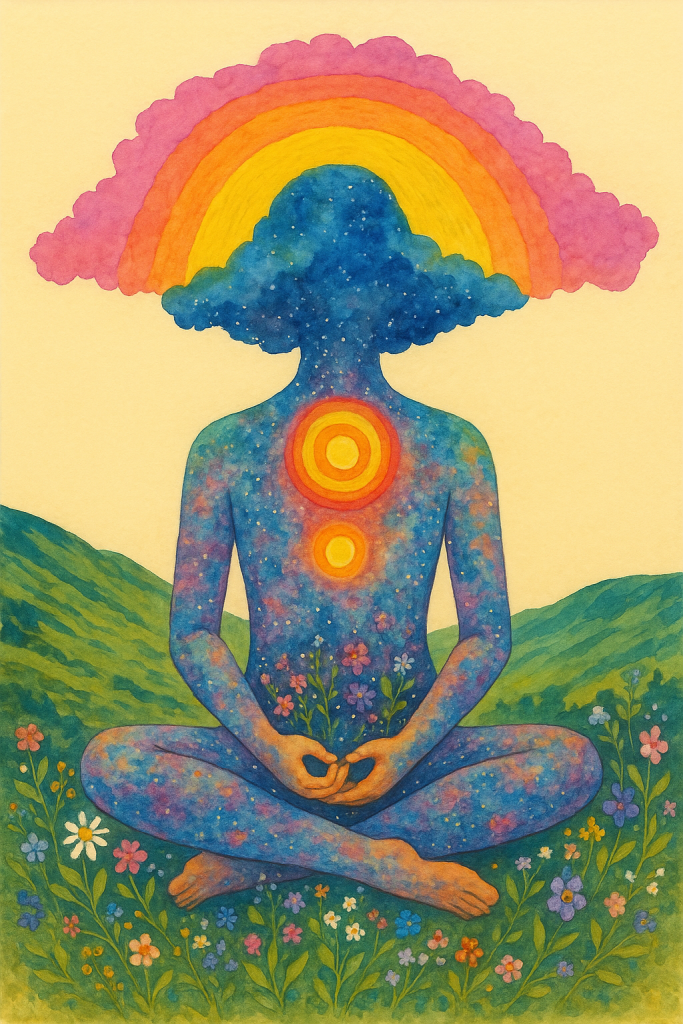
Why Psilocybin Pushes Us to the Edge
Psilocybin isn’t just a compound that makes you “trip.” It’s a biological key, and your brain is the lock.
At a chemical level, psilocybin mimics serotonin — one of the most crucial neurotransmitters for mood, memory, imagination, and emotional processing. Once ingested, psilocybin is converted into psilocin, which binds especially strongly to the 5-HT2A receptors, concentrated in areas of the brain responsible for high-level thinking, imagination, and meaning-making.
But the real magic — and the real unraveling — doesn’t happen from this binding alone.
It happens when those receptors start disrupting the usual connectivity patterns in your brain. The default mode network, which keeps your internal narrative running like background music (“I’m this kind of person,” “This is my life,” “Here’s what I should do”), suddenly goes quiet.
And in that silence, something radical happens:
You stop performing who you think you are.
You stop reinforcing the version of yourself that got built out of survival, socialization, or trauma.
You simply exist — raw, present, porous.
This is why people say things like, “I felt like I became the forest,” or “I dissolved into the sky,” or “I remembered my great-grandmother’s grief in my own bones.”
It’s not hallucination. It’s reconnection — with self, with memory, with collective emotion, with the cosmos.
And it’s why clinical researchers are now studying psilocybin — not just as a mood enhancer, but as a therapeutic disruptor for some of the most entrenched psychological conditions: depression, addiction, PTSD, end-of-life anxiety.
Because when the ego steps aside, the walls around old wounds begin to soften.
The brain, untangled from its habitual loops, becomes a landscape for reorganization.
The stories that once held you hostage — “I’m broken,” “I’ll never change,” “This is who I am” — start to lose their grip.
But — and this is crucial — that process isn’t always peaceful.
The Threshold of Death (and Why It’s Terrifying)
This is where many journeys reach the edge.
Because when your ego dissolves, it doesn’t go quietly.
For many, the moment of letting go feels like dying.
There might be physical shaking, a sudden flood of tears, a desperate sense that reality is slipping through your fingers. Your mind may scream, “I’m never coming back!” And in that moment, it feels entirely true.
Time dissolves. Language disappears. You can’t remember what “normal” even means.
But here’s the paradox: nothing dangerous is happening. What’s dying isn’t your body — it’s the scaffolding of your identity.
And the truth is, that scaffolding may have been holding pain in place for years.
The mushroom doesn’t destroy who you are. It dissolves who you aren’t.
What Comes After the Death?
And then — often when you least expect it — the storm clears.
Not with fireworks or applause. But with stillness.
You come back. But something’s different.
There’s a softness in your chest.
A quiet in your nervous system.
A sense that you don’t need to try so hard to “be someone.”
You might not be able to put it into words. You might not even try.
But you notice the shifts where it matters:
You pause before reacting.
You choose rest without guilt.
You say no when it matters, and yes when your heart says yes.
You begin to live like someone who remembers that worth isn’t earned. It’s remembered.
That love isn’t performed. It’s received.
That you’re not your job, your mistakes, your masks — but something far older, wiser, and more connecte
This Isn’t for Everyone — and That’s Okay
Let’s drop the mythology for a second.
Not everyone needs to dissolve. Not every trip cracks open the heavens. And not everyone should be chasing ego death like it’s a badge of honour.
Because this path — the real one, not the Instagram version — isn’t about impressing anyone or collecting transcendental moments. It’s about facing yourself, honestly. And for some, that doesn’t require a high dose or a psychedelic at all.
Some people experience their most profound breakthroughs in a single microdose — when the fog of depression lifts just enough for them to feel sunlight on their skin again.
Others reconnect with themselves during a silent hike, a messy cry on a friend’s couch, or a long-forgotten dream that bubbles back to the surface after years of suppression.
Psychedelics aren’t the only portal.
And ego death isn’t the only destination.
But for those who feel the pull — the unmistakable, bone-deep knowing that something old inside them is ready to be unraveled — it can be one of the most meaningful initiations this life offers.
Not glamorous. Not clean. But real.
It’s Not Enlightenment — It’s Relationship
The aftermath of ego death doesn’t look like floating through life in a permanent state of bliss.
You still get irritated. You still forget your inner wisdom. You still live in a world that’s messy, contradictory, and loud.
But something fundamental shifts:
You stop relating to your Self as a thing to manage or fix.
Instead, you begin to befriend it — as something that’s fluid, alive, ever-changing.
You don’t cling to your pain, but you don’t bypass it either.
You become less obsessed with identity, and more curious about essence.
Less attached to certainty, more open to mystery.
That’s the quiet power of these experiences. Not that they make you “better” — but that they reconnect you to something truer than performance.
If You’re Curious — Walk with Intention
So if something inside you whispers that it’s time — that you’re ready to lose who you thought you were — take it seriously. But also take it slowly.
Because ego death isn’t a product. It’s not a flex.
It’s a psychological, emotional, and sometimes spiritual undoing — and it asks for care.
That means:
Set and setting matter. Who’s guiding you? Where are you? What’s your emotional landscape right now?
Integration matters even more. What will you do with what you learn? How will you hold what’s revealed? Who will you talk to when the glow fades?
And above all, your intuition matters most. If something says “not now,” listen. If something says “yes, but prepare,” honour that too.
No one can tell you when you’re ready. But you’ll know.
And when that moment comes — the one where everything familiar starts to slip away — it might be terrifying.
But on the other side of that unraveling is something so quietly sacred, it doesn’t need to shout.
It just remembers.
You are already whole.
And nothing real can ever be lost.