
Do Magic Mushrooms Make You More Creative? What Studies Show
By Lily Pelenis / September 24, 2026 / 12 min read
Magic mushrooms do not reliably make you more creative, but they do change how creative thinking works. In the best-controlled study so far, a dose of psilocybin made people feel more creatively inspired while it lowered their scores on structured creativity tasks, and a week later they came up with more new ideas than a placebo group (Mason et al., 2021).
Microdosing tells a similar, smaller story: people who microdose often say it helps their creativity, but placebo-controlled trials find at most one narrow effect, a higher share of original answers on a brainstorming task (Prochazkova et al., 2025). Below is what each kind of study found, what seems to happen in the brain, how that fits the idea that creativity is something you notice rather than manufacture, and the safety points to know first.
TLDR
In a double-blind trial of 60 people, psilocybin at 0.17 mg per kg of body weight raised ratings of spontaneous creative insight but lowered task-based creativity during the experience; seven days later the psilocybin group listed more novel ideas than the placebo group (Mason et al., 2021). A similar split showed up with LSD, which raised novelty and originality but lowered the usefulness of ideas and convergent thinking (Wiessner et al., 2022).
For microdosing, an open-label study at a Dutch microdosing event found better scores on both divergent and convergent thinking after truffles (Prochazkova et al., 2018), but later double-blind trials did not hold that up. A pooled analysis of three placebo-controlled truffle trials (171 people) found only a higher ratio of original answers (Prochazkova et al., 2025), and a 2026 meta-analysis found minimal impact on creativity in randomized trials (Meshkat et al., 2026). A microdose on our dosing guide is 0.1 to 0.25 g of dried mushroom.
Who this article is for
- Artists, writers, musicians and other makers who have heard that mushrooms help creativity and want to know what the research found
- People thinking about microdosing for creative work who want to separate measured effects from expectation
- Anyone curious about the default mode network and why it keeps coming up in creativity research
- People on medication, especially antidepressants or lithium, who need the interaction facts before trying anything
Lily Pelenis
Author’s note
I care about this question because so many of the people who write to us are makers of some kind, and the claim that mushrooms make you creative gets repeated far more often than it gets checked. I would rather give you the studies, including the ones that found nothing, so you can decide with a clear picture of what is known and what is still a hope.
I also keep coming back to the question in this article’s title. The research suggests psilocybin does less to produce ideas on demand and more to change what you notice and let through. That matches how a lot of creative people describe their own process anyway, and I think it is a more useful way to look at the topic than asking for a magic boost. None of this is a promise: everything below links to the study or government page it comes from.
Do magic mushrooms make you more creative?
Not in a simple way: during a psilocybin experience people tend to feel more inspired while doing worse on structured creativity tasks, and some studies find a modest rise in new ideas after the effects have worn off. The table sums up the main controlled studies on full doses of psychedelics and creativity.
| Study | Design | What it found |
|---|---|---|
| Mason et al., 2021 | Double-blind, placebo-controlled; 60 healthy people with past psychedelic experience; psilocybin 0.17 mg/kg | Higher ratings of spontaneous creative insight and lower task-based creativity during the experience; more novel ideas on an alternate uses task 7 days later (moderate effect size, d = 0.52), with no change in total ideas or originality |
| Wiessner et al., 2022 | Double-blind, placebo-controlled crossover; 24 healthy people; LSD 50 micrograms | More novelty, surprise and originality, and more symbolic thinking; less usefulness of ideas and less convergent thinking |
| Kuypers et al., 2016 | Open-label, at two ayahuasca workshops; 26 people | Divergent thinking rose and convergent thinking fell on one task; no significant effect on a second task |
Two terms come up again and again. Divergent thinking is producing many possible answers, as in listing every use you can think of for a brick. Convergent thinking is finding the one right answer. The full-dose studies point the same way: psychedelics seem to loosen the first and weaken the second while the drug is active, which is why the authors describe the effect as a shift rather than a boost (Wiessner et al., 2022).

What the Mason study means in practice
The participants felt more creative during the session, but when asked to produce ideas on a task, they did worse than the placebo group. The gain in new ideas came a week later, when the drug was out of their system. The authors say their findings add some support to historical claims that psychedelics influence aspects of the creative process, and present psilocybin mainly as a tool for studying creativity (Mason et al., 2021). That is a long way from saying a trip will help you finish a project.
Does microdosing make you more creative?
The placebo-controlled evidence says mostly no, with one narrow exception: a higher share of original answers on a divergent thinking task. The early positive results came from studies where people knew they had taken a microdose.
| Study | Design | Creativity finding |
|---|---|---|
| Prochazkova et al., 2018 | Open-label, no placebo; people at a Dutch Psychedelic Society microdosing event, tested before and after truffles | Better convergent and divergent thinking after the microdose; fluid intelligence unchanged; authors call it preliminary |
| Cavanna et al., 2022 | Double-blind, placebo-controlled; 34 people; 0.5 g dried Psilocybe cubensis | No improvement in creativity, well-being or cognition; a few small changes towards impairment |
| Prochazkova et al., 2025 | Three double-blind, placebo-controlled truffle trials pooled; 171 people | Higher ratio of original answers (originality divided by fluency), which held after controlling for dose guessing; no effect on other divergent scores or on convergent thinking |
| Meshkat et al., 2026 | Systematic review and meta-analysis; 24 studies, 3,681 participants | Randomized trials showed subjective and brain-wave effects but minimal impact on cognition, creativity or lasting mood |
Notice that the Cavanna study used 0.5 g of dried mushroom, which sits in the threshold range (0.25 to 1 g) on our dosing guide, above a typical microdose. Even at that amount it found no creativity gain, and the stronger felt effects showed up only in people who correctly guessed they had taken the real dose (Cavanna et al., 2022).
The pooled finding is worth reading carefully. A higher ratio of original answers means the ideas people gave were, on average, less common, not that they produced more ideas or finished more work. The authors conclude that the effects of truffle microdosing seem limited to the quality of divergent thinking (Prochazkova et al., 2025). For a wider look at microdosing evidence, see our psilocybin microdosing guide.
Why do people say mushrooms help their creativity?
People who use mushrooms often report more creativity, and those reports are consistent across large surveys, but surveys cannot separate the drug from expectation, mindset or the kind of person who chooses to microdose.
What surveys report
- In the Global Drug Survey, 6,753 people who had microdosed in the past year often reported better mood, creativity, focus and sociability. People who microdosed to reach a specific goal reported fewer benefits, not more (Petranker et al., 2022).
- In a pre-registered online study, current and former microdosers scored higher on an unusual uses creativity task than non-microdosers, though the creativity difference was small (r = 0.15). The design cannot show whether microdosing caused it or whether more open, creative people choose to microdose (Anderson et al., 2019).
- A 2026 systematic review of psilocybin mushroom and truffle microdosing found that some studies reported benefits including creativity, but rated the certainty of evidence as low and said a causal effect cannot be inferred (Page et al., 2026).
What trials measured
Once people do not know whether they took psilocybin or a placebo, most of the reported creativity benefit disappears from the measurements. The Cavanna team concluded that expectation underlies at least some of the anecdotal benefits of microdosing mushrooms (Cavanna et al., 2022), and a 2024 critique of 15 microdosing papers concluded it is premature to draw conclusions about efficacy or safety (Petranker et al., 2024). Both things can be true at once: people sincerely feel more creative, and the tests mostly do not show it.
What does psilocybin do to the brain’s creative networks?
Psilocybin loosens the default mode network, a set of brain regions active during daydreaming, memory and self-reflection, and creativity research suggests good ideas depend on that network working together with the brain’s control systems.

The default mode network and creativity
Creative thinking seems to involve cooperation between the default network and the executive control network, two systems that often work against each other (Beaty et al., 2016). In a study of 163 people, a pattern of connections across default, salience and executive regions predicted how creative people’s ideas were (Beaty et al., 2018).
What psilocybin changes
An early brain imaging study found psilocybin reduced activity in hub regions and weakened the link between two key nodes of the default mode network, which the authors linked to a state of unconstrained thinking (Carhart-Harris et al., 2012). A 2024 study that scanned each person roughly 18 times found that a 25 mg dose of psilocybin disrupted brain connectivity more than threefold compared with a stimulant, with the strongest changes in the default mode network, and a drop in connectivity between the anterior hippocampus and that network that lasted for weeks (Siegel et al., 2024).
In the Mason study, connectivity within and between brain networks, including the default mode network, predicted both the in-session and the one-week creativity effects (Mason et al., 2021). Researchers have proposed that the psychedelic state may favour the generating stage of creativity, the part where ideas arrive, over the evaluating stage, where you sort the good ones from the rest (Girn et al., 2020). Our article on quieting the default mode network covers this network in more depth.
What if creativity is something you notice rather than create?
That is a fair reading of the research: psilocybin seems to change what comes to you and what you pay attention to, more than it improves your ability to produce ideas on command.

The Mason study measured exactly this split. Psilocybin increased what the researchers called spontaneous creative insight, the feeling of ideas arriving on their own, while it decreased deliberate, task-based creativity (Mason et al., 2021). The LSD study found a pattern break: more surprising and original associations, with less organization and less usefulness (Wiessner et al., 2022). In both cases the drug seemed to open the gate and loosen the filter rather than build anything.
Seen that way, the practical lesson is about timing. If ideas arrive during an experience, the sorting and shaping happen afterwards, with an ordinary mind. A way to put that into practice:
- Keep the session for noticing, not for producing finished work, since task performance dropped during full doses
- Write down what came up as soon as they are able to, then return to it days later, when the Mason group showed its gain in new ideas
- Treat the editing, structuring and finishing as sober work, which is the part convergent thinking handles
Our article The Creative Brain on Mushrooms looks at this from a maker’s point of view, and How to Use Microdosing to Break Through Creative Blocks covers microdosing around a stuck project.
Is it safe to use mushrooms for creative work?
Research guidelines describe psilocybin and similar drugs as relatively safe physically, but they carry real psychological risks, interact with some medications, and are controlled substances in Canada (Johnson et al., 2008).
Psychological risks and who should not take it
The main risk in research settings is overwhelming distress during the experience, and less often prolonged psychosis. Safety guidelines from Johns Hopkins researchers exclude people with a personal or family history of psychotic disorders or other severe psychiatric disorders, and stress preparation, a safe setting and a sober monitor (Johnson et al., 2008). Our dosing guide asks for one sober person nearby for a first time, a big dose or a new setting.
Medication interactions
- Lithium: in an analysis of online reports, 47 percent of 62 reports of lithium combined with a classic psychedelic involved seizures (Nayak et al., 2021). Do not combine them.
- SSRIs and SNRIs: in a Johns Hopkins survey, these antidepressants often weakened the effects of psilocybin (Gukasyan et al., 2023). Never stop a prescribed medication on your own; talk to your prescriber.
- Other medications, including MAOIs: a 2024 systematic review found psychedelics combined with antidepressants, mood stabilizers and other drugs can produce weaker, stronger or unchanged effects (Halman et al., 2024). Our dosing guide advises no SSRIs, SNRIs, MAOIs, lithium or tramadol.
The law in Canada
Psilocybin and psilocin are listed in Schedule III of the Controlled Drugs and Substances Act. Health Canada states that producing, selling or possessing magic mushrooms is illegal unless authorized, and that using them with cannabis, amphetamines or alcohol raises the risk of serious harm. Having any detectable psilocybin or psilocin in your blood within two hours of driving is also an offence (Justice Canada), so plan creative sessions at home with no driving.
How much do people take for creativity?
There is no proven creativity dose; the studies above used either full doses given in a lab or microdoses in the range of about 0.1 to 0.5 g of dried mushroom. Here are the dose ranges on our dosing guide, with where the studies fall.
| Range on our dosing guide | Dried mushroom | Where the creativity research sits |
|---|---|---|
| Microdose | 0.1 to 0.25 g | Typical microdosing range; the pooled 2025 trials found only a higher ratio of original answers (Prochazkova et al., 2025) |
| Threshold | 0.25 to 1 g | The Cavanna trial used 0.5 g and found no creativity gain (Cavanna et al., 2022) |
| Light | 1 to 2 g | Not tested for creativity in the studies above |
| Moderate | 2 to 3.5 g | Full-dose lab studies used measured psilocybin, not grams of mushroom (Mason et al., 2021) |
| Strong | 3.5 to 5 g | Not studied for creativity; higher risk of a difficult experience |
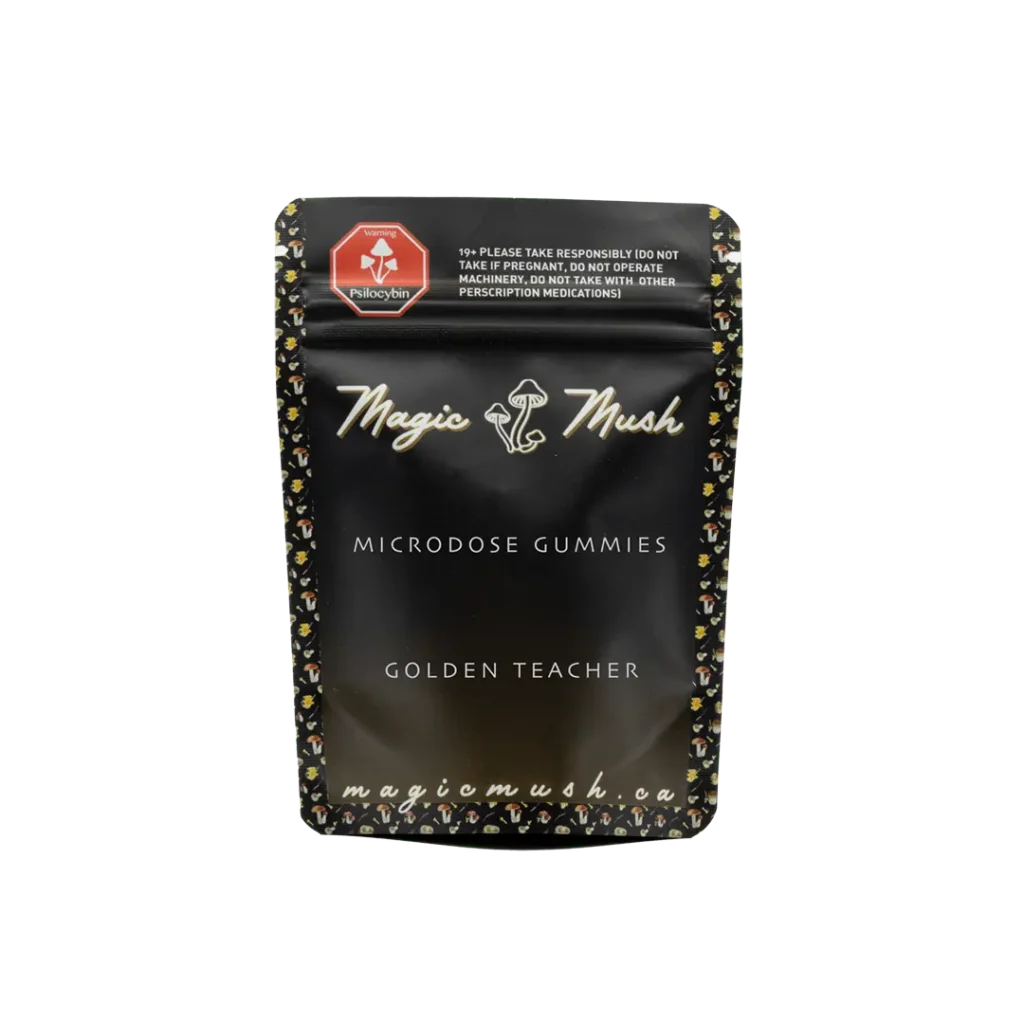
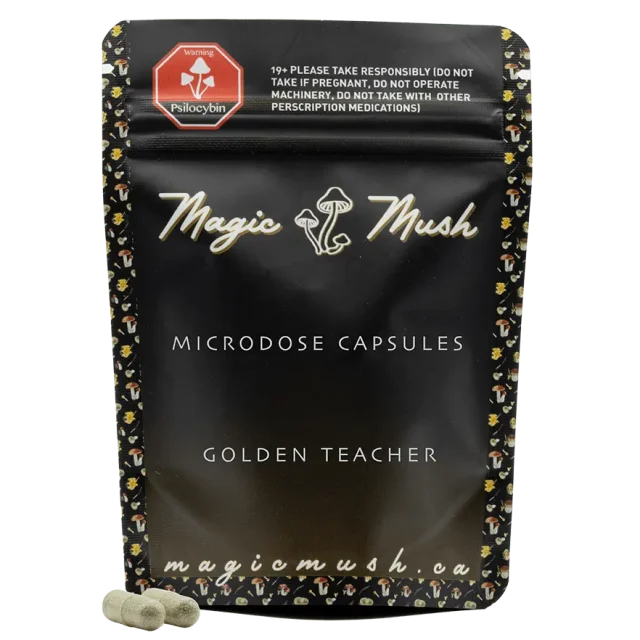
Fixed-amount products make it easier to take the same amount each time and compare your notes fairly. Golden Teacher microdosing capsules hold 125 mg of ground mushroom each, with a recommended 1 to 2 capsules every second day, and carry the lowest potency rating in our capsule range. Golden Teacher microdose gummies are 100 mg of mushroom equivalent each, starting with 1 to 2. For a full experience, dried Golden Teacher mushrooms are described on their product page as bringing a creative, introspective mood, and we sit them in the middle of our potency scale.
Make room for ideas, then do the work
If you explore mushrooms for creative work, expect a change in what you notice rather than a shortcut to finished pieces: a measured amount, a safe setting at home, notes taken as soon as you can, and the editing left for a clear head. Our dosing guide sets out every dose range in each format we sell, and Golden Teacher microdosing capsules give you the same 125 mg every time so you can judge the effect honestly.
FAQ
Do mushrooms make you more creative?
Not reliably. A controlled study found psilocybin raised the feeling of creative insight but lowered task-based creativity during the experience, with more new ideas a week later (Mason et al., 2021).
Does microdosing psilocybin help creativity?
Placebo-controlled trials mostly say no. Pooled data from three double-blind trials found only a higher ratio of original answers on one divergent thinking task (Prochazkova et al., 2025).
Why do people feel more creative on mushrooms?
Psilocybin increases the sense of spontaneous insight (Mason et al., 2021) and loosens the brain’s default mode network (Siegel et al., 2024). Expectation also plays a large part in reported microdosing benefits (Cavanna et al., 2022).
What is divergent thinking?
Divergent thinking is generating many possible answers to an open question, such as listing uses for an everyday object. Convergent thinking is finding the single correct answer, and full doses of psychedelics tend to lower it (Wiessner et al., 2022).
Can you make art while tripping?
You can, but in a controlled study task-based creativity dropped during the psilocybin experience (Mason et al., 2021). It may work better to treat the session as a time to notice and record ideas, and do the shaping afterwards.
Is it safe to microdose for creativity on antidepressants?
Talk to your prescriber first. SSRIs and SNRIs often weaken psilocybin’s effects (Gukasyan et al., 2023), and lithium combined with psychedelics has been linked to seizures (Nayak et al., 2021).
How much psilocybin is a microdose for creativity?
On our dosing guide a microdose is 0.1 to 0.25 g of dried mushroom, which is 1 to 2 capsules of 125 mg or 1 to 2 gummies of 100 mg. No dose has been shown to reliably raise creativity.
Find your strain, then your dose
Every product on the shelf shows its potency rating and the effects people report. The dosing guide walks through amounts before you order, and a real person answers if you write to us.
About the author
Lily Pelenis
I'm a Toronto-based lifestyle coach, psilocybin enthusiast and certified yoga instructor. I guide people toward mindful, balanced living, and my coaching blends modern wellness practices with ancient wisdom to help clients find deeper self-awareness, resilience and joy.
I've been experimenting with shrooms for over a decade, and I write about my own experience. I love nature, psychology and humans. That is why my articles tend to follow a trip past its peak and into the weeks after it.
Some pieces start with a strain I have tried myself, such as Golden Teacher or Albino Roller Coaster. Others are the practical ones, like how much to take the first time or how to brew a tea that sits easier on the stomach. Over the years I've learned that intention is everything, so I write about why you are taking it before I get to how.
Related articles
50% off your first order
New strains, restocks, sales and new writing from the Notebook, by email. No spam, unsubscribe any time.